A quotation email can be a game-changer, keeping your business at the forefront of sales success as it acts as the bridge between your offerings and your potential clients.
In this article, we will take you through a detailed journey of crafting an effective quotation email that gets your prospects to sit up and take notice.
Plus, we’ve added 7 inspirational samples that will help you write compelling quotation emails for your business.
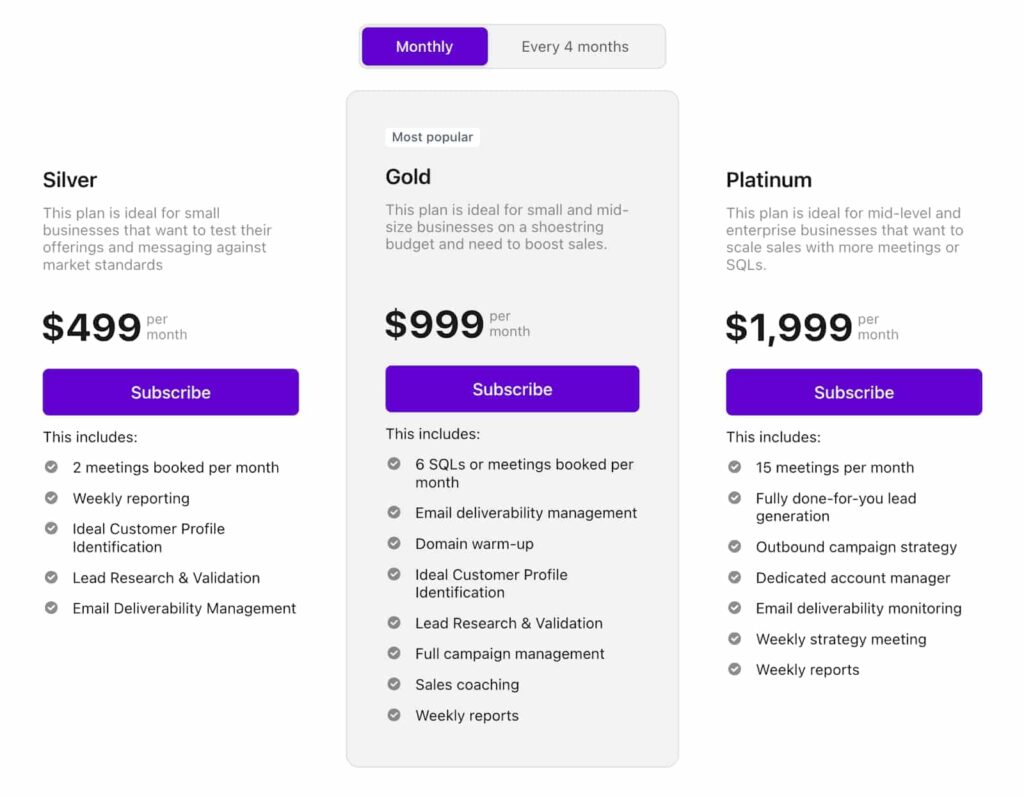
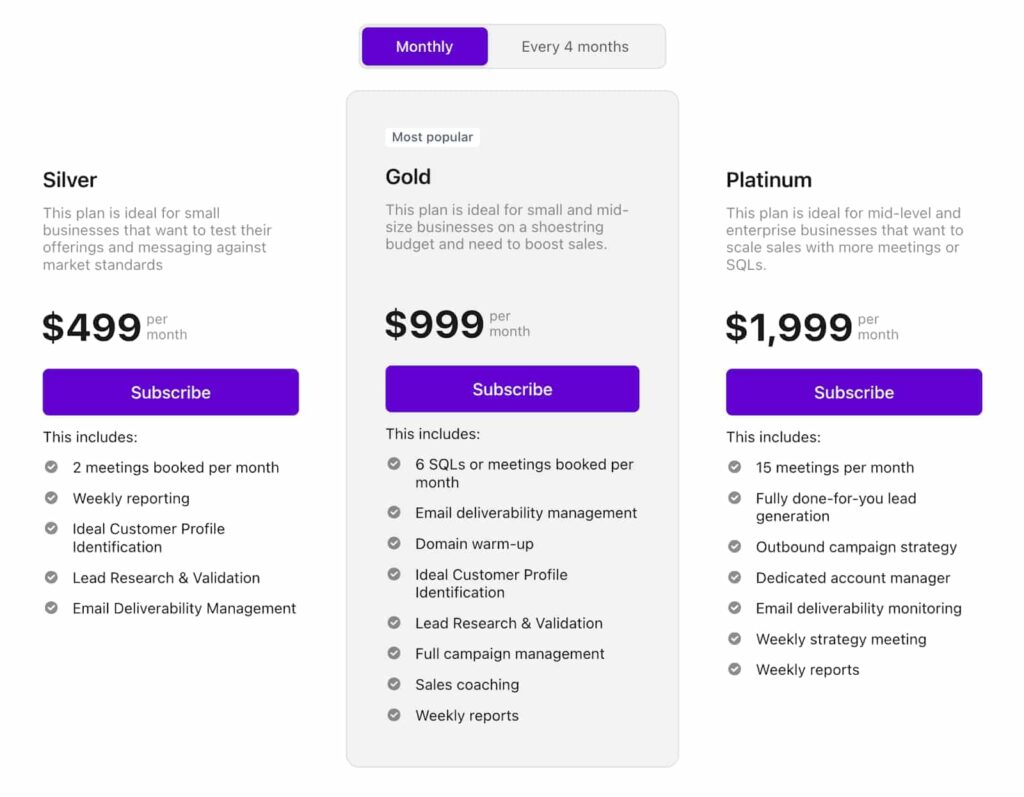
Note:Struggling to get replies or book meetings with prospects that fit in your ICP? We’ll help you get 6 SQLs or book 6 meetings with prospects that are ready to buy for only $999/month. Book a 15-minute consultation now.
What is a quotation email?
A quotation email is a business email sent by an individual service provider or a business to a potential customer to provide details on the price for certain goods, products, or services. It’s generally a response to a quote request from a potential client.
So, as per the client’s requirements, it typically includes specific details such as the nature of the goods or services, quantity, fixed price per unit, total cost, payment terms, delivery details for the entire process, and other relevant information.
Why and when to use quotation emails?
A quotation email is not just important because it helps you detail your pricing and service terms for your customers. There are key business reasons why you should always use quotation emails in business procedures.
Here are some of the main reasons you should always use them:
Providing clarity and transparency: Quotation emails help you give your customers a clear understanding of what they’ll get and how much it will cost them. It clarifies everything from hidden or upfront fees down to the reasons for these fees. They help you avoid any potential misunderstandings or disputes down the line.
Professionalism: Providing a formal quote demonstrates professionalism and helps you or your business stand out from competitors who may be less thorough. After all, 59% of respondents say that email marketing influences their purchases. Providing a quote via email shows that you care and mean serious business.
Record keeping: Quotation emails also serve as a written record of the proposed deal, which can be useful for accounting, legal, and customer relationship purposes. Here again, quotation emails can help you rapidly resolve issues down the line or avoid them altogether.
Encourage commitment: If a customer is comparing prices or considering different providers, a clear, detailed, and prompt quote can encourage them to commit to your business over the competition.
That said, you probably have a pricing page on your website. So, you’re probably thinking that you can’t just keep whipping up quotation emails whenever somebody stops by your business; you’re right. Here are some situations that demand a quotation email:
Creative service provision: If your company provides services, such as consultancy, marketing, content creation, design, software development, etc., it’ll be an excellent idea to send a quotation email to give your potential clients an idea of your pricing structure as well as your terms.
Custom orders: If a customer requests a custom order that’s not part of your standard product or service range, you can send them a quotation email to give them an understanding of the cost and timeframe.
Bulk purchases: If you’re a wholesaler or own a company selling goods, you can send quotation emails to your customers for large or bulk orders. This is a good idea since bulk purchases typically come with discounts or special terms.
Complex projects: For projects that involve multiple stages, materials, or other complexities, a quotation email can break down the costs involved. It lets you give the customer a clear understanding of what they’re paying for each part of the project. This is particularly useful for carpenters, bricklayers, and other parallel services.
Negotiations: In some business scenarios, virtual meetings aren’t possible, and pricing isn’t fixed and needs to be negotiated. A quotation email in these contexts can form part of this negotiation, setting out your initial pricing position.
Quotation email format: How to write a quotation email (the anatomy of a successful quotation email)
These are the key components of an excellent quotation email. Keep in mind that they’ll also serve as the stages you’ll have to go through as you write your quotation email.
The quotation email subject line
The subject line is what the recipient sees first in the inbox. This is not an email to sell. So, you need to make your intentions in the subject line clear and simple so that your recipient understands that you are coming to them with a quote.
For instance, your subject line could be “Request for a quote” or “Quote for [service or product’s name].”
Initial greeting and introduction
Start the email with a professional and polite greeting such as “Hello + name” or “Good morning + name.”
You’ll most likely know their name. If it happens that you don’t know the person’s name, omit the name, but still greet them politely. A simple “Hello” or “Good morning” can help to set a friendly tone for the email.
Detailed description of products/services
The next thing to do is to give a vivid description of the products or services (to be) purchased. It enables your client to identify what they want to purchase. A detailed description can be the product name, a picture if need be, and a product identification code or something similar — based on the system of identification you have at your company.
Pricing breakdown
Ensure you list the products or services you’re quoting as line items. Include a vivid description of the items, quantities, unit price, and total price per item. You can separate the products and services’ pricing details.
Furthermore, make sure to differentiate the labor from the material cost. Also, state what the cost doesn’t cover. You should also indicate details about shipping and delivery fees. This helps you to stay organized when breaking down the cost in the email.
Terms and conditions (including payment terms, delivery dates, etc.)
This is where you state the possible variations in your business. Whatever terms or conditions you have at your business that might influence the costs mention it. Or add a link to a page that covers them very well. You should detail things like:
The delivery of the project depends on location or good weather.
Additional work hours will require extra cost.
Late payments include 1% penalties.
Etc.
In addition, let them know about the payment option and when you want to be paid. Whether it is through direct deposit, checks, credit cards, or full or installment payments, let them know to avoid confusion.
Include add-ons, VAT, interdependencies, and clauses
You should let your client know the different variations that can affect the cost. For instance, they should know the amount of value-added tax they are paying on a specific item. Or you can let them know if any discounts apply to them and any other disclaimers associated with your business.
Closing statement
Just as the greeting, you must end your email politely. Closing statements such as “We’re looking forward to hearing from you” can help your recipient understand that you expect a reply within a specific timeframe.
Contact information or a professional email signature
Ensure you include your details in the email. This enables your recipient to reach out to you if they have inquiries or want to clarify the details to you. Your contact information can include business name, address, phone number, email address, and job title.
Five tips for proofreading and refining your email
Here are some email tips you can consider for the proofreading and refining process.
Make it about your client’s needs
Every quotation email must address their client’s needs. Think of it like a guide to enable them to make an informed purchasing decision.
So, as a foundational step, take the time to map out everything you should include in the email but, more importantly, what they’ll need to know.
Things like:
The value for their money
The ROI for them
The costs and the drivers
Terms and conditions
Delivery fees
Preferred payment options
Payment deadlines
Service or delivery turnaround time
Etc.
Keep in mind that it will all depend on your service or product and the needs of the customer in your particular context.
Use a formal writing style
A quotation email is professional. Be sure to be polite and friendly throughout your correspondence.
Use an item list
Write a detailed list of each item. You can use bullet points to help you stay organized and list the quote for each item.
Talk about the fees
You should break down the cost of each item to your recipient. You must also let them know about any additional fees such as VAT, shipping and delivery fees, discount, and everything else.
Payment option
Inform your recipients about the payment options as well as the time of payment. Is it direct deposit, check, or credit card? One-time payment or installment payment? This will enable the client to know if the options match the form of payment.
07 sample quotation emails to inspire you
Here, you’ll find 7 samples of quotation emails you can use to answer your client’s requests. Simply copy, paste, and edit them in a way that suits your needs and your branding styles.
Sample quotation email for price
The price quotation email is the simplest quotation email. It provides two simple things — the price and details for your prospective clients. You can do this by outlining the items first and then the price. Or you can outline the price and make a comparison with your competitors. Here is a template that can work out for you.
Subject: Quotation request response — [your company name]
Dear [client’s name],
Thank you for your interest in [your company name] and for reaching out to us for a quotation on our products. We appreciate your inquiry, and we are pleased to provide you with our pricing.
Here is the price quote for the items you requested:
Aluminum alloy window frames
Unit price: $200.00
Minimum order quantity (MOQ): 50 units
Eco-friendly bamboo dining tables
Unit price: $150.00
MOQ: 30 units
Energy efficient led lighting systems
Unit price: $50.00
MOQ: 100 units
Ceramic bathroom sinks
Unit price: $100.00
MOQ: 40 Units
Luxury memory foam mattresses
Unit price: $300.00
MOQ: 25 Units
Ergonomic office chairs
Unit price: $80.00
MOQ: 60 Units
Please note that these prices are exclusive of shipping and handling charges. You’ll receive a shipping estimate once we receive the shipping address details.
Our prices are highly competitive, and we strive to provide high-quality products. Rest assured, our products pass stringent quality checks and come with the necessary warranties.
The quotation is valid for 30 days, and the delivery timeline will be approximately 4-6 weeks from the date of order confirmation.
Our terms of payment are 50% advance upon order confirmation and the remaining 50% before shipment.
We hope to have the opportunity to serve your needs. If you have any questions or require further information, please feel free to contact me directly at [your email] or [phone number].
Thank you once again for considering [Your company name]. We look forward to the possibility of working with you.
Best regards,
[Your name]
[Your signature]
Quotation with a discount offer
If one of your clients is loyal or is buying in bulk from you, this is a good reason to send a quotation email. A quotation email with a discount informs your clients about a special discount.
When writing this type of email, ensure you use the right tone and be clear. An effective quotation email must be easy to read and find information quickly (discount code/coupon).
Subject line: Special IBM discount offer for [client’s company name]
Dear [client’s name],
We hope this email finds you in good health and high spirits.
It’s always a pleasure to serve esteemed clients like you. Your continuous support and faith in our services at IBM have never gone unnoticed, and we appreciate it deeply.
That’s why understanding your needs and considering the long-standing relationship between our organizations, we are thrilled to provide you with a special discount on select IBM products that will support your business operations.
Here is the quotation for your consideration:
IBM Cloud Pak for Data: The price after a 20% discount is [discounted price].
IBM Watson: We are offering a 15% discount on this, taking the price to [discounted price].
IBM Security: After a generous discount of 10%, the final price is [discounted price].
Please note that these special discounted prices are exclusive to you and valid for [time period]. To activate these discounts, kindly use the code IBMLOYALTY20 at checkout or while negotiating your contract.
We hope this tailored discount offer provides significant value to your business. If you have any questions or need further assistance, please do not hesitate to reach out. Our team will be more than happy to help you.
Thank you once again for your loyalty and trust in IBM. We look forward to continuing our fruitful partnership.
Best regards,
[Your name]
[Your signature]
Revised quotation email
A revised quotation email is written by a company that has quoted a price for an order and is revising it. When sending a revised quotation email, ensure you precisely state what your clients need. Here is a template that can help.
Subject line: Revised quotation for your requested products
Dear [client’s name],
I trust this message finds you well.
I am writing on behalf of Walmart regarding your recent request for a quotation for a range of products. After reviewing your request thoroughly, we have noticed some discrepancies in our initial quotation. So, we have revised the prices for the listed items.
Here are the revised details of the products with the updated prices:
Samsung 50″ Class 4K Crystal UHD LED Smart TV
SKU: 6000199899330
Revised quotation: $498.00
Ninja 4-Quart Air Fryer
SKU: 700395909
Revised quotation: $99.00
Mainstays 5 Piece Dining Set
SKU: 55503161
Revised quotation: $179.00
Instant Pot DUO60 6 Qt 7-in-1 Multi-Use Programmable Pressure Cooker
SKU: 506579110
Revised quotation: $89.00
Acer Aspire 5 Slim Laptop
SKU: 365115488
Revised quotation: $369.00
Blackstone 4-Burner 36″ Griddle Cooking Station
SKU: 56355727
Revised quotation: $274.00
Keurig K-Classic Single-Serve K-Cup Pod Coffee Maker
SKU: 49673944
Revised quotation: $119.00
The total revised quotation for your order is $3,023.90.
Please note that these prices are valid until [insert expiry date], after which they may be subject to change.
We apologize for any inconvenience caused by this revision and value your understanding. Should you have any queries or require further clarification, please feel free to contact us at [Walmart contact info].
Once you have reviewed the new quotation, we kindly ask for your timely response to finalize the order and to ensure prompt delivery of the products.
Thank you once again for considering Walmart. We look forward to a successful business relationship.
Best regards,
[Your name]
[Your signature]
Quotation email for additional services/products
If you have some additional services or products that weren’t listed in the initial email, you can send another quotation email. Ensure that the tone and language are appropriate when communicating with the client. Here is a template that can guide you.
Subject: Quotation request response — [your company name]
Dear [client’s name],
I trust this email finds you in good health.
We would like to express our gratitude for your ongoing support of Colgate.
We are pleased to offer you products from our portfolio in recognition of your needs and our commitment to providing our valued customers with the best oral care solutions.
We believe these offerings can further enhance your customer experience and satisfaction.
Colgate Total Advanced Whitening Toothpaste: This breakthrough formula offers 12-hour antibacterial protection and advanced whitening for your customers.
Unit price: $4.50
Colgate MaxFresh Cooling Crystals Toothpaste: Infused with cooling crystals, this toothpaste ensures fresher breath and whiter teeth.
Unit Price: $4.00
Colgate 360 Advanced Whitening Battery Toothbrush: This battery-operated toothbrush offers 5X cleaning action and helps to remove stains from teeth.
Unit Price: $12.00
Colgate Plax Peppermint Mouthwash: This mouthwash offers effective protection against bacteria and plaque for a fresher and cleaner mouth than brushing alone.
Unit Price: $5.50
Should you choose to avail any or all of these products, we are ready to offer attractive quantity discounts:
5% off on orders above $200
10% off on orders above $500
15% off on orders above $1000
Please note that these prices are subject to applicable taxes.
These products can seamlessly integrate into your existing range of oral care offerings and are guaranteed to bring immense value to your customers.
We would love to discuss these options further at a time that suits you best. Our account manager will reach out to you shortly to answer any queries you may have.
Please feel free to contact us directly at [company’s contact information] should you need any additional information.
We look forward to continuing to serve you with the highest quality products and services.
Thank you for considering our proposal.
Best regards,
[Your name]
[Your signature]
Quotation following a meeting/discussion
After having a discussion or meeting with your clients about your products or services, you can send them a quotation email.
Your email shows you’re interested in doing business with them and also acts as a follow-up email or even a reminder email to give them a nudge, taking them a step closer to purchase. Here is a template that can work for you.
Subject line: Detailed overview post discussion
Hello [client’s name],
Our recent meeting was highly constructive, and I wish to express my genuine appreciation for your consideration of Epson’s offerings. Your interest in our range of products is valued and acknowledged.
As we discussed, the following Epson products piqued your interest:
Epson EcoTank ET-4760 All-in-One Supertank Printer: A top-of-the-line printer offering cartridge-free printing with large, easy-to-fill ink tanks. It includes two years’ worth of ink and provides features like wireless printing and automatic 2-sided printing.
Epson Pro EX9240 3-Chip 3LCD Full HD 1080p Wireless Projector: With 4000 lumens of color and white brightness, it ensures impressive image quality. It also supports wireless projection from various devices, along with Miracast capabilities.
Epson FastFoto FF-680W Wireless High-Speed Photo and Document Scanning System: This scanner can digitize your photos and documents quickly and in high resolution, providing a practical solution for your document management needs.
Epson DS-780N Network Color Document Scanner: Designed for greater efficiency in heavy-use environments, the DS-780N delivers high-quality scans, plus a built-in network interface for enhanced security and seamless integration into existing workflows.
Here is the detailed quote for the discussed products:
Product
Quantity
Unit price
Total
Epson Pro EX9240 3-Chip 3LCD Full HD 1080p Wireless Projector
5
$800
$4000
Epson FastFoto FF-680W Wireless High-Speed Photo and Document Scanning System
15
$600
$9000
Epson DS-780N Network Color Document Scanner
20
$700
$14000
Total
$37000
Note: The provided prices include delivery charges but do not cover applicable taxes. This quote remains valid for a period of 30 days from the date of this email.
Should you decide to move forward or if you need further clarification on our products or services, please feel free to get in touch.
Once again, we are grateful for your interest in Epson. We are thrilled at the prospect of partnering with you and look forward to your response.
Best regards,
[Your name]
[Your signature]
Follow-up quotation email
If you have sent a previous email to your client, but they are yet to respond, you can send a follow-up quotation to hear from them. Here is a sample that can help you out.
Subject line: Your recent IKEA quotation request
Dear [client’s name],
I wanted to touch base with you regarding the quotation request you made. We understand how busy schedules can be, and it’s quite possible you may not have had the chance to go through the initial quotation we sent over.
I’m re-sending the details of the quotation you requested for your consideration:
KLIPPAN Loveseat, Vissle Gray – $299M
A modern and spacious two-seater sofa with a robust design and comfortable seating. Perfect for creating a cozy corner in any room.
KALLAX Shelf unit, Black-Brown – $69
A versatile shelf that can be placed against a wall or used as a room divider. It offers ample storage and display space.
HEMNES Desk, Black-Brown – $299
A traditional-style desk with modern functionality, including drawer stops to prevent the drawers from being pulled out too far.
POÄNG Armchair, Knisa Light Beige – $79
A layer-glued bent birch frame gives comfortable resilience, and the cover is easy to keep clean as it is removable and can be machine washed.
MALM High bed frame/4 storage boxes, White – $399
A stylish, functional bed frame with ample under-bed storage. The white finish gives it a clean, modern look.
For these selections, your total comes to $1,145 before taxes and shipping. If you would like to add or remove any items or explore further customization options, please feel free to let us know.
If you have any questions or require additional information, please don’t hesitate to respond to this email or call us directly at our customer service hotline at (123) 456-7890.
Looking forward to your response and the opportunity to serve you.
Best regards,
[Your name]
[Your signature]
Bonus: Sample email to request a quotation from a supplier/vendor
Wanna write an email to request a quote from a business but know where to get started? Here is the perfect template for a client email requesting a quotation. See it as a formal letter to a sales rep to request all the details about products you’re interested in.
Subject: Quotation request response — [your company name]
Hello [company name],
My name is [your name] from [company], and I am writing to inquire about the pricing of some of your products that have caught our interest.
We are in the process of updating our office space, and we have identified several IKEA products that align with our vision and quality standards.
The items we are interested in include:
BEKANT Desk, black stained ash veneer, black – Quantity: 15
MARKUS Office chair, Vissle dark gray – Quantity: 15
KALLAX Shelf unit, white – Quantity: 5
LACK Side table, black – Quantity: 10
REGISSÖR Bookcase, brown – Quantity: 4
Could you kindly provide us with a detailed quotation for the above-listed items, including any bulk purchase discounts that may be applicable?
Also, could you provide information on your delivery times, shipping, and handling charges to our location at [your location]?
We would greatly appreciate your prompt response to this request as we are hoping to finalize the purchase decision by [specific date].
Thank you for your time. We look forward to hearing from you soon.
Best regards,
[Your name]
[Your signature]
Key takeaways
A quotation email typically includes specific details such as the nature of the goods or services, quantity, cost per unit, total cost, payment terms, delivery details, and other relevant information.
Ensure you consider your client’s need and incorporate it within the body of the email in a professional tone. You should also prepare follow-up emails or even an entire follow-up sequence to re-engage your prospective client who request for quotation in case they go silent on you.
You can write a quotation email when your client requests it, when you’re planning a budget, or when you need to revise the initial email you send.
Need help with email marketing and lead generation? We are here to help. Nerdy Joe can help you get highly-stellar results from our sophisticated email marketing efforts. Give us a response today.
Note:Struggling to get replies or book meetings with prospects that fit in your ICP? We’ll help you get 6 SQLs or book 6 meetings with prospects that are ready to buy for only $999/month. Book a 15-minute consultation now.
Whenever a customer completes a purchase, or you hire someone new into your organization, an onboarding email is the first item they will look out for. That’s the initial point of contact to get them started.
In this article, you will learn what onboarding emails mean, their benefits, and different templates you can use for your business.
Note:Struggling to get replies or book meetings with prospects that fit in your ICP? We’ll help you get 6 SQLs or book 6 meetings with prospects that are ready to buy for only $999/month. Book a 15-minute consultation now.
What is an onboarding email?
Generally speaking, an onboarding email is a business email you send to someone to onboard them as they join your business. It serves as a welcome message (or as part of the welcome sequence) for both new customers as they purchase your product or sign up for your SaaS tool and new employees as they join your company.
Onboarding email for new customers
As known as user onboarding emails, for new customers, the primary goal of an onboarding email is to guide them through the initial setup process, help them understand how to use the service or product, share some resources and tutorials (if any and if applicable) and set them up for an excellent customer experience.
It’s the first point of contact that aims to familiarize new users with the key features and interface of the product. Its goal is to make the new customer feel valued, create a good mood for customer relationships and ensure that the customer continues to use your products for a long time.
Onboarding email for new employees
As for new employees, the onboarding emails help make them feel welcome and provide them with the necessary materials, contact details, and tools to get started smoothly in their new roles. This may include information about their direct teammates, department, or the company as a whole.
Some companies share their mission statement, values, SOPs, training materials, or important cultural aspects. It can also include logistical information covering work hours, dress code, who they will be reporting to, how they will be evaluated, important dates, etc.
Why do you need an onboarding email for your business?
Onboarding emails are a great way to show your employees and customers that they’re greatly valued. They’re crucial to any business seeking long-term success. Here are various reasons why you need one for your business.
1. It boosts customer engagement
A new customer is similar to a first-time visitor in a city. They’re new and need help on how and where to begin their journey.
In this context, the onboarding sequence serves as a non-invasive starter that serves as a guide and can walk your customers through each step of what you have to offer them. It opens the door for valuable interactions that boost engagement and promote customer success.
2. It influences customer retention and satisfaction
A study by Wyzowl shows that 86% of people are more likely to become loyal to a business that invests in onboarding content and welcomes and educates them after they’ve bought.
This shows that if your customers have a good experience in the initial stage of the customer’s lifetime, it can help in customer satisfaction and retention. Customer retention helps to reduce churn rate and is even less expensive than customer acquisition. In short, your onboarding emails foster long-term relationships with your customers.
3. It helps with customer success
Onboarding emails are vital to show your customers how your products or service can make their lives better.
For example, if you’re a B2B SaaS brand, many of your customers may not be familiar with your tool as they’re new to it. Creating onboarding email sequences helps you anticipate potential challenges they might have and proactively help them solve them.
4. It helps new employees get started
Employee onboarding is crucial in any organization. A study by Glassdoor shows that employees who feel welcomed and valued are more likely to be more productive and stay in the organization.
Onboarding helps employees get rapidly familiar with the company and access all the documents and information they need to perform their job well.
5. It describes the different SOPs, company culture, tutorials, and more.
The first impression of a company is also a real thing. You want to show the culture and professionalism of your company to the new employees.
You can do that through onboarding emails. Onboarding emails offer your employee educational content about the company’s culture, different SOPs, and tutorials, or keep them updated about any company news.
Different scenarios where onboarding emails are used
There are different scenarios where you can use onboarding emails. Some of these include:
1. New user sign-up
When a new user sign-up for your products or services, you’ll need engaging content to walk them through the cycle. An onboarding email can help to provide value to these subscribers and nurture them.
2. Users in a trial period
Every business’ goal is to convert its lead into paying customers. A great way to achieve this is by providing an onboarding process for your potential customers in a trial period. An onboarding email can help keep your customers interested in your products or services and show them how they can get more if they use a paid version.
3. New employee
An onboarding email is a good way to welcome and get new employees started in your company. With different emails that show support and make them inclusive and enthusiastic about their new job, they’d feel welcomed and valued. Plus, it can help to get them to be more productive and improve their retention rate.
4. Changes in company directives
If there is a change in a company’s directives, an onboarding email can introduce the employees to the new goals and mission. It can help them to feel at ease and let them know what’s expected from them.
Onboarding email format: How to write successful onboarding emails
Here is the email format you need to follow to create effective onboarding emails.
The onboarding email subject line
If your onboarding email subject line doesn’t catch the attention of your recipient, you’ve failed the task. The best way to draw your readers to open and read your email is by crafting an actionable and compelling subject line.
Include what you want to promote and how it’ll benefit your recipients. Also, remember to keep your sentence short. Your reader will only see a few words in the preview.
Here’s an example of some subject lines you can use for your new employees:
Welcome, [first name]
Yay! You’ve joined the team
A message from the CEO
Nervous about your first day?
Here’s another example of some subject lines you can use for your customers:
Welcome, [first name]
Getting started with [product name]
We’re glad you’re here.
Explore the features of [product/service]
Ready, set, go: Begin your journey with [company name]
The onboarding email body
A personalized greeting
The salutation in the email often depends on the recipient. Be it for an employee or a customer, you have to use a formal salutation that makes you sound respectful and professional. You should also personalize the greeting so that it can resonate with the recipient.
Some examples include:
“Dear + name,” “Hello + name,” or “Hi + name.”
We’ve found that personalizing the greeting is a great way to forge a relationship with your customers. It can make them feel valued and encourage them to further engage with your brand.
The warm welcome
After greeting your recipient, you should start your email with a warm welcome that catches your reader’s attention and lures them to read on.
We recommend that you weave the email opening line around the purpose of the onboarding email so that your recipient will want to know what you have for them.
Rather than the usual “I hope this email finds you well” phrase, you can creatively craft the opening line to intrigue your audience.
Here are some examples you can learn from for a new hire.
Genuine and professional: “Welcome aboard, [employee’s name]! We are thrilled to have you in our team. Your experience and skills will be a great addition and we can’t wait to see the heights we will reach together.”
Friendly and enthusiastic: “Welcome to the team, [employee’s name]! We’ve been eagerly waiting for you and we’re so excited that the day has finally come. We’re confident you’re going to bring something special to our workplace.”
Some examples for new customers:
Formal and professional: “We are delighted to welcome you to [company name]. We appreciate your decision to choose our services and are committed to ensuring your utmost satisfaction.”
Enthusiastic and energetic: “Welcome aboard! You’re in for a great journey with us at [company name]. We’re thrilled to have you!”
Friendly and casual: “Hey there! We’re so excited to have you on board. We can’t wait to see what we can achieve together.”
The purpose of the email (let them know why they are receiving the email)
Once you’ve established a connection with your recipient, you should focus on the reason why you’re sending the email. Is it to solve their problem? Walk them through the company’s policy. Let them know how the email will benefit them.
For instance, let’s say you’re welcoming a potential customer into your brand community.
Thanks for joining the [brand’s name] family – It’s great to have you onboard.
We’re proud to have you be a part of our community of customers who appreciate having a long-lasting [product/service]. We look forward to bringing you our favorite products and our special promotions. Please enjoy 15% off your first order with [code] at checkout. The code expires in 72 hours.
It clarifies the main point of the message. Your recipient knows that you’re welcoming them, and they can receive the latest information relating to your brand. Plus, they also get an incentive they have to redeem within a specific timeframe.
Moreover, you should format your email well. Avoid lumping up blocks of text together. Keep your paragraphs between 3-4 sentences and include lots of whitespace. This makes it easy for your recipient to skim through the information and pick what they need.
Helpful resources (guides, tutorials, or customer service contacts)
You may want to provide extra help, especially if your product is complex or if there are things about your company that need clarification. For instance, your customers may need help installing your product or they could use some guidance on troubleshooting.
What you need to do is to provide them with helpful content that can help them with the task. You can include a link to a tutorial video, helpful blog posts, or an FAQ page to help them with their troubles.
As for new employees, you should also provide helpful content on how they will navigate around. You can send them the company culture, tutorials, SOPs, training materials, or other useful content that they will need to become productive in their work activities.
Offer to answer questions
Even though you provided them with helpful content, your recipient may still need to clarify some issues. You can’t foresee every problem they may encounter during the onboarding process. This is why you should let them know that you’re available to answer their questions.
Avoid sending them on a treasure hunt when they need to communicate with you. To do this, you can say something like, “If you have any questions, do reach out to us via email.”
Clear CTA (What they need to do next)
End your onboarding email with a clear call-to-action (CTA). Make things easier for them through a button that prompts them to take the next step.
You should also make the button visible, eye-catchy, and hard to ignore. Don’t forget to personalize the CTA. A personalized CTA converts at a whopping 202% rather than basic ones.
For instance, if you want your customer to create an account, you should state it in your email clearly. Also, if you want your employees to visit a specific page on your website, you can inform them through email and add a link that will direct them to the page.
The onboarding email closing line
The closing line of an onboarding email is also an important element, as it often includes a call to action and sets the tone for ongoing engagement. Here are a few examples of closing lines:
“If you have any questions or need further guidance, please don’t hesitate to reach out. Welcome again, and we look forward to serving you!”
“We’re thrilled to have you on board. Let’s make great things happen together. Reach out anytime if you need help.”
“Thank you for choosing [company]. We’re just an email or phone call away if you need any assistance. Welcome to our community!”
“Feel free to explore, experiment, and get comfortable with our platform. We’re here for you every step of the way. Welcome aboard!”
“Remember, our team is always ready to assist you. Don’t hesitate to get in touch if you have any questions. Welcome to [company]!”
“We’re excited to see how our [product/service] can contribute to your success. Welcome to the family, and remember, we’re here to support you!”
After your closing line, remember to include your name and relevant contact information.
Your contact information
Including this piece of information can build trust and reassure your recipient that you’re available when needed. You should include your full name, job title, company name, phone number, and link to your social profile to facilitate communication.
4 tips for writing an engaging onboarding email
Here are some email writing tips you can keep in mind to encourage your recipient to open your onboarding emails and read through them.
Use clear, concise, and friendly language.
Your primary goal is to communicate and persuade your recipient to take a specific action, not impress them with fancy jargon.
A great way to achieve this is by writing at an eighth-grade level. It helps the recipient to understand what you’re saying.
They don’t misinterpret what you’re saying and have better clarity of the information you’re passing across. With this, you enhance your brand’s image and show professionalism through email.
Use visuals: (incorporate images, infographics, and videos)
Need to grab your recipient’s attention? Then, use visuals. Humans process visual elements 60,000 times faster than text. They are a great way to engage your audience, improve readability, and encourage click-through rates.
Incorporate visuals within the body of your onboarding emails to connect with your recipients. Add icons, emojis, images, infographics, and even videos to highlight your text and make them more clear and readable to your recipient.
It’s about how you talk to your audience in the right voice. Your tone may be formal or relaxed, depending on your relationship with your recipient. You can also incite happy emotions to create a positive brand reputation.
If it’s the case of a new employee, you may want to sound official and pleasant to give them a warm welcome into your company.
But, if you are onboarding a customer, you may want to sound more relaxed and respectful to avoid getting misinterpreted.
Messages such as “You’re in!,” “Get the latest fashion tip,” or “Let the fun begin” are a great way to make your customers enthusiastic about your email. Remember, it’s not what you say but how you say it.
Automate your onboarding process
Part of creating effective onboarding emails is also automating the sending of onboarding emails. You can possibly handle and send an onboarding email campaign manually.
Set up a system that helps you automatically track new sign-ups and ensures your new customers receive automated onboarding emails right from the first phase of their customer journey.
3 samples of onboarding emails for new users and achieving customer success
Here are some onboarding email samples you can use as inspiration.
1. The welcome email template
Your first email in the onboarding sequence is the welcome email. 80% of people will open a welcome email as it generates 4x more opens and 10x more clicks than other emails. This implies that a welcome email can keep your customers excited to learn about and engage with your product.
You need to show genuine appreciation to your customers for choosing your brand first. Connect with them by making them feel at home. If you want to, you can offer them a discount to get them started. Here is a template for this.
Subject line: We’re thrilled to have you on board!
Dear [customer’s name],
We’re excited to welcome you to the [Your Company] community! It’s fantastic to have you with us.
We’re committed to [value proposition or mission statement]. Our goal is to ensure you have the best possible experience and achieve your desired outcomes.
To get you started, here are some resources that you might find useful:
[Links to your getting started guide/tutorial/user manual]
[Link to support or contact page]
Also, as a token of our appreciation and to help you kickstart your journey with us, we’re offering a [x%] discount on your next purchase/use. Use the code [code] at checkout.
Don’t hesitate to reach out if you have any questions or need further assistance. Our team is always ready and eager to support you.
Again, thank you for choosing [your company]. We can’t wait to see what you’ll achieve with us!
Best,
[Your name]
[Your signature]
2. The how-to onboarding email template
How-to emails are your customer’s guide and usually come after the welcome email. Sometimes when customers sign up to use your product, they may not understand something or even know what to do.
To avoid having your customers put calls through every time they’re faced with a challenge, your customer success team can work on an onboarding email sequence right at the beginning of the customer lifecycle. It helps your new users get started easily, eliminates customer bouncing, and increases customer loyalty.
If your onboarding strategy requires that you make it a single email, you can include a step-by-step guide that details the common questions you think they may ask.
You can also include a video link to walk them through the process. Below is a how-to onboarding email example that explains how a product works.
Subject line: Getting started with [product/service]: A step-by-step guide
Hello [customer’s name],
Thank you once again for choosing [your company]. We’re excited to have you with us!
We understand that getting started with a new [product/service] can sometimes feel overwhelming.
So, we’ve created this handy guide to help you get up and running as smoothly as possible.
Here are some step-by-step instructions for getting started with [Your Product/Service]:
Step 1: [Describe the first step in a simple and concise way]
Step 2: [Describe the second step]
Step 3: [Continue describing the steps as needed]
For a more detailed visual guide, we’ve also created a tutorial video that walks you through the entire process: .
And remember, our comprehensive [product/service] FAQ is always available for your reference: [link here].
If you run into any issues or have any questions, don’t hesitate to reach out to our support team at [contact information]. We’re here to help you get the most out of [product/service].
Happy exploring, and here’s to making great things happen together!
Best,
[Your name]
[Your signature]
3. The cross-sell/up-sell onboarding email template
Your customer may have only signed up for one product or service, but you can still offer them. This is where you cross-sell, or up-sell appears in the picture.
With this email, you can show your customers how you can further address their needs through the other products or services your company offers. If you succeed with this, you’ll not only increase revenue but also increase customer satisfaction and retention.
Here is a sample that can serve as an inspiration for you.
Subject line: Enhance your experience with our [product/service]
Hello [customer’s name],
We’re truly delighted to have you as a part of the [your company] community and we’re excited to see you making the most of [the product/service they’ve signed up for].
As you continue on your journey, we wanted to let you know about some additional offerings that can complement your experience and help you achieve even more.
[product/service #1]: [Briefly describe what this product/service does and how it can provide added value to the customer. Highlight any integration with the product/service they’re already using.]
[product/service #2]: [Again, describe the benefits of this product/service and how it can enhance the customer’s experience.]
We believe these offerings can bring additional value to your [current product/service] experience by [explaining benefits].
You can learn more about them [provide link to product/service information or sales page] or reach out to our team for more detailed information.
As a special thank you for being a valued customer, we’re pleased to offer you a [x%] discount on any additional products/services you choose to add within the next [time frame].
We are happy to answer any questions and assist you in any way possible. Don’t hesitate to reach out to us at [your contact information].
Thank you for being a part of [company]. We look forward to continuing to serve you!
Best,
[Your name]
[Your signature]
3 samples of emails to onboard new employees to guide you
In this collection, we have provided you with five onboarding email templates you can send to your employees.
1. Pre-onboarding email template
You don’t want to keep your new hire waiting, especially when you’ve tried so hard to find the right talent for your job. The pre-onboarding email template congratulates your new hire. It keeps them prepped and informs them if they need to provide any documents to complete the recruitment process.
It also states who will contact them next and when. Here is a template that can walk you through the process.
Subject line: Welcome to [company] – Preparing for your first day!
Dear [new hire’s name],
Congratulations on your new role at [your company]! We’re thrilled to have you join our team and look forward to working with you.
In anticipation of your start date on [start date], we want to provide some information to help you prepare for your first day and to ensure that the onboarding process goes as smoothly as possible.
Required documents
Please bring the following documents with you on your first day:
[List any documents they need to bring, such as identification for I-9 verification in the U.S.] What to expect
On your first day, you can expect:
[Give a brief outline of what they should expect on the first day, such as team introductions, training sessions, etc.] Next steps [If there are any next steps they should complete before the first day, such as completing online forms or tasks, list those here.]
Finally, you will be contacted by [person’s name], our [person’s role], who will guide you through the next steps of the process. Expect to hear from them around [time frame].
If you have any questions before your first day, please feel free to reply to this email. We’re here to assist you in any way we can.
Once again, congratulations on your new role. We’re excited about the value you will bring to our team and can’t wait to officially welcome you on board!
Best,
[Your name]
[Your signature]
2. Onboarding welcome email template
The onboarding welcome email ensures your new hire has a roadmap for their onboarding journey.
Some information you may want to include here are the start date, working hours, dress code, contact information, local transportation information, reporting sickness, vacation policy, and more. Here’s an onboarding welcome email template for a new employee.
Subject line: Welcome to [company], [employee’s name]!
Dear [employee’s name],
We’re delighted to welcome you to the [company] family! We’re confident that your skills, experiences, and passion will be a valuable asset to our team.
To help you get started, we’ve put together some important information for you:
Start date & working hours: Your first day will be on [start date]. Our standard working hours are [working hours].
Dress code at [company], we [describe the dress code policy, for example: “encourage casual attire”, “require business formal attire”, “have a flexible dress code policy depending on your schedule for the day”, etc.]
Reporting illness: If you’re unable to come to work due to illness, please contact [appropriate person or department] at [contact information].
Vacation policy: [Provide a brief overview of the company’s vacation policy or where to find detailed information]
That’s it. Should you have any questions before your start date or at any time during your onboarding, don’t hesitate to reach out to [appropriate person or department] at [contact information].
We understand that starting a new job can be a big transition, and we want to assure you that we’re here to support you every step of the way.
We’re excited about the journey ahead and can’t wait for you to officially start on [Start Date]!
Welcome aboard!
Best,
[Your name]
[Your signature]
3. Onboarding follow-up email
The onboarding follow-up email is another critical part of the process. After you’ve provided everything to your new employee, you can send a follow-up email to check if they still need anything. Perhaps they have a question or need help with something; the follow-up email can help.
Here is an example that you can use.
Subject line: [employee’s name], how is your onboarding experience so far?
Hello [employee’s name],
It’s been [time since their start date, e.g., a week] since you joined us at [company], and we’re thrilled to have you as a part of our team.
I just wanted to check in and see how you’re settling into your new role. The onboarding process can often be a whirlwind of information, and it’s completely normal to have questions or need clarification on certain aspects.
Please feel free to share any feedback about your onboarding experience so far. Your insights are extremely valuable and can help us enhance the experience for future new hires.
Moreover, if there are any areas you’re struggling with or if you have any concerns or queries, please don’t hesitate to let us know. Our team is here to support you in any way we can.
I look forward to hearing from you, and once again, welcome aboard!
Best regards,
[Your name]
[Your signature]
Key Takeaways
An onboarding email for new customers is the first point of contact that guides them through the initial setup process and helps them to better understand your product or service.
An onboarding email for new employees helps make them feel welcome and provides them with the necessary materials and tools to get started smoothly in their new role.
An onboarding email must consist of an intriguing subject line, a detailed email body, and a remarkable closing statement.
Need help with email marketing and lead generation? We are ready to help. Nerdy Joe can help you get highly-stellar results from our sophisticated email marketing efforts. Give us a response today.
Note:Struggling to get replies or book meetings with prospects that fit in your ICP? We’ll help you get 6 SQLs or book 6 meetings with prospects that are ready to buy for only $999/month. Book a 15-minute consultation now.
The Martal Group and Belkins.io are both big names in the world of B2B lead generation and sales development. Both companies are known across the industry and are typically the go-to agencies for businesses looking to hire for lead generation and sales enablement services.
Selecting the right lead generation company between these two can be complex. Typically, people will look at their service range, team size, tech tools, etc. Well, that’s not always the best approach, especially if you care about getting sales-ready leads.
The truth is that these elements or features don’t tell much about the way they actually approach the work and what result quality it’ll bring for your company.
So, we take our analysis beyond surface-level features, focusing instead on the essential elements that set a truly effective lead generation service apart from the rest.
To do this, we go from the principle that if you are hiring a lead generation company, it means that you want to fuel growth for your company by getting high-quality leads you and your sales team can sell to — to increase revenue without worrying about the lead generation.
Based on that, there are clear specific features you need to care about in a lead generation company, and that’s how we will help you choose between Belkins.io and the Martal Group.
Here we go:
Proactive engagement: The firm should take the initiative to connect with potential prospects instead of employing strategies that would require the leads to come to the company.
So, outbound over inbound, with a focus on rapid and well-defined outcomes, you can’t afford the luxury of time or massive investment associated with drawn-out strategies.
Concentrated expertise: Avoid firms offering a plethora of services that have very little to do with your growth objectives. By “concentrated,” we imply that they don’t dabble in countless lead generation services.
Instead, they concentrate their expertise on a single service (e.g., LinkedIn lead generation), mastering it to deliver exceptional results.
Prompt outcomes:Employing a lead generation agency implies a need for rapid growth and a promptly filled sales funnel. You need an agency that can deliver high-quality leads expeditiously, as long delays are not affordable or desirable.
You need to be sure you’ll start getting results from Month 1 and that they won’t bury you into lead generation banalities.
Dependable and respectable outreach platforms: Depending on your business’s nature and offers, you should be able to easily identify the appropriate outreach platform.
These should be platforms that your clients are at ease with, professional mediums that uphold engagement and respect your prospects.
You don’t want a company that relies on outdated outreach channels or those that will piss off your prospects.
Steady lead attraction and generation strategy: The primary reason you hire a professional lead gen agency is to compensate for the knowledge and skill gaps in capturing and converting leads.
Deep understanding of your ICP or excellent mechanisms to achieve it: The agency should have an in-depth understanding of your target market and their unique challenges or exhibit a clear process for achieving this.
Meaningful, personalized, impactful outreach: You don’t want a firm that sends generic emails to random lists obtained from databases such as ZoomInfo or Apollo.io.
The agency’s approach should be uniquely tailored to each prospective lead to maximize results.
Their work should command respect, even from those who don’t make a purchase, to maintain your reputation and brand image — or at least avoid hurting them.
All-inclusive, done-for-you service: The ideal agency should handle all lead generation and outreach activities, freeing you up to focus on other aspects of your business, like personal meetings with leads and finalizing deals.
Service over technology: While lead generation tools can be beneficial for outreach campaigns, some companies include them in their package without adding real value.
You should opt for a firm that’s more focused on doing the actual work and executing creative strategies rather than heavily relying on AI and other tools.
Affordable and scalable solutions: Finally, the agency’s services should be cost-effective and designed to grow with your business.
Clear pricing structures detailing exactly what you’ll receive and transparency about potential lead numbers before you engage their services.
That’s essentially it. These are the pivotal factors to focus on when selecting a lead generation agency.
Here’s a revelation, upon evaluating these fundamental elements, very few of the supposedly remarkable lead generation companies meet the criteria of “what’s an excellent lead generation company for your needs”, and this includes Belkins.io and the Martal Group.
Thus, we will delve deeper into the specifics of Belkins.io and the Martal Group, revealing their methods, strategies, services, and how they integrate these critical elements into their operations.
Without any further delay, let’s get started.
Note:Struggling to get replies or book meetings with prospects that fit in your ICP? We’ll help you get 6 SQLs or book 6 meetings with prospects that are ready to buy for only $999/month. Book a 15-minute consultation now.
Martal Group vs Belkins.io: which company should you hire for your lead generation and appointment setting needs?
So, here is how the two companies compare, starting with their different services.
Scope of service: Comparing what they do and how your business can benefit from it.
Here, we’ll give you an overview of both companies’ service ranges and what these actually mean, pertaining to your need for generating leads and setting appointments.
Belkins.io’s service overview
Belkins.io has positioned itself as an international company for B2B lead generation and appointment setting, offering a service spectrum that helps them find, and reach out to generate leads for their clients. Let’s delve into the key services they provide.
Lead research: Belkins.io conducts extensive lead research. Their primary goal is to pinpoint potential clients who exhibit a high probability of conversion. The process is comprehensive and entails identifying your ICP, curating target lists, analyzing demographics, evaluating industry trends, studying competitors, and understanding the business requirements of possible leads.
Lead outreach: The team at Belkins.io assists in initiating contact with potential leads via bespoke email marketing campaigns, LinkedIn outreach, social media, and other channels. You can find more details about their strategies and methodologies on their website.
Lead qualification: This involves evaluating the potential leads generated to determine their level of interest, relevance, and fit for your products or services. By assessing various criteria, such as the lead’s demographics, industry, pain points, and budget, Belkins.io prioritizes the most promising leads for their client’s sales team.
LinkedIn marketing: Belkins.io helps businesses increase their LinkedIn visibility by increasing your connection requests and content distribution. Plus, they can manage outreach campaigns on your behalf, generating leads or setting appointments on LinkedIn.
Lead management: Once leads are identified and qualified, effective lead management becomes crucial to handle and nurture these prospects throughout the buyer’s journey. Belkins.io uses a CRM tool to keep track of interactions, appointments, and other important details related to each lead. This helps ensure that no potential opportunity falls through the cracks, and your sales team can follow up with prospects at the right time.
Appointment setting: Belkins.io reaches out to your potential leads and sets appointments on your behalf. This could mean employing cold calls, email outreach, or social media engagement.
Email marketing/deliverability services: They work diligently to boost your email deliverability rates by devising engaging email content, optimizing send times, ensuring full compliance with spam regulations to dodge spam filters, and more.
That’s pretty much it for Belkins.io. Now, let’s move to the Martal Group.
Martal Group’s range of services
The Martal Group is primarily a team of sales reps and lead generation experts who serve its wide clientele by generating leads, setting up appointments, and driving conversions. They focus on serving companies that offer tech, software, and innovative products or services. Here is a breakdown of their main services as per their website.
Sales development: Martal Group offers sales development services. The service is designed to help businesses broaden their sales activities and get more clients. Their seasoned professionals help businesses run the entire sales enablement process, from spotting potential leads to reaching out to the leads and setting meetings.
Outbound lead generation: Martal Group employs a blend of outbound marketing tactics and unique tools to generate premium leads for its clients. These tactics generally include targeted cold emailing campaigns, outreach via LinkedIn, and cold calling, among others. Interestingly, they offer three tiers for outbound lead generation.
Outbound lead generation
Outbound lead generation + sales and customer onboarding
Outbound lead generation + customer onboarding + account management
Inbound lead generation: This tactic involves attracting potential clients to your enterprise through strategies like content marketing, social media marketing, search engine optimization (SEO), and branding. The objective here is to attract customer attention rather than the marketers reaching out to the prospects.
Account-Based Marketing (ABM): Martal Group also offers ABM services, which concentrate on a more tailored approach to B2B marketing. They pinpoint high-potential accounts and create customized marketing tactics to convert these into customers.
Outsourced sales team (People-as-a-Service): For businesses that may lack the necessary resources or expertise to establish and manage their own sales team, Martal Group can provide a full, outsourced sales force. This service lets businesses concentrate on their fundamental capabilities while Martal Group oversees their sales procedures.
Consultation services: The company also offers sales consultation services that help businesses get counseled and improve sales and marketing endeavors. This could include sales process optimization, increasing lead conversion rates, or upgrading your overarching marketing strategy.
That’s about it for their services. Martal Group takes great pride in their skilled team of seasoned sales professionals, niche industry experts, and adept account managers, all of whom are well-versed in the B2B tech market.
Further, they possess three B2B databases, which combined with their know-how, facilitate their work. Essentially, they offer an exceptional, all-inclusive lead generation service.
On the other hand, Belkins does not have any client database of their own. Their tech arsenal is limited to a few proprietary tools that help them run email campaigns.
Here is our verdict on their services:
The many services both companies offer are structured into siloed marketing offerings to accommodate businesses that might already possess internal teams and only need specific offerings.
However, when you hire them for “lead generation”, you can be sure that all these services (if not most of them) are bundled into the package they provide.
Taking Belkins.io as an example, if you hire them for lead generation, lead research, lead outreach, lead qualification, etc, will all be part of the service you get.
Bear in mind that services like LinkedIn marketing, inbound marketing, appointment setting, and email marketing are different forms of lead-gen services. You should choose based on the characteristics of your product, your target audience, and other considerations.
Moreover, we also note that Martal Group leans more towards being a sales outsourcing firm rather than purely a lead generation service provider. Conversely, Belkins resonates more as a lead generation company because they concentrate more on the service itself rather than providing people-as-a-service.
Last but not least, both firms offer a plethora of services, arguably too many. They lack a single area of specialized focus. This implies numerous teams and self-proclaimed expert individuals performing diverse tasks under the same banner — the company name.
While this may not be a critical issue, it could hint at a lack of unequivocal focus on the lead generation service you’re most interested in. As the old adage suggests, a jack of all trades is a master of none.
The process of lead generation: Comparing strategies for identifying your ideal client profile, building lists, and approaching prospects.
This is where things start to become very interesting. We will discuss how these companies go about the real business of lead generation and how their techniques and strategies shape the results you get.
Also, you will get a good understanding of their different lead generation workflows and frameworks and see whether or not the way they do things aligns with your standards and how you want your brand to be perceived by your target audience.
Spoiler alert, it does not. Well, we might be biased. You should see for yourself.
That cleared, we’ve found there are three (03) things you should care about when it comes to a company’s lead generation strategy. These are:
how they research and find your ICP,
how they build lists and where they find the people they reach out to, and
how they reach out to them.
Now let’s look at how each of the companies approaches lead generation.
“When you have to choose between two lead generation companies, the one that has the best approach or system to nailing your ideal customer profile is the one that can bring you the best results, aka real leads who are ready to buy.”
We are sure most lead generation experts can confirm this.
So, that means the effectiveness of the target company’s process here directly shapes the quality of leads they provide you with. Basically, securing high-quality leads requires a lead generation company with an accurate and comprehensive way to identify your ideal customers.
So, how does Belkins approach this?
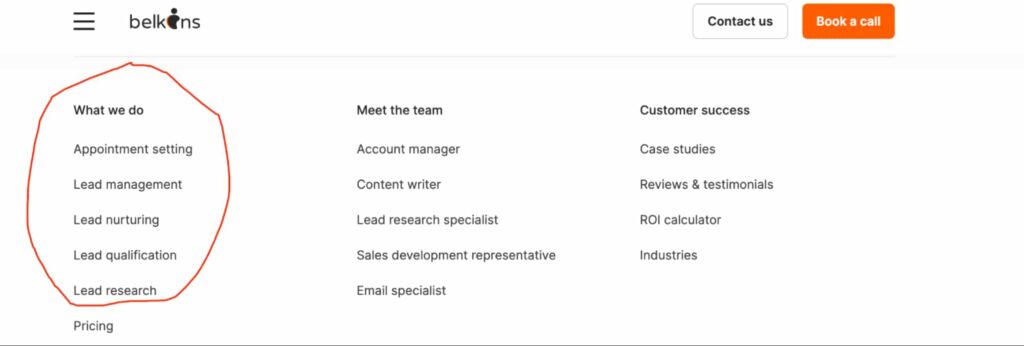
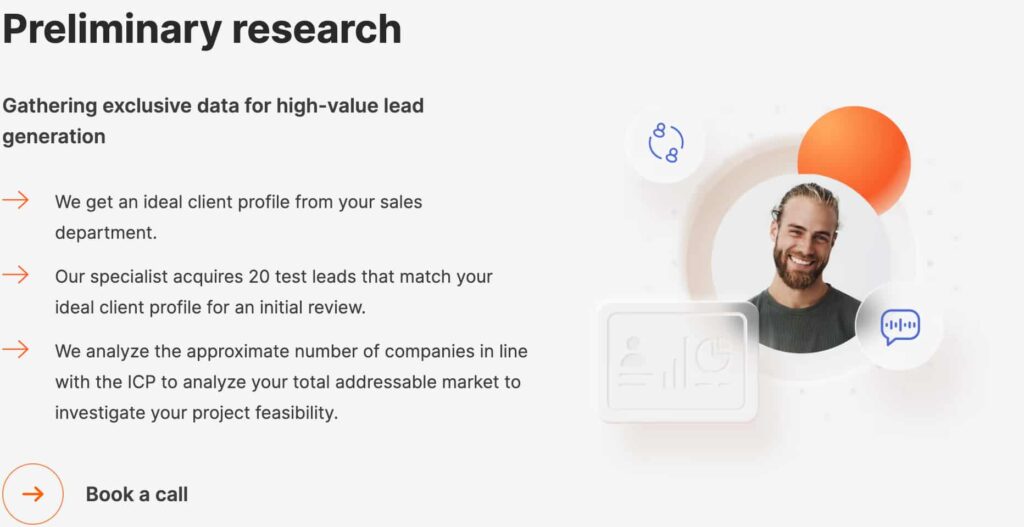
We took a tour of their website. In a nutshell, the team starts by working with your existing sales team, and together they get to the bedrock of what constitutes an ideal client profile from your sales department. The image below details it a little more.
This is a good approach. And the sample test they run allows them to get even more precise on who they should reach out to. We can say that their technique for finding and nailing your ICP before running the campaign is top-notch. But we can’t say the same about the Martal Group.
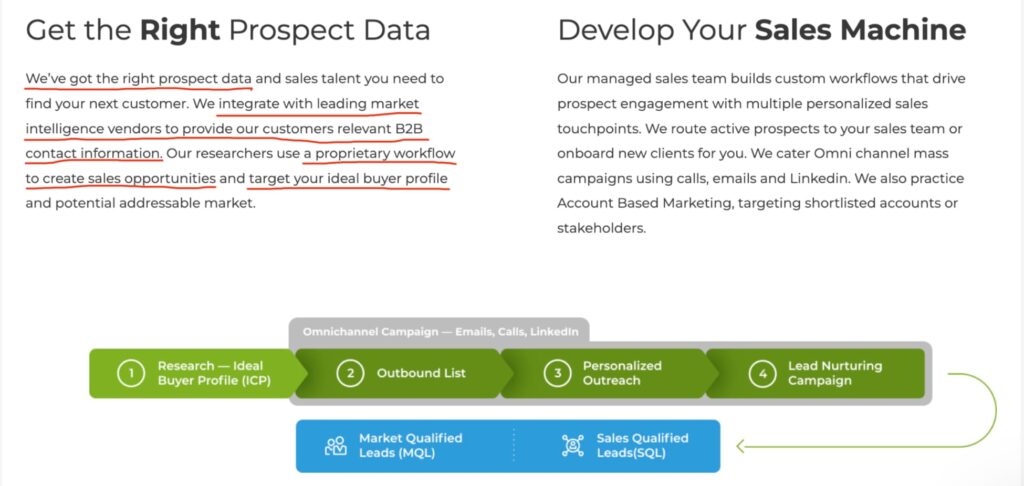
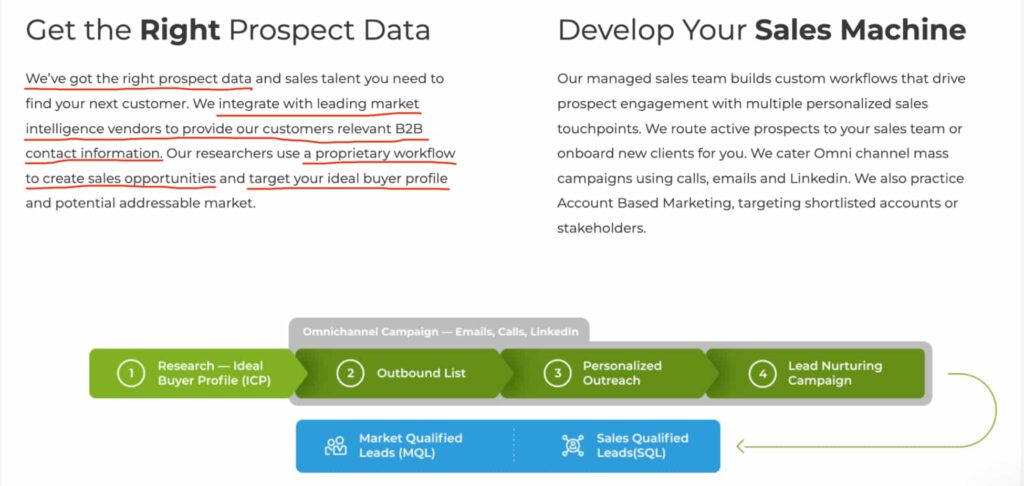
The Martal Group relies on data intelligence databases and tools to find your ICP.
So, unlike Belkins, the Martal Group relies more on their tools rather than real insights from you or your sales team to clearly understand your ICP.
The reason we believe this is bad is because it’s always a guessing game for a lead generation company to identify the right targets without in-depth discussions about your ICP with you or your sales team.
The thing is that even the preliminary data or filters fed into their tools need to be aligned with your ICP, which they can’t merely guess. That’s the main reason most companies’ lead generation processes are broken. No ICP can even be found on a database or devised by a tool.
It’s as if they’re bypassing the most crucial step in lead generation: understanding your ICP. This understanding involves discussions, posing queries, and running A/B tests to gather direct psychographic data relevant to your ICP (who they are, their pain points, what product features they value, and so on).
If your lead gen company can’t discuss and nail your ICP, your product can’t make sense to them. They cannot relate to its unique use cases or the problems it solves, and subsequently, they cannot sell your product better than a company that understands your ICP at a deeper level — the way Belkins does.
Picking up leads and building lists
Following the identification of your ICP, the next step involves conducting research to locate potential customers who align with that profile and building a list for outreach campaigns. So, this section will delve into that specific procedure, beginning with Martal Group.
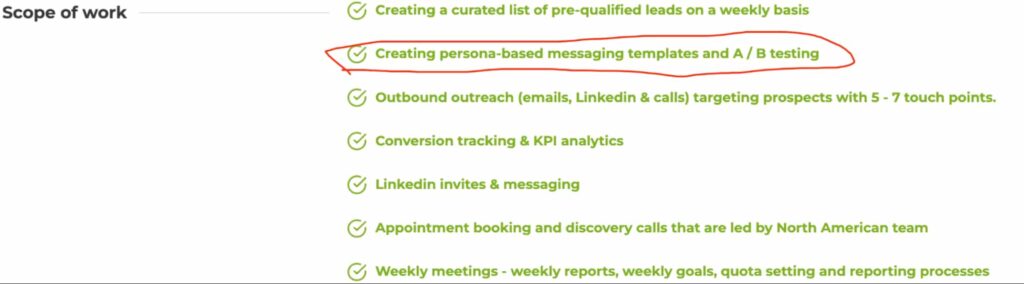
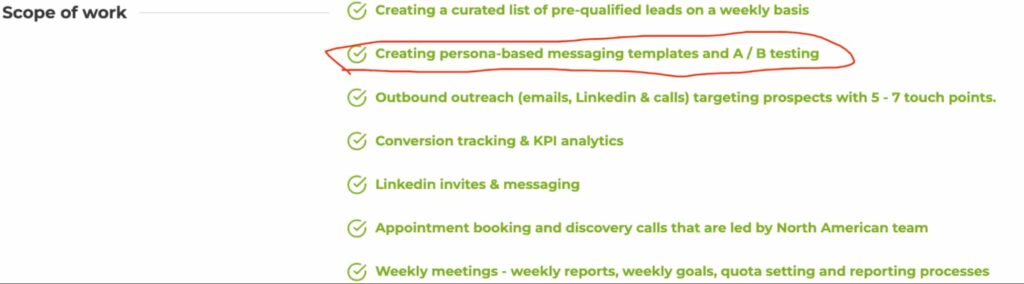
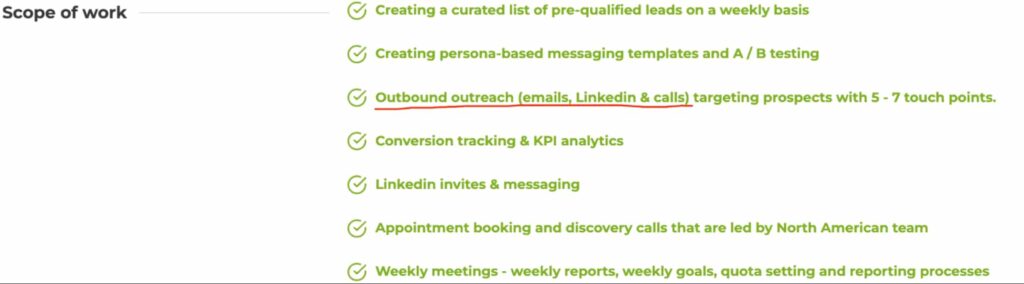
The company’s website mentions that they generate a curated list of pre-qualified prospects each week, which they use for their outreach campaigns.
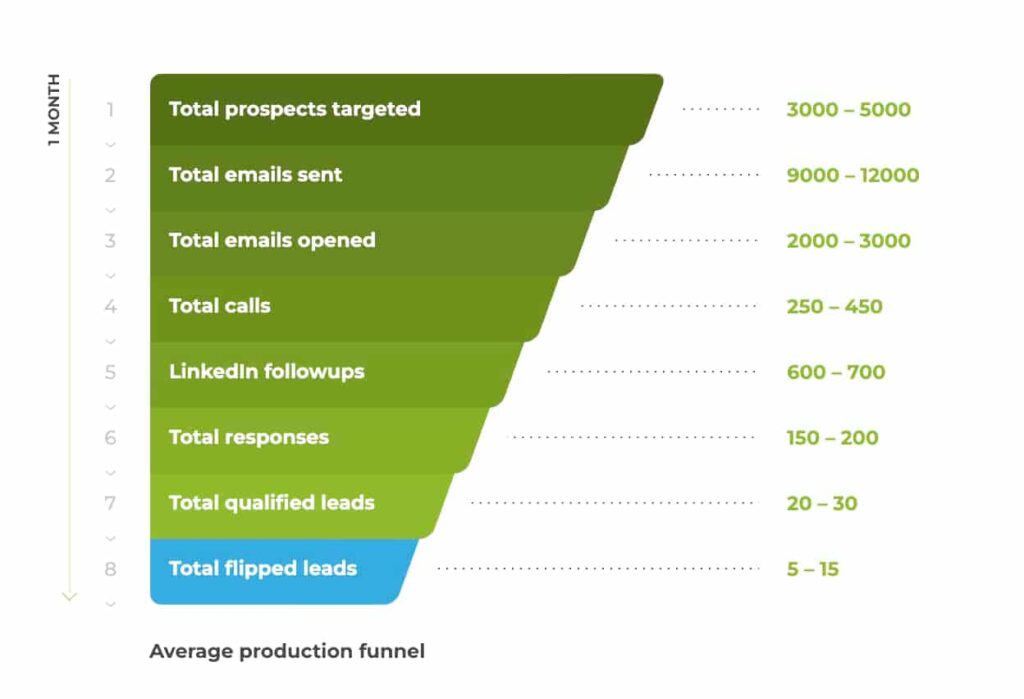
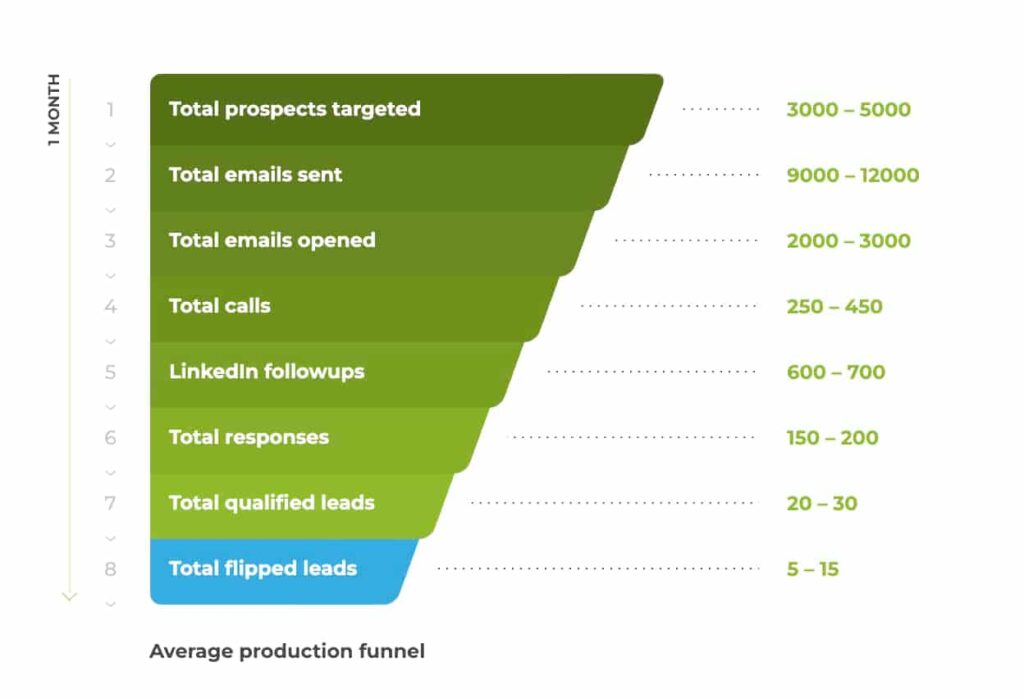
Moreover, the website reads that they build a monthly list of up to 3000 – 5000 prospects. Considering that they build these lists and target prospects on a weekly basis, this translates into creating a list of approximately 750 – 1250 prospects every week.
It’s safe to assume that manually building outreach lists of this magnitude would be impossible. As a result, they probably employ a data intelligence tool (of which they possess three in-house) to rapidly compile prospect lists and then curate them.
With B2B contact information databases, it’s easy to rapidly build lists by applying several filters. Plus, building lists this way effectively accelerates the list-building process, thereby enabling them to seamlessly target thousands of prospects without breaking a sweat.
We take issues with that.
Our first concern is that data intelligence tools, while convenient, only provide generic information that are useless for outreach campaigns. Sure, you can apply filters to narrow down the lists and focus on particular audiences. Still, the resulting data remains generic.
In most cases, you’ll only see data in the range of:
IPO companies
Companies that have 500-1000 employees
Companies that use Salesforce
Companies that are in the UK
Companies that are Serie A funded
Etc.
As you can tell, this data provides no insights about your ICP, their problems, or any distinctive attributes they might possess. While it may form a decent groundwork for cold emailing, it doesn’t shed light on the specific needs and reasons to target a company.
This implies that you can’t definitively tell whether a company listed on these platforms actually faces the challenges that your product or service seeks to solve.
Consequently, it devolves into a game of speculative outreach, where you send cold emails to random individuals hoping to receive a response. This is far from ideal.
Plus, even when you achieve success and get a couple of interested people, leads generated in this way are the most challenging to convert. It’ll require considerable informational content and time to educate them and get them to be sales-ready.
This is not ideal for your business, especially since you’re investing in lead generation services with the intent to promptly fill your sales pipeline with sales-qualified leads and accelerate growth. (You’ll see how we do it better at Nerdy Joe later)
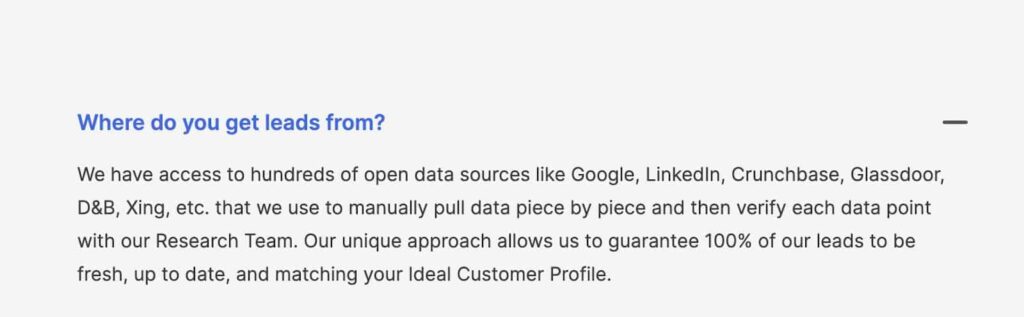
Interestingly, Belkins operates pretty much in the same way as the Martal Group here. According to their website, they rely on openly available data from platforms such as Google, LinkedIn, Crunchbase, Glassodor, and Xing, among others, to find potential leads for your business.
In other words, the company extracts a list of potential buyers from these platforms, after which their research team dedicates time to validate that the identified potential buyers are indeed accurate and align with your ICP. See? Same as Martal Group.
Remember how you should build your ICP based on the needs and pain points that your product solves? Now, you’re targeting random people off the internet based on technographic and firmographic data — it’ll be hard to get leads that’ll actually buy.
The thing is that there is no filter you can ever apply on a data intelligence platform to pinpoint people who match your ICP. These platforms only register companies based on technographic, firmographic, and demographic data.
But you need to understand that even if you’re selling Nextiva, the mere fact that a company uses RingCentral and has a team of 100 doesn’t make them a suitable prospect. So here, both Belkins and Martal Group’s processes don’t guarantee the best outcome for you.
Reaching out and targeting leads
To ensure you get a comprehensive understanding, we’ll divide this section into two parts: campaign-level and copy-level approaches.
This will help you understand how they conduct campaigns, create the content or copy they send to prospects, and how these factors influence the results you receive.
Campaign-level
We’ll start with Belkins.
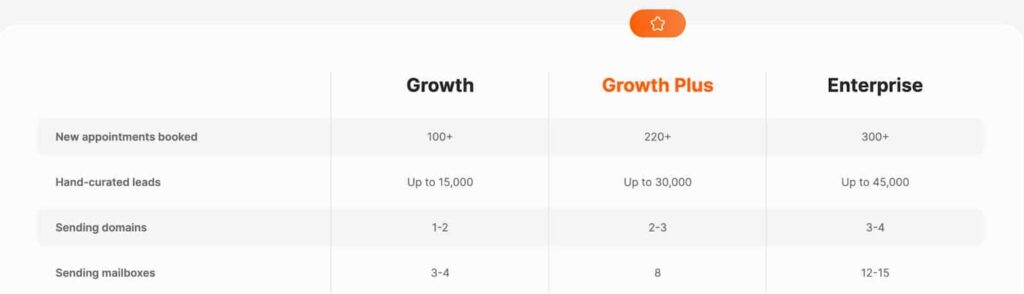
Belkins offers varied targeting strategies. Essentially, you’ll have three options. Based on your chosen plan, you’ll have a distinctive campaign scale.
For each package, they will curate a custom list of leads based on your chosen plan, set up sending domains and mailboxes to ensure email deliverability and send emails to book a certain number of meetings by the end of the month — ALL GOOD.
This strategy is akin to the modus operandi of most lead generation agencies. The issue here, however, lies in the scale of targeting, specifically, the volume of individuals contacted.
For instance, consider the “Growth Plus” plan. It promises a lead list of up to 30,000 curated leads and guarantees over 220 meetings. This suggests that they’ll interact with as many as 30,000 individuals within the agreed-upon timeframe.
That’s a staggering number of people to reach out to, even over a span of six months. It leads one to question whether this method guarantees high-quality meetings or a favorable conversion rate for these leads.
Admittedly, they’ll establish new sending domains and mailboxes, warm up the domains, and run a test sample to determine the optimal go-to-market approach before fully launching the campaign. But here is what it could mean if you are targeting huge lists:
Mass outreach: If you are sending emails to this many people, you can possibly have the time to properly research your prospects and tailor your email to each individual. So, it means you’re blasting people with generic cold emails and pushing for action. They might say you’re selfish and lazy.
Substandard lead quality: Since there is no super personalization, the quality of the leads you get will be subpar, and you can’t convert, at least not easily or in a short timeframe.
Pissed prospects: Some prospects can be mean to you, saying things like “Remove me from your list”, “Don’t ever email me again”, or worse, “Your cold email sucks”.
Bad rap on socials: Targeting people with generic emails can negatively impact your company’s reputation. This can be particularly damaging if you are in a competitive industry or rely heavily on word-of-mouth referrals. Also, we are sure that’s not how you want your business to be represented.
Hopefully, our perspective is clear. We’re not suggesting that our critique is indicative of the service you’ll receive from Belkins. Our argument is simply that quality outreach necessitates significant effort and time, and targeting gargantuan lists (30.000) does not necessarily support this.
Interestingly, the Martal Group does the very same thing. Well, slightly differently. Here it is.
Understand that we are only focusing on the 1st tier of the service, outbound lead generation, as it aligns with your current needs the most.
As part of their outbound lead generation campaign, Martal Group targets between 3,000 – 5,000 potential leads and sends a range of 9,000 – 12,000 emails EACH MONTH.
Within the same period, they also establish connections with prospects on LinkedIn, sending between 600 – 700 LinkedIn messages.
The package further includes call follow-ups with potential leads. You can expect to receive 20 – 30 qualified leads from the campaign at the end. They guarantee that you can convert between 5 to 15 of these leads into customers.
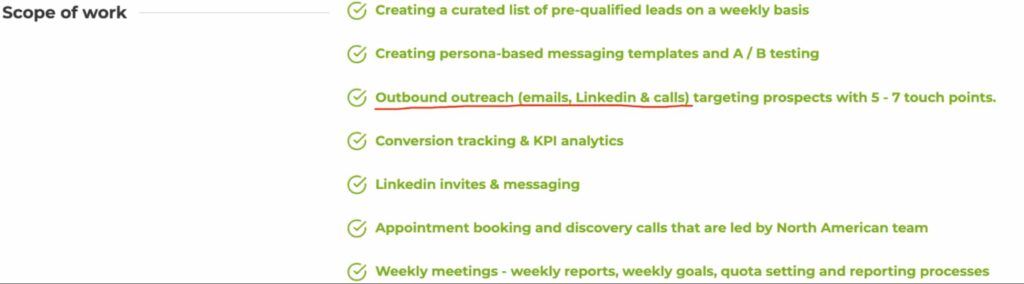
Integrating these three outreach channels can efficiently reach prospects across various platforms and ensure actual engagement and responses from potential leads. However, it’s worth noting that people are generally averse to cold calls.
Putting that aside, the actual concern is that Martal Group also reaches out to AN OVERWHELMING NUMBER OF PROSPECTS and SENDS AN EXCESSIVE NUMBER OF EMAILS. Therefore, the same issues we identified with Belkins are also prevalent here.
Mass outreach: You’re selfish and lazy.
Substandard lead quality: You can’t convert the leads, at least not rapidly.
Pissed prospects: People will be mad because your campaigns suck.
Bad rap on socials: That’s not how you want your business to be represented.
Copy-level
The companies also do the same thing at the copy-level as well. And the way both approach copy creation leaves much to desire. Let’s start with the Martal Group.
Like we said before, mass outreach chips away the time and brain power you should normally invest into crafting compelling copies. So, here is what they do.
While creating templates might seem efficient on the surface, it essentially implies that they’re using one successful example as the foundation for all their content across the entire campaign.
Given the large volume of prospects they target, they can’t create or tailor their emails to each individual. So, they have to engage in wide-ranging, generic personalization, which, as you look closer, isn’t truly personalized at all.
Essentially, they’ll create email templates for every campaign and send them to the vast list of prospects they’ve compiled from a data intelligence tool, altering only some generic variables (like company name, job title, first name, etc.) within the email.
This sort of superficial personalization is far from ideal. Your engagement will be crickets. Fun fact, it explains why they must send thousands of emails before getting substantial results. Belkins also employs the very same approach.
As we’ve found before, the company engages in mass outreach, targeting huge lists of customers. Again, as we said before, this leaves little room to do excellent research and create individually-personalized messages that align with each prospect individually.
So, confirming our theory, it reads on their website that the company develops and delivers personalized outreach messages using templates.
Proper outreach requires excellent research and creating a personalized email for each of your prospects. No two prospects are the same and shall thus never receive the same outreach emails or messages. (More on that later as we detail how we do it).
Lead outreach channels included
Belkins deploys a multi-channel outreach strategy that incorporates email, LinkedIn, phone, and more. They employ data intelligence tools, proprietary outreach tools, and their expertise to drive their operations.
Similarly, Martal Group also executes a multi-channel outreach approach, including email, LinkedIn, phone, and more. They make use of data intelligence tools, proprietary outreach tools, and their expertise to steer their operations.
However, at Nerdy Joe, we take a different stance. We believe reaching out to prospects on so many channels can be overwhelming and, sometimes, counterproductive. We’ll explain more about our unique approach later.
Lead generation and sales enablement tech stack included
Belkins is not particularly famous for having an extensive list of lead generation tools, but it does possess a notable selection of its own lead generation facilitation tools.
These include an email delivery tool known as Folderly, a proprietary platform named Wordstir that assists in crafting emails and provides ready-made templates, and an appointment scheduling platform, among others.
It’s worth mentioning, however, that, unlike Martal Group, Belkins has to rely entirely on a few third-party tools for research and outreach. For instance, they lack a tool offering a comprehensive B2B database of companies like Apollo.io and ZoomInfo, as Martal Group does.
Remember that these factors can influence their pricing model as they have to invest in these tools.
On the other hand, Martal Group presents a collection of lead generation tools, including databases for B2B contact information and dashboards for outreach analytics and reporting. Interestingly, despite this, Martal Group also uses several third-party tools.
This could imply that Martal Group’s clients might have to invest in additional tools to achieve their lead generation objectives. It’s crucial to remember this when comparing the services offered by these two companies.
Service pricing: Pricing model, refund policy, average deal size, minimum commitment period, and contracts.
As you are probably aware that most lead generation companies do, none of the two companies leaves a clear pricing detail on its website.
That means you’ll have to reach out to them to get custom pricing. That said, we’ve looked on Clutch to see the average deal size of the two companies.
Pricing/average deal size
According to Clutch, Belkins.io and the Martal Group have an average deal size of between $10,000 and $50,000.
That’s a significant financial commitment, especially for small to medium-sized enterprises. They can both justify this pricing with the extensive reach of their campaigns, their ambitious prospect targeting, and the plethora of tools they use.
However, when we factor in all the possible issues related to lead quality and conversion efficiency, as mentioned previously, the return on investment won’t be the most advantageous for your business.
Minimum commitment period and contracts
When working with Belkins, the typical subscription period is 12 months. You must commit to working with them for 12 months before starting.
As for the Martal Group, the typical subscription period is 3 months.
This implies that you’re required to commit to paying them for a period of either a year or three months before initiating a working relationship. This arrangement might not be the best fit for your needs, particularly if you’re a small business or a startup, and here’s why.
This system makes you pay for several months while they experiment with different approaches, potentially leaving you with no tangible returns on your investments.
To put it into perspective, the minimum outlay for the Martal Group is $30,000, while for Belkins, it could skyrocket to a staggering $120,000.
What’s even more critical to understand is that being locked into a long-term contract or subscription can considerably hamper your ability to modify your lead generation tactics or transition to another provider.
This could pose significant challenges if your business requirements evolve or the outcomes do not meet your expectations. But regardless of your level of satisfaction with the services provided, you’re still obligated to pay them and abide by the contractual terms.
Refund policy
Belkins offers no refund, and they are not shy about it.
On the other hand, the Martal Group doesn’t mention any refund policy anywhere on their website.
What this implies is that if you invest in their services and they fail to deliver the desired results, you’ll be left with no option but to accept the situation and move forward.
Nerdy Joe vs. Martal Group and Belkins: Why we are a better option for lead generation than the Martal Group and Belkins.io
Our dedicated service guarantees a steady flow of leads for your enterprise, eliminating the burden of lead gen for you and your sales team. Outsourcing your lead gen to us allows your sales team to focus on what they do best – having sales meetings and closing deals.
We position ourselves as a much better alternative to Belkins and the Martal Group on the grounds that these organizations, in our view, neglect the most crucial elements of lead generation.
To give you a clearer picture, let’s talk about the key components of lead generation that, in our opinion, Belkins.io and the Martal Group seem to lack.
Here we go:
Both Belkins and the Martal Group fall short in personalizing outreach messages to their maximum potential. They lean heavily on templates, tweaking only for industry specifics, resulting in a one-size-fits-all messaging strategy.
Martal Group’s process for ICP identification is rather ambiguous and leaves many questions unanswered. They lean more on technological tools than discussing to get direct insights from your sales team. The campaign is doomed from the start.
Both organizations rely on sales and data intelligence tools for lead sourcing. This implies a lack of precise targeting. Their outreach campaigns essentially boil down to a numbers game — broadcasting mass emails to a random audience and passively waiting for responses.
Neither of these companies prioritizes researching and addressing individuals in your target audience based on their unique needs and challenges. Instead, they scrape huge lists from data intelligence tools and start to blast them with poor emails.
Both companies are “jack-of-all-trades”. They offer a broad spectrum of services across multiple channels. You’re better off working with a team that excels at mastering a few channels.
The outreach campaigns from both firms won’t bring you the highest quality leads. This is primarily due to their mass-targeting strategy, leading to subpar campaign performance. As well, it’ll take time and more educational materials to convert leads.
Neither Belkins nor Martal Group offers refunds; even more concerning, they fail to provide a results guarantee. This uncertainty, coupled with their commitment periods of three or twelve months, forces you to allocate budgets for these durations with no promise of successful outcomes.
Lastly, their pricing is on the higher end and appears to be based on the tools they employ and the effort they put in rather than the actual results delivered. This pricing structure might not be the most beneficial for your business.
Both Belkins and the Martal Group fall short in several critical areas for a lead generation company. They fail to align with the key elements we initially discussed, which you would ideally want from a service to ensure they can really fuel your business growth.
From personalization to targeting, campaign strategy to pricing structure, both companies show significant limitations in delivering an optimal lead generation service.
Now here is why you really should work with us at Nerdy Joe.
Outreach services: Belkins and Martal Group are jacks of all trades; our team is dedicated to only cold email outreach and LinkedIn outreach.
A significant issue with both the Martal Group and Belkins is their tendency to overextend themselves. Their team is spread too thin trying to offer a range of services, from LinkedIn marketing and sales enablement to inbound marketing and even technology services.
They market themselves as all-in-one solutions in the lead generation sector, which can make them less effective because it becomes a team of self-acclaimed experts trying different things at the same time instead of professionals who are sure of their work and can promise you clear outcomes.
Instead of attempting to be a universal fix, we at Nerdy Joe take immense pride in specializing in only two core lead generation areas — cold email and LinkedIn outreach. Our strategy focuses on reaching out to leads via these two channels to deliver unparalleled results.
Our concentrated approach provides significant advantages to our clients. We maintain a straightforward yet powerful strategy: focusing on developing compelling cold email and LinkedIn outreach campaigns that captivate and draw in potential leads.
For us, lead generation is only a segment of the broader picture. The true indicator of success is converting leads into long-term customers. Therefore, our goal is not simply to bring you leads but to generate high-quality ones with a substantial probability of conversion.
Service value: The Martal Group and Belkins charge you for the work they do and their vast (not-so-useful) tech stack; We charge only for the results we bring you.
For us at Nerdy Joe, when you hire a lead generation company, the only important outcome for you is the number of sales leads generated by the end of the month. That should be the only thing they promise and the only performance you get billed for.
Both Belkins and the Martal Group charge hefty fees for their services, with costs tied to the outreach volume, the number of contacts they add to your list, and their fancy tech tools.
This pricing model is not beneficial to you since it does not take into account the number of leads to your sales team. It’s more about what they do rather than the results they bring you.
At Nerdy Joe, we clarify from the get-go that clients need not fret about the list of prospects we build or the email volume we send — don’t worry, we don’t do mass outreach.
This is because we understand the core struggle for companies seeking lead generation help revolves around their need for LEADS. It’s that simple.
So, our lead generation specialists concentrate only on metrics that truly reflect your outreach performance and ROI. We focus on metrics like:
Number of positive responses
Number of meetings scheduled
Count of new sign-ups
Number of demo requests
Lead to close rate
Our reports are customized to align with your company’s product or service and your broader objectives. This enables us to discern the results that hold the most importance for you, and those become our primary targets for achievement.
For instance, if you task us with getting more guest posting opportunities for you, we’ll report on the following:
The count of positive replies from editors
The volume of affirmative responses we receive from webmasters
Outreach strategy: The Martal Group and Belkins approach lead generation as a number game; We at Nerdy Joe adopt a careful and systematic approach to lead generation. We manually build our lists and prioritize strategic targeting.
Many firms in the lead generation sector, including Belkins and the Martal Group, commonly approach lead generation as a numbers game. Truth be told, it’s a widespread industry practice.
These companies build vast lists off of data intelligence tools like Apollo.io and ZoomInfo. Next, they launch cold email campaigns, blasting them with generic emails, hoping to get a few replies and handing over anyone that replies to you as a lead.
While this approach can generate some leads, it lacks the meticulous groundwork that truly drives success in lead generation.
Targeting extensive lead lists brings about numerous issues:
Poor research and subpar lead data enrichment
Lack of room or time for personalization
Generic, ineffective emails or messages
Low-quality leads, resulting in little to no return on investment
Risk to company reputation
Email deliverability and spam issues
We are not suggesting that the service quality of Belkins and the Martal Group is any less than stellar. What we’re telling you is that it takes considerable effort and time to build efficient outreach campaigns. Mere mass emailing of individuals found on databases like ZoomInfo is not ideal for this.
Furthermore, as dedicated marketers, we believe it’s hardly impressive to connect with 30,000 individuals only to generate engagement from 200 leads, many of whom may not even convert — and charge you thousands of dollars for it.
That’s why we at Nerdy Joe prioritize personalized messages. We like the idea of doing extensive research and analysis it takes to find the right people to reach out and create effective messages that engage them. That’s one key difference between us and most agencies.
In a typical scenario, we build a concise list of 20 prospects, study them in-depth, understand their pain points, and craft personalized cold emails or LinkedIn messages. This approach can often result in 15 responses, 10 of which are positive, leading to 6 sales-qualified leads or meetings for our clients.
Our personalization is about ensuring each email is genuinely relevant, timely, and uniquely tailored to every recipient. It goes beyond merely inserting [[First name]] or similar variables into the subject line and considering the job done.
We aim to make each recipient feel understood and pique their interest. Our goal is to create emails that foster a sense of personal connection, compelling the recipients to take your proposal seriously, whether they decide to sign up for your offer or not.
Achieving this involves investing substantial time in understanding and researching your ICP before launching any email campaign. This is a feat you cannot achieve with mass list targeting.
We work closely with you to formulate the ICP, analyze each prospect individually, and gather data points to create impactful cold emails. Contrary to the Martal Group, we don’t depend on any tool to shape your ICP or conduct research.
As soon as we onboard a new client, our initial step is to inquire about their ICP through a set of probing questions.
We might ask:
Who are your highest-value clients?
Which client category is the easiest to convert?
Which type of clients shows the fastest turnover?
What are the main objections that come up during sales calls?
What was your motivation for starting the company?
What issues were you aiming to address?
And so forth.
Your responses to these inquiries equip us with precise target demographics and their associated reasons. This granularity of information helps distinguish between:
“We’re reaching out to series A tech companies OR companies that use ClickUp”
And
“Our ICP is a VP of Sales at a B2B software company, catering to HR professionals, who is struggling with organization, time management, and team collaboration. They frequently resort to XYZ podcasts for insights on efficient team management.”
After gaining a clear comprehension of the ICP, we move forward to manually compile our list, which becomes the foundation for our lead generation campaigns.
Research and copywriting: CIENCE and the Martal Group provide basic, generically personalized emails; we research each prospect individually and create truly personalized cold emails and LinkedIn messages.
Unlike the Martal Group and Belkins, we don’t rely on email templates to run our cold outreach campaigns.
For us, using template-based messages is mass customization which strips away the unique personal touch that connects with each recipient’s distinctive characteristics.
So, what do we do?
Our process begins with individualized research of each prospect to gather useful information. That’s how we enrich our data.
We don’t rely on software to just feed us with basic information like job titles, geographical location, the technology they use, or the size of their company.
Instead, we seek psychographic data — insights into their personalities, values, opinions, attitudes, interests, and lifestyles.
We deploy all our resources to acquire this data, and it makes a remarkable difference. To give you an idea, here are some things we do:
We listen to podcasts featuring your potential customers.
We read their blog posts.
We examine their posts on LinkedIn, Twitter, and Mastodon.
We analyze discussions in forums they participate in.
Etc.
Leveraging this compiled data, we identify unique angles that enable us to formulate personalized introductions or icebreakers.
Here’s what it looks like in real life. We pitched CoSchedule’s Head of Content, Ben Sailer, and asked him if we could write for them.
Here’s what he replied 1 hour later.
Here is another successful example from a similar strategy.
As you can see from both screenshots, the cold emails sent to the prospects were so compelling that they couldn’t help but acknowledge it before offering to hire us.
Contracts and signup implications: Belkins and the Martal Group both require you to sign longer-term contracts; We don’t — you’re free to renew or stop your subscription based on satisfaction.
Unlike the Martal Group and Belkins, who require long-term commitments ranging from 3 to 12 months, potentially leading to significant investments for your business without assured results, we at Nerdy Joe operate on a subscription-based model.
If you sign up with us, you can be sure you’ll see tangible outcomes from the very first month of our collaboration. The decision to maintain your subscription hinges entirely on your satisfaction with our services and your financial considerations.
Our pricing structure is transparent and straightforward, potentially making us one of the top contenders in the lead generation industry. You choose a plan that suits your budget and requirements, and you’re fully aware of what you’ll receive by the end of the month.
You won’t be faced with vague responses like
“The results depend on various factors.”
“Your account manager was unable to work because he inadvertently swallowed the office key.”
As long as your product fits the market well and addresses a common problem, that’s essentially all we need to generate results for you. However, if you’re still in the process of finding your product market fit, we might not be able to offer effective support.
Nerdy Joe Pricing: Unlike Martal Group and Belkins, we offer affordability and scalability without burning a hole in your wallet.
Belkins and the Martal Group are notably pricey, excessively so for most reasonable measures. Moreover, they do not offer refunds, and their pricing models are convoluted, often charging for services that you might not require.
We believe that their pricing structure is overly expensive and unsustainable for the average business operating within a budget.
So unlike the Martal Group and Belkins, we offer a flat fee for a specific number of leads or appointments booked for you and keep it all transparent on our site.
DeLorean: It costs $1799/month and gives you 10 leads or meetings with high-quality leads.
Batmobile: This is the plan we recommend, as it gives you the biggest bang for your buck. It costs $2199/month and gives you 15 hot and sales-qualified appointments or LEADS.
Millennium Falcon: It costs $3099. This plan is good for mid-level to enterprise companies willing to fuel their sales team with up to 25 sales-ready leads on a monthly basis.
Starship Enterprise: This is the enterprise-level plan, and it comes at $5099. We added it for large organizations and enterprise-level businesses willing to fuel their sales team with a huge flow (50+) of meetings with sales-ready leads on a monthly basis.
What’s interesting with us is that you know what you’re getting upfront and know exactly how much you’ll have to pay for it. We don’t play hide and seek or get you on long sales calls to discuss pricing with you.
Hire Nerdy Joe and start generating sales-ready leads today
The Martal Group and Belkins are both highly respected in the field of lead generation, backed by robust portfolios and a strong industry presence. This post could potentially guide you to the lead generation company that best fits your business needs.
Our verdict is that the Martal Group is mainly fit to be a sales outsourcing company, while Belkins and knee-deep into lead generation for their customers.
However, if you’re in search of a superior lead generation partner, we encourage you to engage with us. We are an agency that prides itself on delivering high-quality service.
As an agency, we:
Execute tailored and effective outreach campaigns rather than mass-blasting lists.
Undertake meticulous research to ensure efficiency.
Charge for results, not individual tasks.
Don’t burden you with unnecessary tools or costs.
Don’t compel you to sign a binding contract.
Value your time, delivering our services affordably and efficiently.
Care deeply about your company’s reputation and the relationships with your prospects.
Nerdy Joe is the lead generation agency you need. We conduct market research, identify leads, manage these leads, and deliver you qualified prospects. Consider us an extension of your team.
Note:Struggling to get replies or book meetings with prospects that fit in your ICP? We’ll help you get 6 SQLs or book 6 meetings with prospects that are ready to buy for only $999/month. Book a 15-minute consultation now.
UpWork or Fiverr? Where should you hire your lead generation experts? To answer this question simply and fast: NEITHER. We will tell you why.
UpWork and Fiverr are two of the most popular freelance platforms where you can hire freelancers for various services, including lead generation.
These marketplaces offer an excellent avenue for locating top-tier freelancers, regardless of your location. Usually, finding the appropriate marketplace for a business hinges on a multitude of elements such as project requirements, financial resources, work style preferences, etc.
But before we discuss those, we need to get clear on what you should look for in a lead generation expert.
When you are hiring for lead generation, it means that you somehow want to grow your business and thus want HOT leads to fill your pipeline for your sales team to sell to.
Because of this, when you hire in the name of lead generation, you want:
Experts who actually understand what lead generation is (inside out) and actually have the creative skills to make it happen.
A team of professionals who have specialized knowledge and experience in different areas of lead generation, such as cold email marketing, sales copywriting, cold outreach campaign, email marketing, lead research, data enrichment, and more.
Dependable experts with resources at their disposal, including the latest tools and software, databases, and technologies to generate leads effectively.
Lead generation professionals who can devise a reliable strategy to attract and acquire leads continuously: That’s basically the expertise you’re lacking and part of the reasons you’re here. So, the agency needs to demonstrate a proven, systematic method for generating leads that will work consistently for your business.
Professionals who can do the work and deliver sales-ready leads fast. If you are looking to hire a lead generation agency, it means that you are not growing at the rate you wish, so you want to fill your sales pipeline and grow fast. Because of that, you want an agency that can deliver quality leads promptly. You don’t have months to wait and can’t afford it.
Last but not least, the lead generation service should be cost-effective and able to grow with your business. More importantly, they should have a clear pricing structure or model with offers that detail what you can get or expect from the service.
That said, we believe from the onset that you should hire neither UpWork nor Fiverr for lead generation — and the reason for this is very simple. Most of the acclaimed lead generation experts on there only do list building and call it lead generation.
The second and most important reason is that they terribly fail to tick the boxes you care about when you need a freelancer or an agency to generate leads. And more.
In this article, we will compare Upwork to Fiverr and discuss all their key offerings. By the end, you’ll have a clear idea of the company that’s best for you. But as well, we will tell you why these job marketplaces aren’t the best place to hire when you want to generate leads.
Let’s get started.
Note:Struggling to get replies or book meetings with prospects that fit in your ICP? We’ll help you get 6 SQLs or book 6 meetings with prospects that are ready to buy for only $999/month. Book a 15-minute consultation now.
Why UpWork and Fiverr can’t get you the leads you want
Our thinking here is based on the principle that if you are hiring for lead generation, that means you want:
To grow your customer base by fueling leads to your sales team
To increase revenue
Leads to sell to
But more importantly, you want leads without suffering through lead generation. You want a completely done-for-you lead generation service that guarantees consistent leads for your business or sales team to close.
With that in mind, when you start looking at Fiverr and Upwork from these viewpoints, you’ll realize that they aren’t in any way fit to get you the professionals you need nor the outcomes you want for your business. We will elaborate more in the following sections.
Lead generation experts on Upwork and Fiverr are mere list builders, not lead generation experts. They CAN’T generate SALES-READY leads.
Yes, you read that right.
We don’t believe you should hire on UpWork and Fiverr for lead generation because most individuals offering their services on the platform are not lead generation experts. In most cases, all they do is build and clean up email lists.
Let’s take a look at an acclaimed lead generation expert from Fiverr, for example.
Here is an example from UpWork.
Surprisingly, all the profiles that pop up when you enter lead generation on both platforms are the same. They all claimed they are lead generation specialists, but all they do is build lists, collect email addresses, or enter data. We all know that’s only a single slice of the lead gen pie.
Somebody or a team that only knows its way around list building just can’t cut it. What we are saying is that hiring people from Fiverr or UpWork is only a good idea if you have an in-house lead generation team already working for you and want to unburden them with list building.
It takes ICP identification, buyer persona development, lead research, list building, data enrichment, copywriting, outreach campaigns, leads scoring and validation, et, to generate high-quality leads that end up buying from you.
That’s why you need REAL marketers, lead generators. People with the skillset to discuss and understand your ICP profile inside out, create sales emails and outreach messages that convert — basically DO THE WORK and GENERATE LEADS, and that’s where Nerdy Joe prevails.
Full-scale lead generation agencies provide consistent service and performance that can be difficult to maintain with an individual freelancer or a team on Upwork and Fiverr.
Another thing that happens with freelancers from platforms like Fiverr and Upwork is that even when they do promise some type of outcomes for the work they do, they can’t provide a consistent level of service and performance as a full-scale lead generation company would.
Successful lead generation requires processes and systems to ensure that work is carried out consistently, proven strategies and workflows to ensure targeting and messaging are excellent, and the results are monitored and optimized regularly.
That’s just something you can’t find on a freelance job marketplace. That’s because it takes experts to design it and a company to run it. Even if freelancers can promise or deliver these occasionally, they cannot be as reliable or consistent as a dedicated lead generation agency.
Also, hiring a lead gen agency like Nerdy Joe provides a contract that details the scope of work, timelines, deliverables, and other expectations. This offers a sense of stability and predictability. A freelancer or a team juggling multiple clients can’t deliver consistent results.
Lead generation freelancers on UpWork and Fiverr can’t guarantee a steady stream of leads and the capacity for scalability.
One of the critical advantages of a full-scale agency is its inherent capacity and adaptability for scalability. And it’s something you can’t have with a freelancer from Fiverr or Upwork.
Let’s take our lead generation agency, Nerdy Joe, for example. We are composed of a diverse team of specialists. We possess the bandwidth to handle multiple projects simultaneously or scale up operations swiftly when required.
So, as your business grows and imposes the need for more leads, we can comfortably accommodate this growth, given our larger team and resources. We can assign more team members to your project to ensure that the increased workload is managed effectively.
Contrarily, individual freelancers or small teams from Upwork and Fiverr will struggle to handle a significant increase in workload. They are limited by their individual capacities and may not be able to meet increased demands as quickly or efficiently.
Scaling up with a freelancer means they have to bring in additional help, which can lead to consistency and quality control issues. Or, it might involve a learning curve and extra time for the new team members to familiarize themselves with your business and the project.
Upwork vs. Fiverr: How do the two work marketplaces’ services compare?
Upwork and Fiverr are both online platforms that connect freelancers with clients who require their services. These platforms provide a marketplace where businesses and individuals can hire professionals for various projects and tasks, including lead generation.
Let’s start the comparison with their UI design structure and what they mean for someone looking to hire.
Platform structure and business model: Upwork is designed to encourage long-term relationships between freelancers and clients, while Fiverr’s structure is more geared towards one-off projects.
Fiverr is primarily designed for one-off projects or “gigs”, with the site’s layout allowing users to browse and hire freelancers for specific tasks like lead generation or video editing.
Each freelancer on Fiverr has individual gig pages detailing their experience, expertise, reviews, past work, job completion rate, how much it will cost to work with them, etc.
You can even reach out to them directly from the page to further discuss with them via the pop-up message feature.
While you can post jobs on Fiverr, the UI isn’t primarily designed to let you do that. They typically encourage their users to surf through the different services they freelancers sell and get them to choose from those.
If you want to post a job application, you’ll have to search for the Request feature from the hidden menu and take it from there. Plus, the feature doesn’t allow you to add as many details to the application as Upwork allows you to.
Upwork, on the other hand, emphasizes long-term collaborations. And when searching on Upwork, you are directed to freelancer profiles, pretty much like LinkedIn pages, rather than specific gigs.
Upwork, unlike Fiverr, lets you post your job and have the freelancers reach out to you in the most convenient way. You can add screening questions to the post, require certain specificities, and even ask applicants for cover letters.
Upwork also offers the option to communicate directly with potential employees. You can provide them with job specifics or encourage them to apply for an already listed position. Moreover, the platform facilitates the interview process by letting you screen and interview potential hires right on the site.
Both platforms also offer mobile apps, each with slightly different features. Fiverr’s mobile app mirrors most features of the website, whereas Upwork has two separate apps for freelancers and clients. The client app lacks some features found on the website, such as the Reports section and timesheets.
In conclusion, the two platforms are pretty much the same here. We believe you should work with Fiverr if you only need a one-off lead generation gig, like someone to build a list or clean up the data. But if you need it on a regular basis, then you should head over to Upwork.
Hiring process: Fiverr is more of a marketplace where you can browse gigs offered by freelancers, while Upwork is more convenient for posting jobs and recruiting based on your own terms.
As you read, Fiverr is more of a marketplace in the literal sense. The hiring process tends to be straightforward: you browse gigs offered by freelancers and filter gigs by price, delivery time, seller level, and more.
The real problem with Fiverr is that the decision is generally based on what the seller offers in the gig and their reviews.
So, you research freelancers based on a specific gig, you pay for the gig, detail your requirements, and the freelancer executes the task. Only when you approve the work does the freelancer receive payment, which is held in escrow by Fiverr to protect you, the client.
On Upwork, you can also browse profiles of entire agencies to find suitable candidates based on various factors such as budget, expertise, and job completion rate.
You can post a job listing describing the specifics of what you need, and freelancers will bid on your project. You can also browse through profiles and invite specific freelancers to bid. This allows for careful selection based on proposals, profiles, portfolios, and past reviews.
Pricing structure: On Upwork, you can choose between whether you want to pay hourly or fixed-price services. The same is not true for Fiverr.
Let’s get this out of the way before we discuss the pricings.
Neither Fiverr nor Upwork provides financial benefits like discounts or bonuses for continued collaboration with a specific freelancer. They only facilitate the rehiring of previous providers. This can foster trust and consistency in results.
That cleared, Upwork’s pricing typically varies based on an hourly rate or a fixed price for the entire project, which is agreed upon before starting. The minimum hourly rate is $3. You also have the opportunity to negotiate the rates with the freelancers.
Upwork sometimes presents inexpensive services, albeit not as cheap as Fiverr, and many operate on an hourly basis. You need to keep in mind that this pricing model can quickly lead to unexpected costs if the project overruns.
On the other hand, Fiverr’s services are generally offered as packaged deals (called “gigs”) with a fixed price, starting from $5, and can go up to several thousand depending on the complexity of the task, seller’s level, and add-ons. Also, you have less flexibility in negotiating prices.
In terms of fees, Upwork generally charges freelancers, with clients only needing to cover a 3% transaction fee. Also, note that freelancers on Upwork often factor these fees into their rates.
On Fiverr, there’s a $2 fee for orders up to $40; beyond that, a 5% charge applies. This means for larger projects, like a $1,000 website design, Upwork could be slightly more economical.
Quality and freelancer verification standards: Upwork’s quality assurance and vetting system seems rock solid, but Fiverr’s community-based rating system generally performs better.
Fiverr and Upwork employ different strategies to vouch for the quality of freelancers on their platforms.
We found that Fiverr does not validate all sellers. Unless it’s a pro freelancer, Fiverr doesn’t vet them. The Fiverr Pro is a special program that accepts highly skilled freelancers after a series of evaluations.
The Pro freelancers have a “Pro Verified” label on their listings and tend to charge higher prices, but they are typically reliable and monitored closely by Fiverr. Non-Pro sellers’ quality is reliant on the community, with reviews and ratings they receive from clients after each gig.
Conversely, Upwork has an extensive vetting process. First of all, they only accept certain freelancers based on demand in specific fields. They make freelancers undergo various tests and meet specific standards.
On the platform, the top-rated freelancers are denoted by a blue shield with a crown icon. Before getting there, they need to meet stringent requirements, like a 90% Job Success rate and monthly earnings of at least $1,000 USD.
We can argue that given its more thorough vetting process, you are more likely to find high-end, professional freelancers with extensive lead generation experience.
The issue with Upwork’s system is that it is often seen as a hindrance, as many skilled freelancers either can’t join the platform or opt not to due to the complicated process. Even more interesting, Upwork still struggles with fraudulent and exaggerated profiles.
Protection, guarantees, and dispute resolution: Both platforms strive to guarantee protection and ensure all disputes are resolved properly.
First thing, both platforms protect the payments through an escrow system until the job is confirmed as completed by the client.
For hourly contracts, Upwork offers a Work Diary feature that provides visual evidence of work in progress. For fixed-price jobs, funds are usually deposited into escrow before the freelancer begins work and are released once the job is completed to the client’s satisfaction.
It’s almost the same with Fiverr. If you’re not satisfied with the work, Fiverr offers a resolution center where you can manage disputes. So, for disputes, Upwork and Fiverr both facilitate the direct resolution of issues between clients and freelancers.
When problems arise, you can report unsatisfactory work. Fiverr handles disputes internally, deciding on the eligibility for a refund. On Upwork, a dispute specialist suggests a non-binding resolution.
If you disagree, you can involve legal arbitrators, costing around $800, with your share nearly $300. The preferable platform depends on your budget, project cost, and preferred method of dispute resolution.
Hire Nerdy Joe and start generating leads today
In conclusion, if you need professional, high-end lead generation services and want to carefully evaluate proposals, Upwork might be your better choice. On the other hand, if you’re more price-sensitive and looking for quick, packaged services, Fiverr is a more suitable option.
It’s worth mentioning that the quality of work you get depends heavily on the particular freelancer you end up working with, so carefully reviewing profiles, portfolios, and customer reviews is crucial on both platforms.
But as we said in the introduction of this article, we don’t believe Upwork and Fiverr are the best places to hire for lead generation. If what you care about is to:
generate leads for your sales team,
fill your sales pipeline with sales-ready leads,
free up your sales team so they can focus more on closing deals and having meetings rather than doing research and suffering with lead attraction and acquisition,
Both Upwork and Fiverr are not ideal for your needs.
You need a full-scale lead generation with a team that has the right expertise and a full grasp of the marketing activities and workflows they need to run from top to bottom to research, reach out to or attract and get you leads you can sell to.
You need a team of experts that demonstrates proven processes and systems that ensure that work is carried out consistently. Systems and strategies that guarantee a consistent flow of leads for your business or its sales team — that’s where Nerdy Joe comes in.
Freelancers on Upwork and Fiverr charging you $100 for the service just aren’t cut out for this. We believe Upwork and Fiverr are both great workplaces to hire freelancers to whom you can hand off one-off gigs that seem tedious to your lead generation team — so you can free them a little and facilitate the work for them.
Note:Struggling to get replies or book meetings with prospects that fit in your ICP? We’ll help you get 6 SQLs or book 6 meetings with prospects that are ready to buy for only $999/month. Book a 15-minute consultation now.
Both the Martal Group and CIENCE are great lead generation companies, that’s well-established. Making an informed decision about which of the two is right for your business can feel overwhelming.
In this blog post, we will provide an in-depth comparison between these two leading players in the B2B lead generation field. However, before we start, we want to establish that comparing lead generation companies isn’t just about examining the range of services or their team size.
While these aspects can have their importance, they should not be the deciding factors. It is the more nuanced components of the company’s approach to lead generation that are critical in determining its effectiveness and suitability for your business.
Let’s discuss these components.
An outbound approach: The agency should actively reach out to potential leads rather than waiting for them to come to you with inbound strategies. That’s because you don’t have months to wait or millions to invest in inbound strategies. You want an approach that’s time-bound and can provide predictable results.
Clear and focused service offering: You don’t want a company that offers 100 services you don’t understand. And by “focused” we mean that they don’t offer a thousand lead generation services. Instead, they’re super focused on a single lead generation service (i.e., LinkedIn lead generation), master it very well, and achieve results with excellence.
Fast results:Hiring a lead generation agency implies a desire for accelerated growth and quickly filling your sales pipeline. Due to this, you need an agency that delivers quality leads quickly. Waiting months is not an option, and you cannot afford it.
Reliable and accepted outreach channels: Depending on your business type and product, appropriate outreach channels should be clearly identifiable. However, these should be channels that your clients are comfortable with, professional channels that don’t jeopardize engagement or piss off the prospects.
Consistent lead attraction and generation strategy: The main reason you’re seeking an agency is to fill the knowledge and talent gaps in attracting and securing leads — and systemizing the whole thing. Consequently, the agency must exhibit a tested, systematic approach to generating leads that will consistently work for your business.
Insightful understanding of your ICP: The agency should have a profound understanding of your target market and their unique challenges — or demonstrate a clear process to achieve this. They should be adept at crafting outreach messages or cold emails that address your ICP’s needs, producing content that persuades and entices them to buy.
Meaningful, personalized, and effective outreach: The agency’s outreach should be customized to each prospective lead for optimal results. You don’t want an agency that sends generic emails to random lists acquired from databases like ZoomInfo. It’s imperative that the agency’s work earns respect, even from non-buyers, to maintain your reputation and brand image.
Comprehensive, completely done-for-you service: Ideally, you want an agency that handles all lead generation and outreach tasks, allowing you to concentrate on other business areas, such as personal meetings with leads and closing deals.
Excellent service over technology: Lead generation tools are great for outreach campaigns, but companies make you pay for their service with tools included in the package. You want a company that focuses more on getting their hands dirty to do the heavy lifting and get the creative done rather than a company that basically relies on AI and other tools for almost all the work.
Cost-effective and scalable solutions: Lastly, the agency’s services should be affordable and capable of expanding with your business. They should provide clear pricing models, detailing what you will get from their service and ensure transparency about the number of leads you can expect before you engage their service.
For us, these are determining elements you need to concentrate on. Spoiler alert, when you consider these elements, very few (if not none) of all the SO GREAT lead generation companies make the cut. And CIENCE and the Martal Group are not different.
So, we will dig into the specifics of CIENCE and Martal Group, uncovering their methodologies, strategies, services, and how they incorporate these vital elements into their operations.
Without further ado, let’s get started.
Note:Struggling to get replies or book meetings with prospects that fit in your ICP? We’ll help you get 6 SQLs or book 6 meetings with prospects that are ready to buy for only $999/month. Book a 15-minute consultation now.
Martal Group vs. CIENCE: which company should you hire for lead generation and appointment setting needs?
Let’s start with an overview of each company’s scope of services.
Service range: Comparing their different services and what it means for your business’ lead gen needs
Martal Group’s range of services
The Martal Group serves its clients by generating sales-ready leads, setting up appointments, and driving conversions. They focus on serving companies that offer tech, software, and innovative products or services. Here is a breakdown of their main services.
Sales development: Martal Group provides sales development services that focus on bringing more sales opportunities to your business. Their team of experts can manage the entire sales development cycle, from identifying potential customers to qualifying leads and setting appointments.
Outbound lead generation: The company uses various strategies and proprietary tools to generate high-quality leads for their clients. This includes targeted cold email outreach campaigns, LinkedIn outreach, cold calls, and more. Interestingly, they offer three tiers for the outbound lead generation.
Outbound lead generation
Outbound lead generation + sales and customer onboarding
Outbound lead generation + customer onboarding + account management
Inbound lead generation: This involves attracting potential customers (leads) to your business through content marketing, social media marketing, search engine optimization (SEO), branding, and other strategies designed to draw customers in, rather than marketers having to go out to get prospects’ attention.
Account-Based Marketing (ABM): Martal Group also offers ABM services, which involve a focused approach to B2B marketing. They identify high-value accounts and develop personalized marketing strategies to convert these accounts into customers.
Outsourced sales team (People-as-a-Service): Martal Group provides a fully managed, outsourced sales team for businesses that may not have the resources or expertise to build and manage their own sales team. This service allows businesses to focus on their core competencies while Martal Group handles their sales operations.
Consulting services: The company offers consulting services to improve the effectiveness of a business’s sales and marketing efforts. This could involve optimizing sales processes, improving lead conversion rates, or enhancing the overall marketing strategy.
That’s about it for their services. Martal Group prides itself on having an experienced team of sales professionals, industry specialists, and account managers who understand the complexities of the B2B tech market.
They also own three B2B databases that they leverage together with their expertise to help their clients find the best potential customers, build strong relationships, and close deals. It’s basically a top-notch, comprehensive lead generation service.
CIENCE’s range of services
CIENCE is also a reputable B2B sales outsourcing and lead generation outsourcing firm. They’ve been in operation since 2015 and rely on a combination of managed services and software to offer a holistic approach to lead generation.
Here’s a brief overview of their key services:
Lead research: CIENCE assists in comprehending your ICP to produce high-quality leads that are ready for sales. Their services include demographic research, industry trend analysis, and identifying customer pain points via their proprietary platform CIENCE GO.
Sales engagement: CIENCE provides services such as the creation of customized email sequences, cold calls, social media engagement, and targeted follow-ups via their tool. They interact with potential leads, nurture and establish relationships, and ultimately help in turning these leads into customers for your business.
Data enrichment: CIENCE offers to improve your existing client data by adding more valuable information. This could involve updating incomplete fields, verifying the accuracy of data, or incorporating new data that could help your sales team close deals more quickly — it’s also done via their proprietary platform CIENCE GO.
People-as-a-Service (Outbound and Inbound SDRs): If required, CIENCE can supply highly skilled sales reps who can blend seamlessly into your current sales team. These professionals undertake tasks such as lead generation, ABM marketing, setting appointments, and initial qualifications, allowing your sales team to concentrate on closing deals.
That sums up the services provided by CIENCE. While they offer a range of sales enablement tools to aid in your lead generation process (which we will discuss later), our focus here is on the lead generation expertise they bring to the table.
As outlined on their website, these services are segmented to cater to businesses that may already have internal teams and require only certain services. However, when you engage them for lead generation, all of these services are included in the package they provide.
Remember, services such as LinkedIn marketing, appointment setting, and email marketing represent different lead generation service models. The choice of service model should be guided by your product, its target audience, and other relevant factors.
Also, understand that when compared, CIENCE is more of a technology company than it is a lead generation service company. The Martal Group registers more as a lead generation company because their business model focuses more on the service than the tools.
Furthermore, both companies offer a lot of services, way too many. They don’t have a single expertise of focus. That implies chunks of teams and self-acclaimed expert individuals who do different work under the same umbrella — the company name.
While this might appear unimportant, it could indicate a lack of clear focus on the lead generation service you care about the most. As the saying goes, a master of everything is a master of none.
Lead generation strategies: Comparing strategies for finding your ICP, building lists, reaching out to prospects, etc.
Now we’re getting to the heart of the matter. Here, you’ll discover how these companies go about the real business of lead generation and how their techniques and strategies impact the results you get.
Also, you need to understand their different lead generation workflows and frameworks to ensure the way they do things aligns with your standards and how you want your brand to be perceived by your target audience.
That cleared; we’ve found there are three (03) things you should care about. These are:
Now let’s look at how each of the companies approaches lead generation.
ICP identification and lead research
When you have to choose between two lead generation companies, the one that has the best approach or system to nailing your ideal customer profile is the one that can bring you the best results, aka real leads who are ready to buy.
Therefore, the effectiveness of this process directly reflects the quality of leads you receive. Essentially, securing high-quality leads requires a lead generation company with an accurate and comprehensive mechanism to understand your ideal customer profile.
So, how does CIENCE do it?
According to CIENCE’s website, their approach to finding your ICP combines human insight with machine learning and AI to facilitate sales lead research. We read on their website that they provide custom sales research that enables businesses to accurately target their best audiences.
Admittedly, the scant details they provide about their process for identifying your ICP leave much to interpretation, making it difficult to comprehend their targeting strategy. However, it’s evident that they lean heavily on AI- and ML-powered tools, alongside their trained curators, as their primary resources.
The problem here is that it’s essentially a speculative process for a lead generation company to identify the right targets without in-depth discussions about your ICP with you or your sales team. The thing is that even the preliminary data or filters fed into their tools must be in sync with your ICP, which they can’t merely guess.
Relying on AI and ML for lead research loses its significance if there isn’t an accurate portrayal of your ideal customer profile to begin with. I mean, without this critical information, how can one even assess the validity or lack thereof of the results produced by these tools?
Furthermore, without casting doubt on CIENCE’s AI and ML tools, most AI and ML tools only provide surface-level data, such as technographic, firmographic, and demographic information. This data reveals little about customers’ needs and the challenges they are facing, or how your product could potentially address these issues. Let’s take a look at the Martal Group.
Just like CIENCE, the Martal Group also relies on databases and tools to find your ICP.
We believe that’s the main reason most companies’ lead generation processes are broken. No ICP can even be found on a database or devised by a tool.
It’s like both companies are skipping the most important step in lead generation, which is discussing the ICP, asking questions to your sales team, and running A/B tests to gain direct insight into psychographic data pertaining to your ICP.
If they can’t discuss and nail your ICP, your product can’t make sense to them (not to the fullest, at least), they cannot relate to its unique use cases or the problems it solves, and subsequently, they cannot sell your product better than a company that has a solid process for the ICP.
Lead research and list building
The subsequent step following the identification of your ICP involves researching potential customers who fit that profile and compiling a list for outreach campaigns. Therefore, this section will focus on that particular process. Let’s start with the Martal Group.
The Martal Group is particularly proficient at generating target prospect lists for their campaigns. As stated on their website, they develop a weekly curated list of pre-qualified prospects for use in their campaigns from their proprietary B2B contact information databases or from other vendors.
Additionally, the website indicates that they compile a list of approximately 3000 – 5000 prospects each month. Given that they construct these lists and target prospects on a weekly basis, this equates to creating a list of around 750 – 1250 prospects per week.
We believe it’s reasonable to infer that manually constructing outreach lists of this size would be impractical. Hence, they likely use a data intelligence tool (FYI, they own three in-house databases for B2B contact information) to rapidly build prospect lists and then curate them.
With such databases, they can rapidly compile extensive lists of businesses by simply applying specific filters. Interestingly, building lists this way can effectively expedite the list-building process, thereby enabling the targeting of thousands of prospects fast.
We take issues with that.
First issue, while convenient, data intelligence tools produce generic information you can easily anticipate. Even when they apply specific filters to narrow down the lists and focus on particular audiences, the resulting data remains generic.
In most cases, you’ll see data in the range of:
IPO companies
Companies that have 500-1000 employees
Companies that use Salesforce
Companies that are in the UK
Companies that are Serie A funded
Etc.
Second issue, the data doesn’t provide specific insights about your ICP, their challenges, or any unique aspects about them. While it might form a solid base for sending cold emails, it fails to illuminate the specific needs of a company and the reasons for targeting them.
That means you can’t confidently determine if a company you see on these platforms experiences the problems your product or service resolves. Consequently, it turns into a speculative endeavor where you send cold emails to a random audience and wait to see who responds. NOT GOOD.
Moreover, when you do manage to pique someone’s interest, leads generated this way are the hardest to convert. When they hand them off to you, you’ll still need significant informational content and time to educate and prepare them for a sales pitch.
This is bad for your business, particularly when you’re investing in lead generation services to rapidly grow your sales pipeline with qualified leads and increase revenue fast. (You’ll discover how we at Nerdy Joe do it better later on.)
Similar to the Martal Group, CIENCE utilizes its proprietary Go Platform to facilitate its lead research and list-building operations. Their approach closely mirrors that of the Martal Group, meaning the same potential issues related to accuracy and efficacy persist, with all the not-so-great implications for your business.
Plus, in terms of coverage, CIENCE appears to reach a smaller audience compared to the Martal Group because they only use their platform and don’t rely on any third-party data intelligence vendors.
Lead targeting and outreach approach
We’ll divide this section into two parts: campaign-level and copy-level approaches. This distinction will aid in understanding how these organizations conduct their outreach campaigns, create the content or copy sent to prospects, and how these elements influence the results you receive.
Campaign-level
Let’s start with the Martal Group. Understand that we are only focusing on the 1st tier of the service, outbound lead generation, as it aligns with your current needs the most.
As part of their outbound lead generation campaign efforts, The Martal Group targets between 3000 – 5000 potential leads and sends out a range of 9000 – 12000 emails PER MONTH.
The package also includes call follow-ups with prospects. Ultimately, you can anticipate 20 – 30 qualified leads from the campaign. They guarantee that you can convert between 5 to 15 of these leads into customers.
The combination of these three platforms or outreach channels can be effective in hitting up prospects across channels and ensuring that you actually touch the prospects and get a response. But people are known to be typically averse to cold calls.
Even with that aside, the real issue is that The Martal Group reaches out to WAY TOO MANY PROSPECTS and SENDS FAR TOO MANY EMAILS. We get that the emails can be sequences. We also get that they’ll create new sending domains, new mailboxes, warm-up domains, and design go-to-market approaches, etc., before completely unfolding the campaign, but still.
Doing so raises the question of whether this approach ensures a high quality of meetings or a good conversion rate of leads. Here is why targeting a huge list and sending too many emails isn’t great for you.
From our experience, here is what it could mean if you are targeting huge lists:
Mass outreach: If you send emails to this many people, you are not taking the time to properly research your prospects and tailor your email to each individual. You’re blasting people with generic cold emails and pushing for action. They might say you’re selfish and lazy.
Substandard lead quality: Since there is no super personalization, the quality of the leads you get will be subpar, and you can’t convert, at least not easily or in a short timeframe.
Pissed prospects: Some prospects can be mean to you, saying things like “Remove me from your list”, “Don’t ever email me again”, or worse, “Your cold email sucks”.
Bad rap on socials: Targeting people with generic emails can negatively impact your company’s reputation. This can be particularly damaging if you are in a competitive industry or rely heavily on word-of-mouth referrals. Also, we are sure that’s not how you want your business to be represented.
We are not saying that this is indicative of the Martal Group’s work, but do you get the idea? We only mean to say that quality outreach requires substantial effort and time, and targeting enormous lists is not the best way to go about it.
CIENCE does not provide explicit details about how they conduct their outreach campaigns. They mention some features but don’t elaborate on the scale of their campaigns or their particular methods.
However, by examining the campaign results they promise, it’s clear that their operations are quite similar to those of the Martal Group — executing large-scale campaigns that reach thousands of people — and therefore, the same concerns about lead quality and conversion rates are relevant.
Copy-level
Both the Martal Group and CIENCE showcase a strong dedication to comprehensive customer research before initiating a campaign. They use the insights obtained from this research to inform their actions and produce personalized content.
However, we hold some concerns about their understanding of personalization. Let’s explore CIENCE first.
CIENCE employs AI to produce personalized content. They use AI and Machine Learning (ML) tools for data collection and enrichment, integrating personalization into their emails, LinkedIn InMails, or web content before delivering them to their clients’ potential customers.
We acknowledge that AI and ML can enhance data collection and analysis, scrutinizing prospects’ social media (such as LinkedIn) posts, customer support interactions, etc. As a result, AI can learn which content resonates with the audience.
We also acknowledge that AI-driven personalization can indeed be effective. However, here’s why we believe that human research and manual content creation yield better results.
Human connection
One of the primary reasons we advocate for human-conducted research and personalization lies in the human element.
A proficient researcher or salesperson can empathize with a potential client, comprehend their needs and motivations, relate to them and deliver a personalized experience that AI simply can’t replicate.
Moreover, this human connection we are talking about is more than simply understanding your target audience and gathering data to tailor personalized messages.
It’s about telling stories that elicit emotions, content that inspires actions, and more. AI tools can mimic it, but they can’t do it the way humans do.
Creativity
Another significant reason we resist the notion of AI-driven personalization is the repetitiveness inherent in AI tools. For instance, once they discover a successful framework for personalizing messages, you’ll likely notice the same framework across all their generated emails.
Meanwhile, innovative thinking is essential in prospect research and personalization. Uncovering unique and personalized solutions for each client makes a substantial difference, and it’s something AI is limited in due to its training data and its incapacity to generate truly innovative solutions — a feat humans take for granted.
Contextual understanding and adaptability
We have the ability to adapt to market shifts or specific changes in your situation more effortlessly than AI. In essence, skilled researchers can adjust their tactics or strategy based on new information or feedback, a capability AI might struggle with.
Moreover, AI and ML tools and their many software platforms provide the data, and that’s cool. But when it becomes a campaign of scale —as we see CIENCE do— the information and their output become generic for lack of specificity or individualism.
The Martal Group doesn’t rely on AI or other tools to create emails or outreach messages. Still, their method of personalizing messages and emails isn’t top-notch. Like we said before, mass outreach sucks away the time and brain power you should normally invest into crafting compelling copies. Here is what the Martal Group does.
While creating templates might seem efficient at first glance, it essentially means that they’re basing all their content on one successful example and applying it across the entire campaign.
Given the large number of prospects they target, they can’t craft personalized emails for each individual. This results in broad, generic personalization, which, when you really consider it, isn’t truly personalization.
Essentially, this means they’ll create a single email template, sent to the vast list of prospects they’ve compiled, with only some generic variables (like company name, job title, first name, etc.) altered within the email.
This kind of superficial personalization is far from optimal. Even if they do manage to generate leads with these tactics, you’ll likely encounter difficulties when trying to convert them.
Lead outreach channels included
Yes, both CIENCE and the Martal Group utilize multi-channel outreach strategies in their approach to lead generation.
CIENCE describes its approach as “AI-enabled research, multi-channel outreach, and our proprietary software platform to start sales conversations with your next, best customers.”
They employ a variety of channels (Email, Phone, Social Media, Web) for outbound sales, combining human intelligence and AI to fuel their operations.
Similarly, the Martal Group also employs a multi-channel outreach strategy, encompassing email, LinkedIn, phone, and more. They leverage data intelligence tools, proprietary outreach tools, and their expertise to drive their operations.
However, at Nerdy Joe, we take a different stance. We believe reaching out to prospects on so many channels can be overwhelming and, sometimes, counterproductive. We’ll explain more about our unique approach later.
Lead generation and sales enablement tech stack included
We believe this is one of the unique reasons you can consider working with CIENCE and its unfair advantage over most lead generation companies.
CIENCE provides a comprehensive suite of tools for all aspects of lead generation. This includes platforms for lead research, data mining and analysis, CRM, email automation, reporting and analytics, and more. This means that clients of CIENCE don’t need to invest in third-party tools for lead generation, which could potentially lead to cost savings.
The Martal Group, on the other hand, also provides several tools for lead generation, including databases for B2B contact information and dashboards for outreach analytics and reporting. However, unlike CIENCE, the Martal Group relies on several third-party tools to deliver its services.
This could mean that clients of the Martal Group might need to invest in additional tools to achieve their lead generation goals. This is something to remember when comparing these two companies’ services.
Pricing and deal specs: Pricing model, refund policy, average deal size, minimum commitment period, and contracts.
None of the two companies leaves a clear pricing detail on its website. In most cases, you’ll have to reach out to them to get custom pricing. That said, we’ve looked on Clutch to see the average deal size of the two companies.
Pricing/average deal size
Both CIENCE and the Martal Group have a typical deal size ranging between $10,000 to $50,000, according to Clutch.
That’s quite an investment, especially for small to medium-sized businesses. Given the volume of prospects they target, the scale of their campaigns, and their many tools, this pricing might make sense.
However, considering the potential lead quality and conversion challenges discussed earlier, this might not provide your business with the best return on investment.
Minimum commitment period and contracts
When working with the Martal Group, the typical subscription period is 3 months. You have to commit to working with them for 3 months.
CIENCE also has something similar for their managed outbound lead generation service. Except their minimum commitment period is 6 months.
That means that you will have to PAY or AGREE to pay them for months before you can start working together. This might not be ideal for you, especially if you are a small business or a startup, and here is why.
This system obliges you to pay them for months while they simply try stuff, and you MIGHT not have any results to show for your investments.
Think about it, that’s $60,000 minimum for CIENCE and $30,000 for the Martal Group. You’ll have a hard time explaining that.
Even more importantly, committing to a long-term contract or subscription can limit your flexibility to adjust your lead generation strategy or switch to a different provider.
It can be problematic if your business needs change or you are unsatisfied with the results.
Whether or not you’re satisfied with the service, you’ll still have to pay them and honor the contract.
Refund policy
The Martal Group doesn’t mention any refund policy anywhere on their website.
CIENCE’s terms of service do not provide any provision for refunds.
This means if their services do not meet your expectations or desired results, there is no mechanism in place for you to recover your investment. You would need to accept this outcome and proceed accordingly.
Nerdy Joe vs. Martal Group and CIENCE: Why we are a better option for lead generation than the Martal Group and CIENCE
At Nerdy Joe, we specialize in B2B lead generation, focusing specifically on email marketing and outbound lead generation methods, such as cold emailing and LinkedIn outreach.
Our service ensures a continuous stream of leads for your business, freeing you from the stress of lead generation. This lets your sales team concentrate on their core competencies — meeting potential customers and making successful sales.
We provide a potentially superior option to CIENCE and the Martal Group, as we feel that these companies overlook some fundamental aspects of lead generation, aspects we prioritize.
To provide some clarity, let’s look at the key elements of lead generation where CIENCE and the Martal Group seem to fall short. It’s worth considering these points before deciding on their services, as they might not be as beneficial as you initially think.
Here we go:
Martal Group’s approach to personalizing outreach messages leaves much to be desired. They rely heavily on generic templates, personalizing only at an industry level, resulting in one-size-fits-all messages. The level of personalization is lacking, making their communications far from unique.
CIENCE’s ICP identification process is vague and leaves too many unanswered questions. Similarly, Martal Group’s ICP identification process isn’t robust either, as they depend more on tools than manual labor, leading to a lack of guaranteed sales-ready leads.
Both companies tend to source their leads from sales and data intelligence tools, which leads to a lack of precision in targeting. Their outreach efforts essentially become a game of chance and volume, sending emails to random individuals and waiting to see who responds. This is a result of their approach, which isn’t centered on addressing individual needs and pain points.
While CIENCE’s AI-powered personalization may seem appealing, it raises concerns about accuracy, quality, and overall effectiveness. Relying on human-researched lead data and personally curated content may serve you better.
Another drawback of these companies is their ‘jack-of-all-trades’ nature. They offer a plethora of services across numerous channels, which can dilute their expertise. Collaborating with a team specializing in one or two channels and excelling in them is more beneficial.
The outreach campaigns of both companies are not well-structured to attract the best leads. This is largely because their strategy focuses on mass-targeting, leading to poor campaign performance and a prolonged lead conversion process.
Neither company offers refunds; more strikingly, they don’t guarantee results. This uncertainty is coupled with three to six months commitment periods, requiring you to allocate budgets for these periods without any assurance of outcomes.
Lastly, their pricing is quite expensive and seems to be predicated on the tools they use (as in the case of CIENCE) and the work they undertake rather than the results they deliver, which is less than ideal.
Both CIENCE and the Martal Group fall short in several critical areas for lead generation companies. They fail to align with the key elements we initially discussed, which you would ideally want from a service that will fuel your business growth.
Both companies show significant limitations in delivering an optimal lead generation service from personalization to targeting, campaign strategy, and pricing structure.
Now here is why you really should work with us at Nerdy Joe.
Outreach services: CIENCE and Martal Group are jacks of all trades; we are deeply focused on cold email outreach and LinkedIn outreach.
One problem with CIENCE and Martal is their propensity to spread themselves too thin. They promise a full spectrum of services, from LinkedIn marketing, sales enablement, inbound marketing, and even technology as a service.
They present themselves as one-stop shops in the lead generation field, which can make them less top-notch than you’d want them to be because one cannot excel at everything.
Rather than posing as a one-size-fits-all solution, we take pride in specializing in two key areas — cold email and LinkedIn outreach. Our strategy revolves around honing these two channels to provide unmatched results.
This targeted approach we take delivers significant benefits to our clients. We keep it straightforward yet potent: focusing on crafting compelling cold email and LinkedIn outreach strategies that draw in and engage potential leads.
To us, lead generation is just a piece of a larger puzzle. The real measure of success? Turning leads into long-term customers. Thus, our aim isn’t merely to generate leads but to generate high-quality ones with a high potential for conversion.
Service value: The Martal Group and CIENCE charge you for the work they do and their vast (not-so-useful) tech stack; We charge only for the results we bring you.
We believe that if you hire a company to generate leads, the only important outcome is the number of sales leads generated by the end of the month. That should be their sole commitment and the only performance you get billed for.
Both CIENCE and the Martal Group charge hefty fees for their services, with costs tied to the outreach volume, the tally of contacts they add to your list, and their fancy tech tools. This pricing model has an obvious downside, as it doesn’t consider or guarantee the number of leads they will deliver.
At Nerdy Joe, we clarify from the get-go that clients need not fret about the list of prospects we construct or the email volume we send — don’t worry, we don’t do mass outreach.
This is because we understand the core struggle for companies seeking lead generation help revolves around their need for LEADS. It’s that simple.
So, our lead generation specialists concentrate only on metrics that truly reflect your outreach performance and ROI. We focus on metrics like:
Volume of positive responses
Number of meetings scheduled
Count of new sign-ups
Number of demo requests
Lead to close rate
Our reports are customized to align with your company’s product or service and your broader objectives. This enables us to discern the results that hold the most importance for you, and those become our primary targets for achievement.
For instance, if you task us with getting more guest posting opportunities for you, we’ll report on the following:
The count of positive replies from editors
The volume of affirmative responses we receive from webmasters
Outreach methodology: CIENCE and the Martal Group approach lead generation as a number game; We at Nerdy Joe adopt a careful and systematic approach to lead generation. We manually build our lists and prioritize strategic targeting.
Most companies in the lead generation approach it as a number game, and CIENCE and the Martal Group are no different. In fact, that approach is industry-standard.
They amass extensive lists using data intelligence tools like Apollo.io and ZoomInfo, then dispatch cold emails hoping to close a portion of that audience. And we do acknowledge this method might yield some leads.
The problem is that it doesn’t allow for the quality work that makes lead generation the most successful. There are a lot of issues that stem from targeting huge lead lists:
Poor research and mediocre lead data enrichment
No room or time for personalizations
Poor, generic emails or messages
Subpar lead quality, no conversion to show for your investment
Company reputation at stake
Deliverability and spam issues
We’re not claiming that the service quality of CIENCE and the Martal Group is not excellent. Rather, we’re emphasizing the immense effort and time it takes to construct effective outreach campaigns. Simply mass-emailing individuals discovered on ZoomInfo doesn’t contribute to this objective.
Even more importantly, as dedicated marketers, we find it unimpressive to reach out to 5000 individuals only to engage 50 leads who may not even convert. That’s why we at Nerdy Joe prioritize individualized messages based on exhaustive research and analysis.
Our typical scenario is to build a short list of 20 prospects, research them thoroughly, and craft cold emails or LinkedIn messages, which can yield 15 responses, 10 of them positive, and eventually result in 6 sales-qualified leads or meetings for our clients.
Let’s be clear about our definition of personalization. It’s about making each email genuinely relevant, timely, and uniquely aligned for every recipient. It’s more than just inserting [[First name]] or similar variables into the subject line and calling it a day.
We seek to make each recipient feel understood and to spark their curiosity. We aspire to create emails that engender a sense of personal connection, encouraging them to take your proposition seriously, regardless of whether or not they decide to sign up.
We achieve this by investing considerable time in understanding and researching your ideal customer profile (ICP) before any email campaign launch. Targeting huge lists does not position you for this.
We collaborate closely with you to craft the ICP, scrutinize each prospect on an individual basis, and gather data points to create impactful cold emails. Unlike CIENCE, we don’t rely on any tool to formulate your ICP or conduct research.
As soon as we onboard a new client, our initial step is to inquire about their Ideal Customer Profile (ICP) through a set of probing questions.
We might ask:
Who are your highest-value clients?
Which client category is the easiest to convert?
Which type of clients shows the fastest turnover?
What are the main objections that come up during sales calls?
What was your motivation for starting the company?
What issues were you aiming to address?
And so forth.
Your responses to these inquiries equip us with precise target demographics and their associated reasons. This granularity of information helps distinguish between:
“We’re reaching out to series A tech companies OR companies that use ClickUp”
And
“Our ICP is a VP of Sales at a B2B software company, catering to HR professionals, who is struggling with organization, time management, and team collaboration. They frequently resort to XYZ podcasts for insights on efficient team management.”
After gaining a clear comprehension of the ICP, we move forward to manually compile our list, which becomes the foundation for our lead generation campaigns.
Research and copywriting: CIENCE and the Martal Group provide basic, generically personalized emails; we research each prospect individually and create truly personalized cold emails and LinkedIn messages.
We don’t rely on AI or ML tools as CIENCE does. Given that AI technology is still in its early stages, the content it generates often tends to be repetitive and lacks human warmth. We’re confident that our handcrafted emails and messages stand out for their authenticity and impact. We’re not in a rush as we don’t aim for a mass-scale campaign.
Unlike the Martal Group, we don’t depend on templates for crafting emails. We maintain that a template-based approach tends to strip away the unique personal touch that can connect with each recipient’s distinctive characteristics. The result is impersonal and often ineffective mass customization.
So, what do we do?
Our process begins with an individualized examination of each prospect to gather useful information. This is the method through which we enrich our data.
We don’t rely on software to just feed us with basic information like job titles, geographical location, the technology they use, or the size of their company.
Instead, we seek psychographic data — insights into their personalities, values, opinions, attitudes, interests, and lifestyles. We deploy all our resources to acquire this data as it makes a remarkable difference. To give you an idea, here are some things we do:
We listen to podcasts featuring your potential customers.
We read their blog posts.
We examine their posts on LinkedIn, Twitter, and Mastodon.
We analyze discussions in forums they participate in.
Here’s what it looks like in real life. We pitched CoSchedule’s Head of Content, Ben Sailer, and asked him if we could write for them.
Here’s what he replied 1 hour later.
Here is another successful example from a similar strategy.
As you can see from both screenshots, the cold emails sent to the prospects were so compelling that they couldn’t help but acknowledge it before offering to hire us.
Contracts and signup implications: CIENCE and the Martal Group both require you to sign longer-term contracts; We don’t — you’re free to renew or stop your subscription based on satisfaction.
In contrast to CIENCE and Martal, which mandate long-term commitments of 3 to 6 months that could lead to considerable outlay without guaranteed results, we at Nerdy Joe champion a more flexible, subscription-based model.
This model ensures our collaboration brings you measurable outcomes from the very first month. The decision to continue subscribing is solely based on your contentment with our services and your budget considerations.
Our pricing structure is clear and upfront, possibly making us one of the leading agencies in lead generation. You select a plan tailored to your budget and needs and know exactly what you will get at the end of the month.
You won’t get ambiguous statements such as
“The results depend on various factors.”
“Your account manager was unable to work because he accidentally swallowed the office key.”
As long as your product fits the market well and resolves a widespread issue, that’s practically all we require to generate results for you. But, if you’re still in the process of identifying the perfect audience for your solution, we might not be able to provide efficient assistance.
Nerdy Joe Pricing: The Martal Group and CIENCE are downright expensive; With us, you get the best bang for your buck and the option to scale without burning a hole in your bank account.
CIENCE and the Martal Group are expensive, way too much, to be fair.
They do not provide any refund.
They have unclear pricing models and charge for things you don’t need.
We believe that pricing is way too expensive and not sustainable for the average business on a budget.
So unlike the Martal Group and CIENCE, we offer a flat fee for a specific number of leads or appointments booked for you and keep it all transparent on our site.
DeLorean: It costs $1799/month and gives you 10 leads or meetings with high-quality leads.
Batmobile: This is the plan we recommend, as it gives you the biggest bang for your buck. It costs $2199/month and gives you 15 hot and sales-qualified appointments or LEADS.
Millennium Falcon: It costs $3099. This plan is good for mid-level to enterprise companies willing to fuel their sales team with up to 25 sales-ready leads on a monthly basis.
Starship Enterprise: This is the enterprise-level plan, and it comes at $5099. We added it for large organizations and enterprise-level businesses willing to fuel their sales team with a huge flow (50+) of meetings with sales-ready leads on a monthly basis.
What’s interesting with us is that you know what you’re getting upfront and know exactly how much you’ll have to pay for it. We don’t play hide and seek or get you on long sales calls to discuss pricing with you.
Collaborate with Nerdy Joe and start generating sales-ready leads today
The Martal Group and CIENCE are both highly respected in the field of lead generation, backed by robust portfolios and a strong industry presence. This post could potentially guide you to the lead generation company that best fits your business needs.
While the Martal Group is well-known for its proficiency and work in lead generation, CIENCE is primarily recognized for its array of lead generation tools.
However, if you’re in search of a superior lead generation partner, we encourage you to engage with us. We are an agency that prides itself on delivering high-quality service.
As an agency, we:
Execute tailored and effective outreach campaigns rather than mass-blasting lists.
Undertake meticulous research to ensure efficiency.
Charge for results, not individual tasks.
Don’t burden you with unnecessary tools or costs.
Don’t compel you to sign a binding contract.
Value your time, delivering our services affordably and efficiently.
Care deeply about the reputation of your company and the relationships with your prospects.
Nerdy Joe is the lead generation agency you need. We conduct market research, identify leads, manage these leads, and deliver you qualified prospects. Consider us an extension of your team.
Note:Struggling to get replies or book meetings with prospects that fit in your ICP? We’ll help you get 6 SQLs or book 6 meetings with prospects that are ready to buy for only $999/month. Book a 15-minute consultation now.
When it comes to writing emails, most people spend most of their time crafting creative subject lines and copy, but fail terribly when it comes to closing and signing off the email.
In this article, we share our latest findings on the email closing phrases you can use to drive engagement to your emails and still ensure you close your emails professionally.
You will also discover the email ending formulas that you need to avoid and why you should.
Note:Struggling to get replies or book meetings with prospects that fit in your ICP? We’ll help you get 6 SQLs or book 6 meetings with prospects that are ready to buy for only $999/month. Book a 15-minute consultation now.
Why is it important to get the end of your email right?
First, there is the inherent reason that a well-written email must always end with a fitting conclusion and salutatory phrase for the context.
This applies regardless of the purpose of the email — whether you are writing to a prospect, your CEO, or even your recruiter.
Furthermore, the end of an email is just as important as the from line, the subject line, and the information in the body of the message.
In other words, all the sections within your email are equally important. In that spirit, you should not leave your email endings to chance.
Little efforts such as adding the appropriate ending phrase and sign off message to your email can significantly influence whether your email is noticed and responded to.
Doing so also can also help instill a lasting good impression as you sign off and make you memorable.
Also, every component within your email is another chance to connect with your prospects.
Email ending phrases can allow you to urge your recipient towards a specific action with a call to action (CTA) as well as convey greetings.
11 email closing mistakes to avoid
Here are some examples of frequently used email closing phrases and sign off formulas that you should avoid and why using them is not a good idea.
1. Being too formal: (Respectfully, Yours faithfully, Sincerely yours, Respectfully yours, Yours truly) You are not a government official, you need to strike your recipients/prospects as someone they can relate to and identify with. Being too formal in your emails does not help with that.
2. Trivial phrases: (e.g., Remaining at your disposal for any further information) Most of the time, recipients will not read trivial phrases. And even when they do, it does not contribute to the way your email is perceived in any way.
3. Unnecessary phrases: (e.g., Kind regards, Take care) These phrases do not add anything to your message. You might as well drop them.
4. Automated sign offs: (e.g., Sent from an iPhone) In most cases automated email sign offs attach the name of the device you used to send your email from to the email.
a) no one cares,
b) it’s not professional,
c) it adds nothing to the email.
So, they’re best deactivated.
5. Leaning too much on hope: (e.g., I hope to see your reply soon, Hoping to connect soon) Such email endings make you look passive-aggressive. In addition, recipients may feel that you are pushing for something and this may cause them to disengage.
6. Requests that appear like orders: (e.g., Thank you in advance for, I’d appreciate it if you) You need to be professional, casual and above all friendly in your emails. Such requests make you look like a pushy marketer and people don’t like that.
7. Leaving the end of the email blank: (saying nothing at all or using alternatives like [Name] or -[Initial]). An empty email ending and signature do not make a good impression, especially if this is your first contact with the recipient.
8. Abbreviations: (e.g., Thks, Rgrds, Ywc) This may look like typos to some recipients. You could also come across as unprofessional and lazy for others.
9. Looking submissive: (e.g., Staying at your disposal) This makes you look desperate and you may even come across as someone who is begging instead of providing value.
10. Overdoing: (adding a lot of phrases or sign offs to your email) Overdoing it will kill the value of your email endings and people will easily get tired of it. One closing sentence and one sign off message is enough. Adding more is extra.
11. Overly familiar phrases: (e.g., Love, XoXo, Hugs, Kisses) If you are sending the email to a relative or close friend, then that’s fine. But any professional or business email should refrain from such ending or signature formulas.
20 email closing phrases — and alternative ways to end your emails
Now that you know why you need to nail your email closings to perfection and the mistakes you need to avoid, let’s set you up for success with 20 email closing sentences you can start using today.
We also included alternatives you can choose depending on the mood of your email.
Email ending phrases for formal business
Here are a few email ending phrases you can include at the end of your business emails. This can include emails you send your coworkers, leadership, or business partners.
1. Best regards
Alternative: Best wishes
“Best regards” is formal, and it’s widely used. It can be the perfect email sign offs for your first touch with prospects.
Also, since it’s widely accepted, you can use it as your go-to email sign off to keep things professional and yet not too boring or too formal.
2. Sincerely
“Sincerely” works especially well in a formal and serious environment. Like reaching out to a government official or your employees, for example. It’s also a great fit for business emails.
But we don’t recommend using it to reach out prospects or clients as it can often come across as an academic-style of email closing.
3. Best
Alternative 1: All best
Alternative 2: All my best
Alternative 3: All the best
Just like “Best regards”, “Best” is also one of the most stumbled upon email ending phrases. People like it because it is short, simple, and can always fit for almost any atmosphere.
Email endings for casual or friendly emails
Here are a few email ending phrases you can use when sending emails to recipients you seek to maintain a casual and friendly relationship with.
1. Cheers
“Cheers” is viewed as casual and friendly. So, you can use it no matter the relationship between you and the person on the receiving end.
But recommend you use this especially when you have a friendly, not-too-developed relationship with the receiver.
2. Cordially
It’s nice, polite, professional and friendly. You can use it without worrying about compromising your rapport with the other person.
But “Cordially” works especially well when you are not sure of the relationship with the recipient or when you are doubtful of the outcome of the email.
So, it can be an excellent example for cold outreach emails.
3. Warmly
“Warmly” is a lesser popular form of “Cordially”. Both express the same things and can be used as alternatives.
4. Talk soon
Alternative 1: Speak soon
Alternative 2: Chat soon
“Talk soon” is an informal, yet friendly way to end an email. So, only use these when emailing people you have regular contact with like coworkers or close customers.
5. Have a good day
Alternative 1: Have a good one.
Alternative 2: Have a good day ahead.
Alternative 3: Enjoy your day.
Wishing your recipients a day is also an excellent way to end your email and sound friendly. Keep in mind that it is an informal formula.
So, the best use case is when sending emails to people close to you like teammates.
The “Have a good one” variation can be a polite and friendly way to end an email and show support to someone taking on a task.
6. Have a great week
Alternative 1: Have a great weekend
Alternative 2: Enjoy your week
Alternative 3: Enjoy your weekend
The “Have a great week” email ending is not formal.
But it makes perfect sense for a friendly and casual email tone when sending an email to someone you frequently correspond with, especially a coworker—on the first day of the week.
The “weekend” variation is ideal for reaching the last day of the week.
7. Have a nice evening
Alternative 1: Have a great evening
Alternative 2: Enjoy your evening
Alternative 3: Hope your evening goes well
This one also works like the two above. The key difference maker is the use case. As you have figured, it depends on the daytime you’re sending the email.
So, make you only use it for people you have regular contact with and at the appropriate time.
8. See you soon
Alternative 1: See you there.
Alternative 2: Catch you then.
The perfect use cases for this email sign off formula are when sending an email about an event, a reminder email about a video call or a virtual meeting. It’s polite and casual.
You can send it to anyone from coworkers to customers.
Email sign offs for “thank you” and gratitude
Here, you will discover short and sweet email closing phrases that will help you show gratitude and appreciation to the right people, be it a business partner or a prospect.
1. Thanks
Alternative 1: Thank you for taking the time to help me/us
Alternative 2: Thanks for your consideration
Alternative 3: Thank you for your time
Alternative 4: Thanks for your help
Saying “Thanks” to someone for something they did for you at the end of an email is nothing new. ‘Thanks” is arguably the most used email closing phrase.
It fits every relationship and persona. Just make sure you truly have a reason to “Thank” the person. Note, that it may sometimes be considered informal.
2. With appreciation
Alternative 1: Much appreciated
Alternative 2: With gratitude
Alternative 3: Grateful for your time/help/advice
Alternative 4: I appreciate you taking the time to help.
Alternative 5: I appreciate your feedback.
“With appreciation” and the included alternatives constitute professional ways to show appreciation and express gratitude.
3. Keep up the good work!
Alternative 1: You’re kicking ass! (informal, slang)
Alternative 2: You’ve done great with this!
Alternative 3: Great work, keep it up!
If you are looking for a motivational way to close your emails, “Keep up the good work” is the most straightforward example of an email closing phrase you can include.
It helps you appreciate the work of your recipient and encourage them to achieve even more. Here are also, be sure to set the ground and have a good enough reason to use it.
Email sign off phrases that require a response
Here is how to end an email if you have any questions. The idea behind the sign off phrases included in this section is to help you end your emails with phrases that beg answers without being pushy or desperate.
1. Do not hesitate to contact me
Alternative 1: Don’t hesitate to ask any questions.
Alternative 2: Here to answer any questions.
This helps you show your recipients that you are at their disposal without making them sound desperate or pushy.
In other words, it keeps you on the professional and casual side of things while begging for an answer from your recipient.
It can be perfect for reaching out to work mates, leadership, customers, and more.
2. Looking forward to hearing from you
Alternative 1: Looking forward to your response.
Alternative 2: Looking forward to hearing your thoughts.
This is the ideal ending phrase for a follow-up email or an email for a cold outreach.
It clearly indicates what’s expected from the recipient and does so while keeping a friendly and respectful tone.
4 email closing ideas and tips that will make you stand out
Let’s discuss a few ideas you can combine with your email closing phrases in order to pique the interest of your recipients and stand out from the competition.
Personalize the ending sentence.
You know how you take the time to personalize the subject line or the opening phrase of your emails? Well, it can be pretty rewarding to do the same for your email sign off phrases, too.
Personalizing email closing makes the email sign off more relevant and memorable for the correspondent.
You can do this by including your recipient’s name in the sign off phrase or adding a personalized CTA note.
Email closing personalization contributes to your overall personalization strategy and can get your recipients to trust you and remember your conversation more easily.
Use your full name.
At the bottom of your email, below your sign off phrase, include your full name (and maybe your job title). It remains one the most professional ways to end an email.
Add a post scriptum (PS)
Adding a brief summary at the end in the form of a Postscript allows you to reiterate your point in the email.
This gives you an extra chance to connect with them and potentially get them to take your desired-action.
But while you’re at it, make that the PS is as succinct and to-the-point as possible, otherwise it can easily be ignored.
Include a professional email signature.
Including a professional signature at the end of your email is like handing a business card to prospective business partners or clients you’ve just had a chat with.
It contributes to building trust, and people will easily remember you by it—or they can refer to it when they need to reach out to you.
Here are a few things you can to include in your email signature.
A professional headshot
Your full name
Your company
Your job position within the company,
Your phone number,
Links to relevant social media accounts (LinkedIn, Twitter, etc)
Your email address.
Key takeaways
Your email closing is just as important as your subject line and email body. So, you need to spend just as much time on it as you do with the rest of your email components.
Beware of email closing mistakes and make sure you’re on the good sides of things. Because using the wrong email signature can still make you memorable. But probably not in the way you would like.
Make sure every email sign off formula you use fits your target audience and the relationship between you. You need to get it right for maximum results.
Want more ideas on how to make your emails highly converting? Download our list of best cold email etiquette.
Note:Struggling to get replies or book meetings with prospects that fit in your ICP? We’ll help you get 6 SQLs or book 6 meetings with prospects that are ready to buy for only $999/month. Book a 15-minute consultation now.
A meeting request email is an email a person or party sends to ask another for a business meeting at a specified date and time. As you can tell, these emails are used in a professional context, and they are important for scheduling meetings with colleagues, clients, or other stakeholders.
Note:Struggling to get replies or book meetings with prospects that fit in your ICP? We’ll help you get 6 SQLs or book 6 meetings with prospects that are ready to buy for only $999/month. Book a 15-minute consultation now.
Good business meeting request emails should clearly state the following:
The purpose of the meeting: It describes why you want to meet. You can do this by including discussion points or the overall goal of the meeting.
The proposed date and time: While offering a few alternatives to accommodate the recipient’s schedule, it proposes a clear date and time for the meeting.
The duration of the meeting: It indicates how long the recipients can expect the meeting to last.
The location or platform for the meeting: This can be a physical location or a virtual platform if the meeting is to be held online.
Any preparation needed: If the recipient needs to review or bring anything to the meeting, it’s also specified in the email.
Meeting request email format: Key elements and how to write a successful meeting request email
The first thing your recipient will notice about your meeting request email is its subject line. Studies show that 47% of emails are opened based on the subject line.
So, as your recipient reads the subject line, they must be able to tell what’s required of them or why you’re emailing them. With that in mind, meeting request emails should be the simplest to write. Here are a few tips you should consider.
Keep it concise and clear: Keep it short and clearly convey the purpose of the email. You want to make it easy for the recipient to understand what the email is about at a glance.
Include necessary details: Mention key details such as the proposed date or topic of the meeting if space allows. This allows the recipient to quickly understand the context of the meeting.
Use action-oriented language: Use verbs that inspire action, such as “review”, “discuss”, or “plan”.
Make it relevant: The subject line should be closely tied to the content of the email. It should directly reflect the purpose of the meeting.
Here are some examples of meeting request email subject lines:
“Request for a meeting on [date] to discuss [topic]”
“Proposed meeting to review [project name] progress”
“Invitation to strategy planning meeting on [date]”
“Seeking your availability for a [topic/project] meeting”
“Let’s meet to discuss [business topic or project]”
Email salutation for requesting a meeting
Once you have crafted a catchy subject line, you need to use an appropriate salutation. In most cases, the salutation you use will depend on who the recipient is and the nature of the relationship between you two.
Here are slime examples you can employ based on the relationship.
Formal meeting request salutation — Business or professional context:
Dear Mr./Ms./Dr. [last name],
Dear [first name],
2. Informal – Friends or Close Colleagues:
Hi [first name],
Hello [first name],
Hey [first name],
3. Team or group — Departments
Dear Team,
Hello Everyone,
Hi Team,
Meeting request email body
Purpose of the meeting
You should state the purpose of the meeting within the first few lines of the meeting request email. It allows the recipient to understand the importance of the meeting and prepares them for the topics that will be discussed.
It also shows respect for their time, ensuring they can make an informed decision about whether or not to participate.
Here are some formulas you can follow to write it:
“I am writing to request a meeting to address recent issues in our supply chain process. Your insights and experience could be key in identifying effective solutions.”
“I am proposing a meeting to plan our strategy for the upcoming financial quarter. Your understanding of our market trends will be essential in shaping our approach.”
“The purpose of this meeting is to engage in team-building activities and strengthen our working relationships. Your involvement would greatly contribute to a successful and enjoyable event.”
Proposed date and time
There is no appointment without a proposed date and time. Inform your recipient about the proposed date and time. With this, they know if the time and date are convenient for them or if they will reschedule.
Here’s how you can frame this in your email:
Single option: “I would like to propose that we meet on [day], [date] at [time]. Please let me know if this works for your schedule.”
Multiple options: “To accommodate your schedule, I’ve provided a few potential dates and times for our meeting:
Option 1: [day], [date] at [time]
Option 2: [day], [date] at [time]
Option 3: [day], [date] at [time]
Please let me know which option works best for you, or if there’s another date and time that suits you better.”
Details about the meeting place or platform
Once you have informed your recipient about the proposed date and time, you should continue the conversation by giving them more details, such as the meeting place or platform. Is it an online or offline meeting?
If it will take place offline, inform them about the physical location. If it is online, inform them about the channel. Include the link where necessary. Some common channels you can use to host your meeting include Zoom, Google Meet, or other platforms.
Here’s how you can frame this in your email:
Physical location (offline meeting): “The meeting is scheduled to take place at our office, located at [physical location/address]. I’ve attached a map with detailed directions for your convenience.”
Virtual platform (online meeting): “We will conduct the meeting via [platform name, such as Zoom or Google Meet]. I will send the meeting link and any necessary access codes closer to the meeting date.”
If the meeting will be conducted on a platform that requires a specific link or meeting ID, it might look like this:
“The meeting will be held via Zoom. Here are the meeting details:
Meeting link: [insert link]
Meeting ID: [insert meeting ID]
Passcode: [insert passcode, if applicable]
Please let me know if you have any issues accessing the platform or if you have any other questions about the meeting.”
Meeting request email CTA: Request for confirmation
Now that you have informed them about the details, you must include a call to action. Think about it! You’ve worked hard to get your recipient’s details and schedule a meeting date and time, location, or channels.
Including a confirmation request brings your efforts home. The best approach is to ask questions to confirm if your request is convenient for both parties to avoid confusion.
Here’s how you can frame this:
Single recipient: “Please confirm your availability for the proposed date and time by [specific date, typically 2-3 days later]. If you are unavailable, I would appreciate it if you could suggest an alternative time that suits you better.”
Multiple recipients: “I kindly request each of you to confirm your availability for the proposed date and time by replying to this email by [specific date]. If you are unable to attend at the suggested time, please suggest alternative times that work better for you.”
Professional meeting request email closure and signature
You should finish your meeting request email with a professional email closing line and sign-off that will sound pleasing to your recipient. Your ending must align with the general tone of the email. That is to say, if your email body is formal, don’t finish with an informal closure.
Here are a couple of ideas to help you frame this:
Formal closing lines:
“Thank you for considering my request. I look forward to your positive response.”
“Thank you for your time and understanding.”
Sign-offs:
“Kind regards,”
“Best regards,”
As you write this, be sure to follow your sign-off with your full name, title (if applicable), and contact information. Here’s a complete example:
“Thank you for considering my request. I look forward to your positive response.
Best regards,
[Your full name]
[Your title]
[Your contact information]”
12 meeting request email templates to request meetings successfully
Template 1: How to write an email requesting a meeting with a colleague
This type of email is often short and straightforward. Since both parties are already acquainted with each other, it requires no formal introduction. You can go straight to the purpose of the email. Include all essential details, such as the time and date of the meeting.
You can also include the location or channel by which you will use to communicate if it is an online meeting. Also, don’t forget to request confirmation from your recipient. Here is a template that can work out for you.
Subject line: Meeting request for project discussion
Hi [colleague’s name],
I’m writing to propose a meeting to discuss our ongoing project. Given the latest updates, I believe it would be beneficial for us to review the status and strategize for the next steps.
I have an open slot this Tuesday, August 1, between 2:00 – 4:00 PM. If that time suits you, let’s plan to meet in our usual conference room. If it’s more convenient, we can also arrange a video call.
Please confirm your availability so I can secure this in our calendars. If the suggested time does not work for you, please suggest an alternative.
Looking forward to your response.
Best,
[your name]
Template 2: How to write an email requesting a meeting with your team
When writing this type of email, you don’t need to introduce yourself, as all the recipients are co-workers in the same organization.
Simply include the necessary details, such as the time, date, and purpose of the meeting. If you find it difficult to craft one, here is a helpful template that can help you out.
Subject line: Team meeting request to discuss [purpose of meeting]
Dear Team,
I hope everybody is having a good week so far.
I am writing to request a team meeting to discuss [brief explanation of what you want to discuss, for example: our progress on the current project/updates on the recent policy changes / our strategy for the upcoming quarter].
I have identified [date and time, for example: Tuesday, August 1, at 3:00 PM] as a potential time for our discussion. The meeting will take place in [location, or specify the online platform if it’s a virtual meeting].
During the meeting, we will cover [list of topics/agenda]. If you have any additional points you’d like to discuss, please feel free to share them before the meeting.
Please confirm your availability so that I can finalize the meeting schedule. If the proposed time doesn’t work for you, let me know so we can find a suitable alternative.
Looking forward to our discussion.
Best regards,
[your name]
Template 3: How to write an email requesting a meeting with a supervisor or manager
A supervisor or manager is usually busy managing one project or the other. So, you don’t want to waste their time with a lengthy email. Be concise and specific about what you want. Include the necessary details as well. Here is an example that can help you out.
Subject line: Request for a meeting to discuss [topic]
Dear [supervisor’s/manager’s name],
I would like to request a meeting with you to discuss [the specific topic, issue, or project]. The meeting will help [briefly explain why you want to discuss it and its impact on your work or the team’s work].
I suggest we meet on [proposed date and time, for example: Tuesday, August 1, at 10:00 AM]. The meeting should take no more than [estimated duration, for example: 30 minutes].
Please let me know if this time works for you or if there’s another time that’s more convenient for your schedule. I’m flexible and can adjust to your availability.
Thank you for considering my request. I believe that our discussion could provide valuable insights and help us [achieve a specific goal or overcome a challenge].
Best regards,
[your name]
Template 4: How to write a business meeting request email to meet with a customer
When writing a meeting request email to a client, you should start by introducing yourself, especially if the customer is new. This is good for maintaining professionalism. Then move on to the purpose of the meeting and why it should interest the recipient.
Next, cover essential details such as the venue, channel (if online), time, and date. Ensure the time frame is flexible to give your recipients options to pick from. Finally, call on the recipient to confirm your meeting request. Here is an example that can help you out.
Subject line: Request for meeting regarding [product/service]
Dear [client’s name],
My name is [your name], and I am the [your job title] at [your company’s name]. Our team greatly values your business, and we are committed to ensuring your experience with us is always satisfactory.
To better serve you, I would like to propose a meeting to discuss [the specific product/service]. The goal of this meeting would be to [provide the purpose of the meeting].
If you are open to this, I am available [provide two or three options for dates and times]. The meeting can be held at your office, our office, or via a video conference call, depending on what suits you best.
Please let me know which date, time, and location work best for you. Once confirmed, I’ll send a calendar invite with all the necessary details.
Looking forward to the opportunity to meet and discuss how we can further improve our service to your company.
Best regards,
[your name]
Template 5: How to write a sales meeting request email
A sales meeting request emails are typically sent by sales reps or businesses to their prospective client or customer. The objective is to arrange a meeting where the business’s products or services can be discussed, demonstrated, or sold.
Basically, the meeting provides an opportunity to address the customer’s needs, answer their questions, and potentially close a sale. So, as you write these emails, you need to focus on clarity, a value proposition, and respect for the recipient’s time.
Here is a template that can guide you.
Subject line: Request for meeting to explore potential collaboration
Dear [client’s name],
I am [your name], and I’m the [your position] at [your company].
I am reaching out because I believe that our [product/service] could be of significant benefit to [client’s company]. We have helped businesses similar to yours [describe how your product/service has helped other companies].
Considering your company’s focus on [mention something specific about their business, operations, or goals], I think a discussion on how we could possibly contribute to your success will be mutually beneficial.
I propose a brief meeting of approximately [duration of the meeting] at your earliest convenience. We could meet in person, or if you prefer, we could arrange a video conference call.
Please let me know your availability over the next week, and I will do my best to accommodate your schedule. Once we’ve established a time, I will send a calendar invite with all the necessary details.
Thank you for considering my request. I look forward to potentially collaborating and helping [client’s company] grow.
Best regards,
[your name]
Template 6: How to write a meeting request email for a project update
Your goal with this email is to schedule a meeting to review progress, discuss challenges, share updates, and plan future steps. Simply provide the meeting’s objective, proposed time and date, and a request for confirmation of attendance. Here’s a meeting request email template to guide you:
Subject line: Request for meeting – project [project name] update
Dear [recipient’s name],
I’d like to propose a meeting to discuss the latest updates on project [project name]. We have made significant progress, and we want to review our current status, discuss any challenges, and plan our next steps.
Your insights will help ensure the success of our project. I suggest we convene on [proposed date and time, e.g., Wednesday, August 3, at 2:00 PM]. The meeting is expected to last [estimated duration, e.g., one hour].
Please let me know if the proposed time works for you. If not, feel free to suggest a time that would be more convenient. Once we have confirmed the schedule, I will send a calendar invite with all the necessary details and our meeting agenda.
Looking forward to your response.
Best regards,
[your name]
Template 7: How to write an email for a performance review meeting
Performance review meeting emails are typically issued by a manager or HR representative to an employee.
The purpose is to schedule a meeting to discuss the employee’s work performance over a specific period. The discussion usually involves evaluating the employee’s accomplishments, challenges, areas for improvement, and goals for the next review period.
Dear [employee’s name],
I trust this email finds you well.
As part of our ongoing commitment to employee development, it is time for us to schedule your performance review meeting. This is an opportunity to discuss your achievements, challenges, and areas for growth over the past [specific period], as well as set goals for the upcoming review period.
I am proposing that we hold this meeting on [proposed date and time]. If that doesn’t work for you, anytime in the next few weeks will be fine by me. The meeting is expected to last approximately [estimated duration, e.g., one hour].
Please let me know if this time works for you. If not, I am open to suggestions for an alternative time that fits into your schedule.
I encourage you to reflect on your performance and come prepared with any questions, comments, or goals you wish to discuss.
Once we have finalized the date and time, I will send you a calendar invite with all the necessary details.
I look forward to our discussion and continued collaboration.
Best regards,
[your name]
Template 8: How to write a meeting email request for a brainstorming session
So, here, your goal is to schedule a meeting to generate new ideas, solutions, or strategies related to a particular topic or project. The email should outline the topic you want to discuss, the time and place, and encourages the participants to come prepared with ideas.
Just like others, be specific about the purpose of the email. Include vital details such as time, date, location, or channel (if online) in the message. Also, request confirmation from your recipient. Here is a great meeting request email template to help you out.
Subject line: Brainstorming session for [project/topic] – meeting request
Dear [recipient’s name],
I am writing to invite you to a brainstorming session for our [project/topic]. As we navigate through [mention the challenge or situation], we need to work on new ideas to find solutions.
I suggest we meet on [proposed date and time, e.g., Thursday, August 5, at 10:00 AM]. The session should last approximately [duration, e.g., one hour]. Please let me know if this time works for you. If not, feel free to suggest a more convenient time.
In the meantime, please start thinking about [specific instructions, e.g., potential solutions, ideas related to the project/topic].
Once we agree on the time, I’ll send a calendar invite with all the relevant details.
Thank you for your time and contribution. I look forward to a productive session filled with innovative ideas.
Best regards,
[your name]
Template 9: How to write an email requesting a company-wide meeting
A company-wide meeting involves everyone working within the company. So, you need to keep the email message professional and use a formal tone. Also, be clear about the purpose of the meeting, the date, time, and duration, as well as any preparation required.
Keep your message short and sweet. Here is an example to help you out with company-wide meeting requests.
Subject line: Invitation to company-wide meeting
Dear Colleagues,
You are invited to a company-wide meeting to discuss [describe the general purpose of the meeting]. This will be an excellent opportunity for us to come together, share updates, and align our objectives as we move forward.
[proposed date and time, e.g., Friday, August 10, at 2:00 PM] is the proposed date. The meeting is expected to last approximately [duration, e.g., one hour]. We can meet in the [meeting location, if in-person] or via [online platform, if virtual].
During the meeting, we will discuss [briefly describe the agenda or topics to be covered]. We encourage you all to come prepared to share your insights and any concerns you may have.
Please confirm your availability by replying to this email. Once we have confirmed the schedule, you’ll receive a formal calendar invite with the meeting agenda and any additional details.
Your participation is crucial for our collective success, and we look forward to seeing you all at the meeting.
Best regards,
[your name]
Template 10: How to write an email to request an online/virtual meeting
Virtual meetings make everyone get together with ease. When requesting an online or virtual meeting, you should specify the platform that will be used (Zoom, Google Meet, Teams, etc.), provide a link if possible, and detail the purpose of the meeting.
Here is a template that can help you out.
Subject line: Request for virtual meeting regarding [topic]
Hello [recipient’s name],
I want to propose a virtual meeting to discuss [mention the topic or purpose of the meeting]. Given the current circumstances, I believe this format will allow us to collaborate effectively while respecting everyone’s safety and convenience.
I suggest we meet via [platform, e.g., Zoom, Teams, etc.] on [proposed date and time, e.g., Monday, August 7, at 3:00 PM]. The meeting should take approximately [duration, e.g., 30 minutes].
Please let me know if this time works for you. If not, I am flexible and can adjust to a time that suits you better. Once we have finalized the time, I will send a calendar invite along with the link to the virtual meeting.
I look forward to our discussion and appreciate your consideration.
Best regards,
[your name]
Template 11: How to write a meeting request for an urgent issue
Urgent meetings can be tough when the participants are often busy. The key to making this successful is by making it clear why your meeting is a priority. Then you simply need to provide a meeting time as soon as possible and include any other detail pertinent to the meeting.
Hello [recipient’s name],
I am writing to request an urgent meeting to discuss [briefly describe the issue]. Due to its immediate impact on our [operations/project/team/work], I find it important that we address this issue promptly.
I propose that we meet [suggest the earliest appropriate time, such as “later today” or “first thing tomorrow morning”]. The meeting may take approximately [duration, e.g., 45 minutes], depending on the complexity of the issue.
Please let me know if you’re available at this time. If not, could you suggest another time that works for you?
Thank you for your immediate attention to this matter. I believe that by addressing it together swiftly, we can mitigate any potential negative effects.
Best regards,
[your name]
Template 12: How to write a meeting request for a networking event
This is typically an email you send to either invite individuals to a networking event you’re hosting or to propose a one-on-one meet-up at a networking event you both plan to attend.
The purpose is to connect, share ideas, discuss potential collaborations, or expand professional networks.
So, that said, we will provide you with two templates for both scenarios.
If you’re inviting individuals to a networking event:
Subject line: Invitation to [event name] – networking opportunity
Dear [recipient’s name],
I am excited to invite you to [event name], a networking event hosted by [company/organization] on [date] at [time]. This event will bring together professionals in [industry/field], providing an opportunity to share insights, build relationships, and explore potential collaborations.
I believe your experience and knowledge in [their area of expertise] would make a valuable addition to our gathering. We will be meeting at [location/virtual platform], and the event should last approximately [duration].
Please let me know if you can attend. I’ll be happy to provide further details or answer any questions you might have.
Looking forward to your positive response.
Best regards,
[your name]
If you’re proposing a meet-up to someone at a networking event:
Subject line: Request to meet at [event name]
Dear [recipient’s name],
I noticed that we are both attending the upcoming [event name] on [date]. Given our shared interests in [mention common interests or fields], I thought it would be an excellent opportunity for us to meet and share ideas.
Would you be available for a quick chat during one of the breaks or after the event? I believe that exchanging insights could be mutually beneficial.
Please let me know if this proposal suits you, and we can arrange a specific time and place to meet.
Looking forward to the possibility of meeting you at [Event Name].
Best regards,
[your name]
A standard meeting request email consists of a proper salutation, the purpose of the meeting, proposed time and date, confirmation request, and professional closure.
One key best practice you should consider is to communicate in a professional tone to your recipient.
Need help with email marketing and lead generation? We are ready to help. Nerdy Joe can help you get highly-stellar results from our sophisticated email marketing efforts. Give us a response today.
A well-phrased email request can open doors, build relationships, and get things done efficiently. However, it’s often challenging to find the right words or the appropriate tone when asking for something through an email.
So, this makes it easy to miss the mark, leading to miscommunications or, worse, leaving most email requests unfulfilled.
In this article, we’ve broken down what you need to do to craft the best request emails. We also have some examples that will show you how to create one. So, let’s dive in.
Note:Struggling to get replies or book meetings with prospects that fit in your ICP? We’ll help you get 6 SQLs or book 6 meetings with prospects that are ready to buy for only $999/month. Book a 15-minute consultation now.
What is a request email?
A request email is a message that you send to someone asking them for something that you need. It could be a request for information, a favor, assistance, service, permission, resources, an appointment, or even for someone’s time.
That said, here are some scenarios wherein you may need to use email to make requests:
Before you write one, you first need to understand what makes a great request email. That’s how you know the request email you’ve written is set to bring you your desired results.
How to write an effective email asking for something
Ready to write your email request? Here are the steps you need to consider. But first, let’s get clear on the key elements that make a good request email successful.
Request email fundamentals: Key elements that make a good request email
Here are 6 key elements that you know your request email is written and up for maximum engagement.
1. It’s direct and concise
There is no need to beat around the bush. State your intentions immediately and keep it short. Tell them what you want, why, and when you want it. The shorter you make the email, the easier you make it for your recipients to read through, and the more likely they are to DO THE THING or GRANT THE REQUEST.
2. It’s polite
Simply asking someone something doesn’t guarantee they’ll fulfill it for you. The way you ask also matters. That’s why the request email should be polite. Using courteous language makes the recipient more likely to want to help you. This includes using phrases like “please” and “thank you”, as well as using a respectful tone throughout the email.
Also, understand that writing a polite email goes beyond the language or the ask; it’s also about showing respect for the recipient’s time and efforts. This includes waiting patiently for a reply rather than making your email sound pushy or sending incessant follow-ups. You need to be understanding if they are unable to fulfill your request.
3. It has a clear and easy-to-understand request
Clarity is key in a request email. You need to articulate what exactly you’re asking for, providing all necessary specifications and guidelines. Avoid using jargon or complex language that could potentially confuse the recipient.
Using bullet points or numbered lists can be useful when asking for multiple items or explaining several parts of a more complex request. The clearer your request, the fewer back-and-forth emails will be needed, saving everyone’s time and effort.
4. It has a clear CTA
Studies show that an email with a clear CTA has a response rate of 371%. Even with that aside, it only makes sense to guide your recipient to the next step with a clear CTA after stating your request.
The CTA should be explicit about what you want them to do after reading the email, whether it’s providing information, performing a specific task, or replying by a certain date. Explicit, clear instructions make it easier for your recipient to act on your request promptly and correctly.
If possible, you can break the task into simpler requests spread over a specific time frame and ask them to get it done in due course. Note that you’ll have to make this clear and write the CTA accordingly.
5. It indicates the level of urgency
Professionals are always busy. If your request is time-sensitive, you have to clearly state it. You could do this by mentioning the deadline in the subject line or early in the email. At the same time, you have to provide a reasonable timeframe for the recipient to fulfill your request.
Keep in mind, though, that misusing urgency or making every request an “urgent” one can undermine your credibility.
6. It emphasizes the recipient’s suitability for the task
Be clear to your recipient about why they are the right person for the job — it’s even the best way to personalize the email. Sometimes, a little flattery can help you get a fast response. Do they have unique skills, knowledge, or resources that make them the best candidate to assist you?
This acknowledgment will help the recipient feel valued, increasing their motivation to assist. It also demonstrates that you’ve done your homework and put thought into who to ask for help, which can boost your credibility.
Request email format: 7 steps to draft your request email
If you have considered the above-mentioned points, your request email should be easy to write, and you should have a clear idea of what to include and what not to.
That said, here are the 7 steps you have to complete to send an effective request via email.
Step 1: Craft a concise and compelling subject line
If you want your email to be opened and read, then you must craft a compelling subject line. The email subject line is the first thing your recipient sees in the inbox. So, you want one that’s clear and grabs your recipient’s attention.
Keep in mind that the best request email subject lines are the simplest ones, and they directly state what the email will be about. For instance, let’s say you are seeking to request a quote concerning a product or service. Your subject line could go this way:
Subject line: Request for quote for [product/service’s name].
Here are other examples:
“Urgent: Need your approval for project proposal by Friday”
“Request for extension on financial audit deadline”
“Invitation: Feedback session for new product line”
“Request for reference: Job application for XYZ position”
“Need your insights: Market trends 2023 research”
Step 2: Start the email with a polite and appropriate greeting
Your relationship with the recipient often determines the style of greeting.
If the recipient is your professor, an investor, or any person with whom you need to maintain a formal and professional relationship, you should greet them politely. Email salutation formulas like Dear + Name or Hello + Name are perfect for this.
If the recipient is someone you are particularly close with, you can try being more casual or open the conversation with a friendly greeting. In this case, a Hi + Name or Hey + Name will be perfect.
Step 3: Build rapport with them by expressing gratitude for their work (especially their skillset related to your request)
Once you have greeted your recipient, you can proceed with the conversation by introducing yourself and creating a connection in the first sentence. The best way to do this is to express gratitude for their work, especially their skillset pertaining to your request. This approach shows that you value their work and expertise.
Here is an example:
“I’ve been following your work in the area of sustainable manufacturing processes with great interest. Your expertise and experience in this area are remarkable, and I believe you’re uniquely qualified to assist with my request.”
There are lots of other ways to do this. For example, you can mention something you have in common (be it a person or an interest), something you find fascinating about them, and more. Here are some more examples:
“I had the opportunity to attend the ‘Leadership in a Digital Age’ conference last month. I was particularly impressed by your contribution to the panel discussion on innovative management techniques. This made me realize that you could provide valuable help for my current project.”
“Our mutual colleague, Jane, has often spoken of your exceptional skills in database management. Given this, I’m reaching out to you with a request that I believe falls within your area of expertise.”
Step 4: Get to the point and make your request clear and specific
The way forward is to clearly state the purpose of your email. Be clear and specific about your request and why it needs to be done. This will help your recipient to understand what you need and get it done.
For instance, it may be that you need a letter of reference, some confidential information, a backlink, a feature on their newsletter, or you need to pick their brain for a project. Here is an example, suppose you need a feature on their newsletter:
“I’m reaching out to kindly request the opportunity to be featured in your upcoming newsletter. Specifically, I’m interested in introducing our recently launched product, [product name], to your audience. This innovative product [briefly describe what the product does and its benefits]. Given the interests and needs of your subscriber base, I believe they would find this product to be beneficial.”
Step 5: Offer a favor in return (if appropriate).
A quick way to have your recipient prioritize your requests is to offer them a favor in return. It’s a good way to show a sense of professional courtesy. It creates a win-win situation where both parties will benefit from the request. Sometimes, it might be what it takes.
While you’re at it, note that you should only consider this if it’s appropriate for the scenario so that your recipient won’t mistake it as a bribe. A good example is in the context of a backlink request.
You can tell your recipient/target if they link to your desired page, you will link back to their site. Or even better, you can promise to link them in your future guest posts. Here is an example of how you can frame this in an email:
“In return, I would be more than happy to include a link to your blog post in a future piece or even in an update to an existing article on our site.
Our content will mutually enhance each other, providing our respective audiences with even more valuable information.”
Step 6: Ensure the clarity of the call-to-action and next steps.
Once you have stated your request in the email message, you should clarify how you want your recipient to take action. It makes it easy for the recipient to say yes to your request.
For instance, you may want to book a meeting with them, schedule a phone call at a specific timeframe, or request to pick up some documents through specific channels. Whatever you want from them, state it in simple terms.
“Thank you very much for considering my request. I understand that you have many demands on your time, and I greatly appreciate your attention to this matter.
Please feel free to contact me if you need any further information or have any questions. I look forward to your positive response.
Best regards,
[your name]”
10 templates of emails you can use to ask for something
Read the sample and then apply it to your situation. Avoid copying and pasting. Instead, personalize the message for each request email you’re crafting.
1. Formal email for a request sample
Writing a formal request email involves structuring your message in a professional way, using courteous language, and being clear and concise with your request. You can customize this email to fit almost every situation. Below is a template you can use as a guide to writing a formal email requesting something.
Subject line: Request for discussion on [project name]
Dear [recipient’s name],
My name is [name], and I am currently working on a project titled [project name] in the capacity of [your role]. This project involves [briefly describe the project], and given your expertise in this field, I believe your insights and advice could be incredibly valuable for its successful implementation.
I am writing to kindly request a meeting at your earliest convenience to discuss this project and potentially gather some of your insights. In turn, I will give you a by-line in the article I’ll produce afterwards.
The meeting could be held virtually or in person, depending on what is most suitable for you. I anticipate that it will take approximately [expected duration of the meeting] of your time.
Please let me know which dates and times would work best for you over the next two weeks, and I would be more than happy to accommodate your schedule.
Thank you very much for considering my request. I truly appreciate your time and assistance, and I’m looking forward to potentially learning from your expertise.
Best regards,
[Your name]
[Your signature]
2. Email sample to request a meeting
A meeting request email enables you to ask for an appointment with someone, be it a prospective client, investor, colleague, or others. The most important thing you must consider when crafting this kind of email is the value of the meeting to the other party.
It immediately tells them why they need to consider the request and what they stand to gain from it. Next, you propose a time, date, and venue (be it physical or virtual) that’s convenient for your recipient. Here is a template that can guide you to write email requests to secure meetings.
Subject line: Request for meeting: Discussing project timeline
Dear Dr. Johnson,
My name is Emily Roberts, and I am the Project Lead for the Building Green Initiative at EcoWorld.
I am writing to formally request a meeting with you to discuss the timeline for the Building Green project. Due to some unforeseen circumstances, there may be a need to revise our current timeline, and your input as our key stakeholder would be greatly valuable to navigate through this process.
If you are available, I propose a meeting at your earliest convenience next week. Please let me know a date and time that works best for you, and I will do my best to accommodate it in my schedule.
Thank you in advance for considering my request. I appreciate your time and contributions to this project, and I look forward to the possibility of discussing these matters with you in more detail.
Kind regards,
Emily Roberts
Project Lead, Building Green Initiative, EcoWorld
Phone: (123) 456-7890
Email: emily.roberts@ecoworld.com
3. How to write an email requesting a quotation
A quotation request email helps to inquire about the pricing of a product or service. It can be sent from a client to a business or a company client to another company provider, aka B2B.
In this email, you must communicate what you want, the quantities (if it’s a product) that you require, and the price (whether unit or total price). Here is an example you can use for writing emails to request quotes.
Subject line: Request for quotation for [product/service name]
Dear Mr [recipient’s name],
My name is [your name], and I am the [your position] at [your company name]. We have been researching potential suppliers for [product/service name] and have been impressed by what we have seen of your company.
As such, I am writing to kindly request a detailed quotation for [product/service name]. We would require [specific quantity] or [specific scope] to be delivered/provided by [specific date]. If possible, please provide the unit price, the total price, and any additional charges, like delivery costs, taxes, etc.
I would also appreciate it if you could provide information regarding your standard terms and conditions, including payment terms, delivery schedules, and any after-sales service you offer.
Please send your quote by [desired date] as we are hoping to make a decision shortly. If there’s any further information you need in order to complete the quote, please do not hesitate to get in touch.
Thank you in advance for your attention to this request. We look forward to the possibility of doing business with you.
Best regards,
[your name]
[your signature]
4. How to write an information request email
A common reason to create a request email is to ask for information. The email helps you ask for specific details or data from the recipient. It can be sent to colleagues, clients, or external stakeholders to gather the necessary information for decision-making or to complete a task.
The key to a good information request email is to be clear and specific about what information you need, why you need it, and when you need it. This helps the recipient understand exactly what is being asked and how they can assist.
Here is a sample you can emulate:
Subject line: Info request on Q2 2023 marketing data
Dear [recipient’s name],
My name is [your name], and I am currently working as [your position] at [your company]. I’m writing to you regarding our upcoming project presentation for Q3, for which we’re compiling the necessary data and insights.
Given your role as [recipient’s position], I believe you’re the best person to provide us with the marketing data for Q2 2023. Specifically, we would be grateful if you could provide us with the following:
Total marketing spend and breakdown by channel
Key marketing metrics such as lead generation, conversion rates, and customer acquisition costs
Any notable trends or observations from the data
Having this information by [desired date] would greatly assist us in making informed strategic decisions for the next quarter.
Should you need any further clarification on the specifics of what we require, please do not hesitate to ask.
Thank you very much for your assistance and cooperation.
Warm regards,
[your name]
[your signature]
5. Sample email requesting documents
Another common reason to create a request email is to ask for documents. You have to write a formal or semi-formal email that asks for specific documents or files from a colleague, a client, or another professional connection. Your email should clearly state what documents are needed, why they’re needed, and the deadline for submitting them.
Here’s a sample email requesting documents:
Subject line: request for project ABC documents
Dear [recipient’s name],
I am writing to request certain documents for our ongoing Project ABC. Specifically, I require the following:
[Document 1]: For [reason why the document is needed].
[Document 2]: For [reason why the document is needed].
[Document 3]: For [reason why the document is needed].
Given the timeline of the project, I kindly request that you send these documents by [specific date]. If there’s any difficulty in obtaining any of the documents by this date, please let me know as soon as possible so we can discuss a solution.
Should you have any questions or require further information, please don’t hesitate to get in touch.
Thank you in advance for your assistance with this request.
Best regards,
[your name]
[your signature]
6. Sample email to fill out a form or request a survey
An email to fill out a form or request a survey helps you reach out to individuals or groups to solicit their participation in a form or survey. This form or survey could be for research, feedback, data collection, or any other purpose.
This type of email should include the purpose of the survey, how the information will be used, how long it will take to complete, and the deadline for completion. Here is a sample you can use:
Subject line: Request for customer satisfaction survey
Dear [recipient’s name],
My name is [your name] and I am [your position] at [your company name]. We value your opinion and would like to understand your experience with our products and services better.
We have created a brief, 7 questions survey to help us improve our offerings and the overall customer experience. The survey should take approximately [estimated time] to complete, and your responses will remain completely anonymous and confidential.
You can access the survey by clicking on the link below:
[insert survey link here]
Please complete the survey by [deadline date]. Your feedback is important to us and will help shape our services and products.
If you have any questions about this survey, please feel free to contact me directly. Thank you in advance for your time and valuable input.
Best Regards,
[Your Name] [Your Position]
Keep in mind that being clear about the purpose of the survey and respecting the respondent’s privacy can encourage more individuals to complete your survey. Also, providing a deadline creates a sense of urgency and may improve response rates.
7. Sample email requesting something an immediate action or something urgent
An email requesting urgent or immediate action is typically written to convey the importance and urgency of a specific task or action required by the recipient. It should clearly explain the situation, state what is required, why it is urgent, and request for prompt action.
Here is an email sample you can emulate for this.
Subject line: Urgent: Immediate action required for project delivery
Dear [recipient’s name],
As you may be aware, our project deadline for [project name] is fast approaching on [deadline date]. Due to unforeseen circumstances [you may specify if needed], we are currently facing significant challenges that might affect our ability to meet this deadline.
To mitigate this situation and ensure that we remain on track for timely completion, we urgently require your assistance with [specific task or action]. This step is critical to progress further and any delay could have serious implications for the project.
Could you please prioritize this task and complete it by [specify urgent deadline]?
Please feel free to reach out if you need any additional information or clarification. I understand that this is a significant request, but I am confident that with your assistance we can navigate this challenge effectively.
Thank you for your understanding and prompt attention to this matter.
Best regards,
[your name]
[your signature]
8. Sample email requesting something from your boss
When you’re considering how to request something from your boss, you have to carefully choose your words. Be clear about what you need and why you need it, but be polite when making your requests by maintaining respect for their position.
This kind of email should be professional and respectful, clearly stating how the request will ultimately benefit you, your boss, or the company.
Here is a template that can inspire you.
Subject line: Request for time off in August
Dear [boss’s name],
I am writing to request your approval for time off, which I would like to take from [start date] to [end date].
The reason for this request is [provide the reason – it could be for a vacation, family commitment, personal matter, etc. However, remember to only disclose what you’re comfortable with sharing].
I understand the responsibilities of my role and have taken steps to ensure that my absence will not disrupt the workflow. [Mention any preparations you’ve made, like delegating tasks, training a colleague to cover for you, or completing work in advance].
Upon my return, I will ensure any pending work is promptly completed, and I am willing to put in extra hours if needed to ensure everything is up to date.
Thank you very much for considering my request. I genuinely believe that this time off will allow me to [provide a benefit – it could be to rest and recharge, deal with personal matters, etc.], which will in turn enable me to continue to perform at my best for the team.
I look forward to discussing this with you further.
Best regards,
[your name]
[your signature]
9. Sample email requesting something from a potential investor
Like the request email to your boss, carefully choose your words when emailing a potential investor. State the purpose of the email and why they should respond to it. Remain courteous when making your requests. Here is a sample email for this:
Subject line: Meeting: Exciting opportunity with [your company’s name]
Dear [investor’s name],
My name is [your name], and I am the [your position] at [your company’s name]. We are a [describe your business briefly] and we are in the process of seeking investment to [explain what the investment will be used for – expansion, product development, etc.].
Your name keeps popping up in almost every discussion we’ve had in [relevant field], and we feel that you would be an ideal partner to help us realize our business objectives.
I am writing to kindly request a meeting at your earliest convenience, during which we can discuss the potential investment opportunity in greater detail. I believe that our company’s mission aligns closely with your investment focus, and that our collaboration could be mutually beneficial.
I am more than happy to share our business plan, financial projections, and any other information that you might require in advance of our meeting.
If possible, I would appreciate it if you could suggest a suitable date and time for this discussion. We are flexible and can accommodate your schedule.
Thank you very much for considering my request. I truly appreciate your time and look forward to the opportunity to discuss our proposal with you further.
Best regards,
[your name]
[your signature]
10. Sample email requesting something from your co-worker
When requesting something from your co-worker, be clear about what you want and why you need it. In fact, it should be a professional message where you ask for assistance, information, or a favor relating to your work tasks. It’s vital to be clear, polite, and respectful in your email as you’re asking for someone’s time or resources. Here is a sample you can emulate.
Subject line: Request for assistance on project ABC
Hi [co-worker’s name],
I am currently working on [briefly describe the project or task], and I’ve noticed that you have extensive experience in this area from your work on [mention a similar project or task they have done].
I was wondering if you might have some time in the coming week to help me understand [mention the specific aspect you need help with]? I believe your insights could be incredibly valuable in ensuring the successful completion of this task.
Please let me know a time that would be convenient for you, and I’ll do my best to accommodate your schedule. I anticipate it won’t take more than [mention the estimated time].
Thank you in advance for considering my request. I truly appreciate any assistance you can provide.
Best regards,
[your name]
[your signature]
Key takeaways
A request email is an email you send to someone asking them to do something for you. Depending on the person, you’ll need to keep the tone appropriate and be polite so that they want to consider your request.
Go straight to the point by presenting what you want in your request email. Avoid beating around the bush.
Spell out the deadline for your request email if it’s a time limit.
Need help with email marketing and lead generation? We are here to help. Nerdy Joe can help you get highly-stellar results from our sophisticated email marketing efforts. Give us a response today.
Note:Struggling to get replies or book meetings with prospects that fit in your ICP? We’ll help you get 6 SQLs or book 6 meetings with prospects that are ready to buy for only $999/month. Book a 15-minute consultation now.
“Dude, he’s never going to reply,” said Ernest as I walked into his room.
“Who?,” I asked.
Ernest was referring to the marketing agency owner we pitched some days ago.
We badly needed to sign him because our monthly metrics didn’t look great.
“But why don’t you follow up? I mean, he already viewed the email 5 times, we just want to confirm he’s interested and we got nothing to lose to be honest,” I said.
Long story short, he did send that follow-up email and guess what? The guy replied and the rest is history.
Now, how many times have you thought of someone ghosting and all you needed to do was to send a follow-up email?
Maybe, you never sent it because you didn’t want to be intrusive or you didn’t know when and how often you should follow up.
Well, in this article, you’ll learn the value of following up on non-response emails and how to do it properly and get the best results. You’ll also get 10+ no-reply email templates to inspire your email marketing campaigns.
Note:Struggling to get replies or book meetings with prospects that fit in your ICP? We’ll help you get 6 SQLs or book 6 meetings with prospects that are ready to buy for only $999/month. Book a 15-minute consultation now.
Why should you send a follow-up email?
You’re probably familiar with the old adage that says “the fortune is in the follow-up“.
The idea behind this adage is that you will never know for sure what a prospect is thinking until they take action or give you a clear answer.
At the same time, prospects may remain silent or not respond to your sales emails for many reasons.
So, it is much better and more effective for you to rely on statistics than on mere speculation. Here are the things you need to know and the main reasons your prospects aren’t replying.
It is highly likely that your email will get lost in the shuffle with other emails in the receiver’s inbox. And if you don’t have a relationship or any prior contact, they may not give your email priority.
Instead, they may prefer to respond to their colleagues and partners. Responding to your email will thus be a secondary activity which may cause them to simply forget and your email will get lost in the mix.
Sending them a follow-up email will allow you to remind them to respond or to take the time to consider your offer. But this is not the only reason why you need to send follow-up emails.
You need more than a single email to sell
No matter how good your email is and how attractive your offer is, it will probably be impossible to convince your prospects to buy your product in one go.
And it’s much more complicated when you target B2B professionals.
Consider cold calls. There is no chance to get a customer to purchase out of a single call. Regardless of what you sell or the value you provide during the call.
Case in point, a study by The Brevet Group confirmed that 80% of sales require five follow-up calls to close a client. The same goes for emails.
Statistics show that it takes a sales rep an average 5-7 cold emails before closing a client. Also, according to email marketing statistics by Mailshake, 80% of people will say “no” to your offer before accepting.
And in some cases, you might need to educate prospects and create a product experience before getting them to act.
Without a doubt, providing this much value and dealing with all the objections and “no’s” from prospects will require you to send more than a single email. And that’s where you’ll need follow-up emails.
How to write a follow-up sales email after no response (5 steps to follow and get a reply)
Here is how you can write an effective follow-up email.
We will technically be providing you with the anatomy of an excellent follow-up on a sales email and the main elements you need to keep in mind and nail down for success.
1- Craft a great subject line
Your subject line is one of the first elements the prospect sees when you send your email. Most people base the opening decision on the subject line alone.
Since your previous email has gone unanswered, you need to rule in the possibility that your previous subject line was unable to stick out in your prospect’s inbox.
That said, here are a few proven tactics for crafting effective subject lines.
Avoid being too obvious: Being too obvious by using subject lines like “ Quick follow-up” is not a great idea. You should give them something that makes them want to check out the email by making it interesting.
Make it interesting: Will you ask an intriguing question? Will you strike curiosity? Create a sense of urgency? Talk about benefits? Make an allusion to a story?
Personalize it: Emails with personalized subject lines are 22% more likely to be opened. Make the subject line specific to your prospect and capture their attention.
Keep it short: Make the follow up email subject line short. Long subject lines never do well. Keep the device the email recipient use in mind, and ensure your subject line does not get cut off for being too long.
Here are a few examples of subject lines you can use for your follow-up email after no response.
Our next moves, [[first_name]]
Here is a useful resource to you
You are going to love this
Ideas about [[prospect’s goal or problem]]
How I helped [[client_name]] achieve XYZ
Sending [[XYZ]] I promised you
Not a priority?
Our team enjoyed speaking with you
Oh, I forgot to mention
Just [[number of days]] day(s) left
If you’ve already sent the first email, a good strategy is to send the follow-up email in the same thread as the previous email.
This helps with context, and the receiver will be able to refer back to the first email to know who you are and quickly catch up with the conversation.
2- Write an intriguing opening line
If you get them to open the email with an excellent subject line, the opening line will determine whether they read through or close your email in the following seconds.
It is the first sentence the prospect will read in your follow-up email. If it’s boring or not catchy, you probably won’t get a response.
Here are a few things you need to keep in mind to create effective cold email opening lines.
Provide context: Are you following up on a previous email? Are you following up on a meeting? Maybe they said they’d get back to you and didn’t. Is that why?
You don’t want prospects to read your email and wonder who you are or not be able to catch up with what you’re talking about. Providing context helps you put your prospects in the right state of mind to read your email and understand it.
Don’t sound desperate: Using phrases like “I know you’re busy”, “you said you’d reply”, “please reply”, “just checking in”, and the likes will make you sound desperate and you’ll lose credibility. Prospects won’t see any value in replying to you.
Don’t be aggressive: Being aggressive rhymes with pushy, and the answer to your follow-up emails will always be a “no”.
It can also sound as if you are making the offer about yourself and not caring about the prospect. You should make less use of or completely avoid phrases like “reply as soon as possible”, “you might want to check it out”, etc. Be sure to write a polite follow up email.
Personalize it: A personalized icebreaker is a winning one. Making the opening line about your prospects is a surefire way to hook them, make yourself interesting, and get them to read your email through.
For example, you can mention a mutual connection or personal connection of theirs, the prospect’s problem, or a specific discussion you had with the prospect.
Note:Struggling to get replies or book meetings with prospects that fit in your ICP? We’ll help you get 6 SQLs or book 6 meetings with prospects that are ready to buy for only $999/month. Book a 15-minute consultation now.
3- Provide more value
Here are three examples of follow-up emails.
The first.
The second.
And the third.
Here is how those emails resonate with your prospects.
The first one is poor and indicates the sender is lazy.
The second one is down right bad and worse than the first.
The third one will definitely win an Oscar for being terrible.
The moral is, the person sending won’t win with either of such follow-up emails. Here is why.
Only asking the prospect to check out the previous email is not enough. Also, these emails do not offer any value and can cause the prospect to ignore you in the future.
See, when you cold call a prospect after meeting them, you don’t go “hey, it’s me again, buy today”.
Instead, you take the time to come up and provide them with more reasons they should listen to you and consider your offer.
Sending emails offers no short-cut to this, the same rules apply. You need to provide more value in each follow-up email you send.
There are a lot of ways you can provide more value in your follow-up emails. For example, you can:
Share a case study of a client you helped achieve certain results.
Provide them a lifestyle perspective of how your product or service can complement them.
Provide more and diverse proof of the results you are promising.
Include additional benefits.
Provide client testimonials and stories.
And much more.
Here is an example of a great follow-up email.
Still want to hit [[Goal]], [[First name]]?
[[First name]],
We just did [[Service / Action]] for [[Client X]] and achieved [[Results]].
Since [[Prospect’s company]] is facing a similar situation, I thought you’d be interested in knowing more.
Want me to proceed? Or you got this figured out already?
Let me know.
[[Sender’s name]]
4- Personalize the email
Personalizing the follow-up email will be a critical element to your success.
The more you can personalize follow-up and make the prospect feel like you’re targeting them individually, the more likely you are to get an answer out of them.
Here are a few personalization tactics you can use:
Using the recipient’s first name.
Mentioning the last conversation you’ve had with them.
Making a personalized offer.
Mentioning the companies they previously worked with.
Mentioning a common connection.
Showing your expertise in their specific business area.
Etc.
Especially, if you are targeting a short number of prospects, you can take the time to research them properly and include unique information that makes your email valuable to them.
You will be able to gain their trust and win them over.
But if you are targeting a laundry list of prospects, you should consider automating using a tool like Hunter Campaign.
It will be time-consuming to do it manually, and such tools provide an efficient alternative.
Though, you must know that such a tool won’t allow you to automate all the process. Also, the more prospects you target in a single bulk, the less you can personalize your emails, and thus the less should expect excellent results.
[
Note:Struggling to get replies or book meetings with prospects that fit in your ICP? We’ll help you get 6 SQLs or book 6 meetings with prospects that are ready to buy for only $999/month. Book a 15-minute consultation now.
5- Include a clear CTA
The very essence of sending a follow-up message is to get your prospect to take action.
It can be that you want them to reply to your email, purchase your product, sign-up for your tool, or any step towards doing business with you.
So, it makes little sense not including a clear call to action for them.
Added to being clear and straightforward to perform, your CTA should be persuasive, placed in the right position in the email copy and at least twice throughout the email, and visually appealing.
Doing so makes it easy for the prospect not to miss out, but spot and act on it. Remember it should be:
So, how many follow-up emails should you send? Well, there are a few short answers.
Steli Efti sent 48 follow-ups and landed a meeting with an investor.
Joshua Harwick recommended not sending more than one follow-up.
Irina Maltseva (then Head of Marketing atHunter.io) recommended 3.
Confusing, yeah?
The question of how many follow-up emails to send to a prospect after they have not responded to your email is subject to many opinions and views.
While some are in the mindset of sending as many emails as possible until they receive a yes (like Steli), others prefer to send a very small number for fear of looking desperate or annoying the receivers (like Irina and Joshua).
There are some criteria you need to follow to send your follow-up email in an optimal and respectful way without annoying the receiver or looking desperate.
The first criteria is to make sure that you have a valid reason for sending an extra follow-up email.
Of course, it’s okay to send a polite follow-up email to remind a prospect to take the time to read your email, discuss it with colleagues or simply respond.
But you can’t send multiple follow-up emails just to ask your prospect to respond.
As we mentioned above, in each follow-up email you need to make sure you provide more value to the receiver.
You need to make sure you give them more reason to consider what you have to say and take the action you desire.
With that said, here are the questions you need to ask yourself before sending a follow-up email to a prospect:
Do I have a valid reason for sending this email?
Will I be able to provide more value to the prospect?
Will I be able to bring more to the table to make my offer irresistible?
If you can’t reply yes to all three questions, you might as well not send more follow-up emails than the first remainder.
Also, you need to consider your sales funnel and your target audience.
Depending on the product you are selling and its complexity for your target audience, you may need more than one or two follow-up emails to educate the audience and build up a case for your offer.
Also, depending on where your target audience stands in your sales funnel, you may need to send them a different number of follow-ups.
For example, prospects who already know about your product and its value will certainly need fewer follow-ups than those who don’t.
The same goes for prospects who have already downloaded your lead magnet or any other material from your brand versus those who never did.
Keep in mind that, based on statistics and prospects behavior, we send no more than 7 follow-ups. That’s our limit.
It’s hard to know the waiting period or the right time to send a follow-up email. Too early will annoy the prospect, and if you delay, they will forget you or you can lose them to competitors.
So, you should look to hit the sweet spot between not being annoying and losing prospects to competitors.
There are a lot of statistics out there. But it’s impossible to go wrong with these general rules we recommend.
2 to 3 days is a good interval to wait before sending the first follow-up email.
Don’t send more than two follow-ups in a single week.
Following the first email, the wait period should always be extended by a few days.
The more follow-up emails you send the more they should be far apart.
Here is a chart showing the best follow-up sequence for 7 emails.
Note:Struggling to get replies or book meetings with prospects that fit in your ICP? We’ll help you get 6 SQLs or book 6 meetings with prospects that are ready to buy for only $999/month. Book a 15-minute consultation now.
10 follow-up email templates you can use now
Here are 10 professional and polite follow-up email templates you can use in your strategy to get good results.
1- The simple reminder
This is a straightforward follow-up email you can send to your prospects after no response. It is short and simple. It helps you remind prospects to check you out without boring or annoying them.
Subject line: Not a priority?
Hi [[First_name]],
I’m writing to follow up on my previous email as I didn’t hear back from you. If it makes sense to talk, let me know how your calendar looks.
If not, could you please let me know who the appropriate person for me to talk to is?
Thanks for your help,
[[Sender’s name]]
2- After a demo
While you may be wondering why they went silent on you after requesting a demo, there is still the possibility that you were not the only company they asked for the demo from.
Also, it can happen that they are still interested but not as urgent about it as you are. They could forget about it too.
So, you should summarize your demo’s key points as well as outlining your next steps in your message. On top of that, if your prospect seems to have any reservations, your follow-up email will need to quell those as well. Here is a successful follow up email template.
Subject line: How about some onboarding tooltips for [[product]]
Hey [[First name]],
It was a pleasure speaking with you today.
The following stage would be to launch a trial for your [[Department or team that uses the product]] so they can investigate and explore [[Your product]] for a good experience.
I can create personalized onboarding tooltips based on the objectives and workflows you’ve already specified, allowing everyone to find features that are immediately applicable to their work.
When can we get that started?
I will be waiting to hear from you.
[[Your email sign off]]
Here is another email template you can use after a demo with a prospect to win them over.
The idea is to reiterate some of the most significant advantages that the prospect’s organization will get from adopting your solution.
[
Subject line: Today’s [[Product]] demo
Hey [[First name]],
Allow me to thank you for coming to our demo today. I sincerely hope that the meeting was fruitful and instructive.
Also, I wanted to go through some of the key advantages of the [[Product]] that can help [[Company name]] achieve [[Expected outcome]].
– [[Mention benefits]]
– [[Mention benefits]]
– [[Mention benefits]]
Please contact us if you need further details.
Looking forward to hearing from you.
[[Your email sign off]]
3- Creating a sense of urgency
The following email template will allow you to create a sense of urgency and get your prospect to reply and take action.
Subject line: Just [[Number of days]] day(s) left.
Hello, [[First_name]]
I reached out to you a few days ago about our [[Product/Service]] and how [[Their company]] could benefit greatly from it.
[[Company name]], our existing clients, recently hit a 10% increase in conversion rate after using our [[Product/Service]]. We provide a full product demo completely free of charge after you complete your sign-up.
Your company too can achieve these numbers and more.
If you want to learn more about this, I would be happy to discuss this further over a short meeting.
Book a call here.
Looking forward to your response.
Best Regards,
[[Your Name]]
4- Providing more value
This email template will help you give your prospects more reasons to consider your offer and take action.
Subject line: 3 stories to make you switch
Hey, [[First_name]]
I noticed your comment on [[Mutual connection]]’s post about [[XYZ]]. You seem to be struggling when it comes to [[Achieving results the prospect cares about]].
I sent you an email three days ago and I have yet to hear back from you.
Are you interested in learning more about [[Product/Service]] and how it could benefit your organization?
[[Parallel company 1]] Was struggling with [[Pain point]] when they adopted our solution in December. Fast forward to February, they got [[Results prospects cares]].
Also, [[Parallel company 2]]
Also, [[Parallel company 3]]
I am constantly reaching out to prospects on a daily basis, and assume you are interested in what we have to offer.
If you want we can schedule a quick meeting to discuss any questions you may have about [[Product/Service]].
[[Meeting request link]]
Let me know how this sounds!
Best,
[[Your Name]]
5- Providing more resources
This is also another form of providing value to your target prospect in a follow-up email. People love ideas and solutions to their pain points.
When you share materials they can leverage to thrive or generate business, they see the value and put you in their good books. Here is the email template you can use here.
Subject line: Ideas about [[Lead’s goal or problem]]
Hi [[First_name]],
I hope all is well. I know I haven’t heard back from you yet but I’d like to provide some assistance. I send you materials that might help with [[Pain points the company is facing at the moment]].
Here are the links:
[[Links or information]]
I was also hoping to schedule a brief conversation this week to learn a little about you and your role at [[Company name]], as well as some of the projects you have on your radar. When are you available next week?
Best,
[[Your Name]]
6- Sharing more benefits
Your prospects mostly care about the benefits they can get out of your offer or the pain points it’ll solve for them.
So, by listing more benefits in your follow-up email, you can quickly get their attention and spark a conversation.
Subject line: You are going to love this
Hey [[First name]],
My colleagues and I have an insider piece of news we have not told many people about yet. The last time I wrote to you, I mentioned [[Mention a key highlight]].
A new version of our previous functionality has been developed which enhances the speed of this [[Mention the problem statement]]. This feature will help you:
– [[Mention benefits]]
– [[Mention benefits]]
– [[Mention benefits]]
I can give you an inside look at this feature in our dashboard for free if you’re interested. I will only need your 15-20 minutes.
Let me know if you would be interested? (I really believe this can bring a difference in your current approach).
Book a meeting here.
I will be waiting to hear from you.
[[Your email signature]]
7- After a business event
So, you went to this great event, met those amazing people who are interested in your product or service, networked with them, you guys exchanged contacts and promised great business for the future.
But since the event, they went radio silent and you never heard back from them. Here is the perfect template for this.
Subject line: [[Your name]] from [[Event name]], remember?
Hello [[First name]],
It was a pleasure talking with you. I appreciate you sharing your [[Expert tips]] with me during our discussion on [[Common interest]] at [[Event name]].
Certainly, you found the show interesting and learned more about [[Discussed topics]] that can help your organization achieve [[Business goals]].
I’m sure achieving [[Business goal]] is a high priority for you and your team. This [[Helpful piece of content]] I thought I’d share with you might be of use to you.
I would be pleased to have a brief conversation with you if you have any questions concerning the [[Details of content]].
Regards,
[[Your name]]
8- After leaving a voicemail to the prospect
As a sales rep, cold calling is probably one of the many tricks in your sleeve. So, it’s possible that you call a prospect and they don’t respond to your call.
So, you leave a voicemail. A professional way to follow up on is to send them a follow-up email. Here is a template you can use in this context.
Subject line: I hit your line [[X]] times yesterday
You probably received calls from an unknown number yesterday. It’s [[Name]] of [[Business name]]. I attempted to reach you earlier today, but I was unable so I left a voicemail.
I was hoping to discuss how our [[Solution] can help your organization implement [[Something that matters to them]] so that you can achieve [[Goals that matter to their business]]
It’s been a few hours since I’ve hit you up so I’m guessing it got lost in the shuffle or you are really busy because I never got a response from you.
This email is a follow-up in case this is more convenient for you.
Please phone me at [[Number]] or reply to this email, and I’ll reserve some time so that we can speak.
Take care,
[[Your signature]]
9- When the prospect asks you reach out in the future
Your prospects may not be interested in what you have to offer right away. But they might need it in the future. So they will either tell you that they’ll circle back to you or ask you to hit them in the future. Here is an email you can use to follow up with them.
Subject line: [[First Name]], how about now?
Hi [[First Name]],
In our last conversation, you requested that I contact you in November. I’m a month early, but I thought it was worth checking in.
Did you give my proposal any further thought? If you have any pending questions, I would be happy to review it over the phone
What does your calendar look like to talk?
Regards,
[[Your signature]]
10- Breaking up with the prospect
There are only so many follow-up emails you can send. And sometimes there is nothing you can do and you will have to face the fact that the prospect is simply not interested.
So you can’t keep sending them follow-up emails. At some point, you have to break off the relationship.
But before that, it can be a good idea to give them a nudge to reply to you to give yourself an extra chance. Below are some sample emails that you can use in this case.
Subject line: Goodbye, [[First name]]
Greetings, [[First name]]
We haven’t been able to get in touch after [[X]] emails, which typically indicates one of two things: Either the timing may not be ideal or you don’t have a need.
In either case, I’ll go ahead and close your file out of respect for your time. Otherwise, let me know if you still want to talk.
Thank you for your time.
Best,
[[Your signature]]
Here is another example.
Subject line: You can always contact us
It is my understanding that you have no interest in the [[Product]], but I would like to provide you with some advice on how to improve the [[Pain point]] the product addresses.
We all want you to succeed, whether you’re a customer of ours or not.
Send us an email at any time if you decide to change your mind about [[Product]] and I’ll be pleased to assist you.
Take care,
[[Your signature]]
What if the prospect still doesn’t reply?
It is possible that you will not receive any response despite your best efforts to convince the prospect of the value of your offer.
Ideally, you don’t want to lose your credibility while trying to convince your prospects. You need to make sure that you remain professional, and try all possibilities without boring them.
A good strategy is to use email service providers that send you email delivery notifications when your recipients open or click on your emails. This way, you know when they’re highly interested or just lurking around.
You can also reach out to your prospects using other channels.
For example, you can use professional social media platforms such as LinkedIn to try to send them personalized InMails. You can also use Twitter.
Keep in mind that targeting the prospect on multiple platforms at once may seem like a desperate act or nagging. Make sure you send no more than one message on platforms aside from email.
Note:Struggling to get replies or book meetings with prospects that fit in your ICP? We’ll help you get 6 SQLs or book 6 meetings with prospects that are ready to buy for only $999/month. Book a 15-minute consultation now.
Key Takeaways
Writing follow-up emails should be part of your email strategies as a sales professional in order to have excellent response rates. This is because most customers will tell you “no” in the decision making process before they finally adopt your product. You should therefore consider a follow up campaign after your initial email to handle their objections and teach them more about your product.
The best approach to writ a follow-up email is to make sure you are providing more value to your prospect. Professionals receive many messages on a daily basis. So you need to make sure your email is relevant and has a good subject line. Make sure you stand out from the competition and get their attention.
The number of emails and the frequency at which you should send them is entirely up to your business and your audience. You should ideally seek to balance between sending too little and sending too much. As for the number of emails you send, always make sure you have a good reason to send the email, and don’t send more than 7.
Note:Struggling to get replies or book meetings with prospects that fit in your ICP? We’ll help you get 6 SQLs or book 6 meetings with prospects that are ready to buy for only $999/month. Book a 15-minute consultation now.
If someone has gone out of their way to help you or do something for you, it’s reasonable to express your gratitude to that person.
Sending a thank you email is about making someone feel appreciated. They are one of the most awesome kinds of emails to receive.
If you are struggling to craft a thank you email, we have provided 50 examples to show how it’s done. Do dive in!
Note: Struggling to get replies or book meetings with prospects that fit in your ICP? We’ll help you get 6 SQLs or book 6 meetings with prospects that are ready to buy for only $999/month. Book a 15-minute consultation now.
What is a “thank you” email?
A “thank you” email, also known as thank you letter, is an email message comprising a short thank you note sent to express appreciation or gratitude towards someone. It is generally used after someone has provided a service, given a gift, or otherwise helped you in some way.
Why should you send “thank you” emails
Here are some reasons why you should send a thank you email.
Showing appreciation for a service rendered (or a gift received)
The primary purpose of every thank you email is to express gratitude. By sending a thank you email, you are acknowledging the effort or thoughtfulness of the other party. It’s a polite way of showing that you appreciate what they have done for you, and it fosters goodwill.
Building relationships
There is more to “thank you” emails than simply showing appreciation; they also help build and strengthen relationships. This can be particularly important in a professional context, where maintaining good relationships can have a big impact on your career.
Demonstrating professionalism
Sending a thank you email in an official setting demonstrates professionalism. It shows that you are considerate and respectful of the time and effort others have put into helping you. This can make a strong impression and reflect positively on your image.
Staying top of mind
Especially in situations like job interviews, a “thank you” email can set you apart from other candidates who may not take that extra step. It shows initiative and can leave a lasting positive impression which can facilitate recall when they’re making the final decision.
Continuing the conversation
A “thank you” email can also serve as a follow-up message to continue a conversation with someone, whether that’s asking further questions after a meeting or interview or simply keeping the lines of communication open for future interactions.
Customer appreciation and retention
Especially in a business-to-business and business-to-customer setting, sending a thank-you message to a loyal customer can help improve satisfaction and increase retention. It will make your customers feel valued and appreciated, which can strengthen their loyalty to your business.
When to send a thank you email
The best time to send a “thank you” email is immediately after a specific interaction with someone, be it a client, co-worker, business partner, and so on. Here are some scenarios that demand that you send a thank you email.
After an interview
Sending a thank you email after a job interview helps you to create a deeper connection with the recruiter. It highlights your appreciation and demonstrates your interest in the job.
After a business meeting or conference
Thank you emails constitute a professional way to express your gratitude after a business meeting. And on top of demonstrating gratitude, you can also use them to keep the conversation going with — or establish connections with — new people after a meeting, build relationships, and secure future business opportunities.
After receiving a service or product
When you receive a product or service, you should acknowledge the gift or help you have received. It shows your sincerity. Plus, the giver will know you are happy and appreciate them for the good they’ve done for you.
After a personal event (wedding, birthday, etc)
Sending a post-event thank you email is a quick message that shows you happy sentiment for the people’s decision to participate in your event. It is polite, and it lets your attendees feel appreciated for their time, contributions, and efforts.
How to structure a thank you email
You can use the following step to craft an effective thank you email.
The “thank you” subject line
The subject line of your thank you email should be clear, concise, and relevant to the content of your email. Simply let your recipients know that you are coming to them to express gratitude for whatever service they’ve done for you.
Here are some examples of subject lines you can use for a thank-you email.
After a job interview:
“Thank you for the interview today”
“Appreciating the opportunity to discuss [job title] position”
“Appreciating your insights from today’s workshop”
“Thankful for the engaging conference session”
After receiving a gift:
“Thank you for the wonderful gift”
“Gratitude for your generosity”
“Overwhelmed by your thoughtful gift”
For customer appreciation:
“Thank you for your continued support”
“Appreciating your loyalty to [your company’s name]”
“Grateful for your trust in [your company’s name]”
For a mentor or someone who has given advice/help:
“Thankful for your guidance”
“Your advice made a difference – thank you”
“Grateful for your mentorship”
Salutation
Email salutations often depend on the recipient. If it’s a formal email such as an email directed to your boss, clients, or professor, you can use “Dear.” If you don’t know the recipient, you can address them by their titles, such as Mr, Mrs., Dr, Prof., and more
If you have an existing relationship with the recipient, you can start the email by addressing them by their first name. This works well with a colleague at work, a friend, loved ones, and more.
The thank you
The length of thank you emails can vary. However, brevity always wins. One to four brief paragraphs is an ideal length. Start your message with what your recipient did for you. Be specific and personalize your message to fit the situation. Here is an example:
Also, like we did, ensure to use professional and clear language. For instance, if you are addressing someone who gave you a gift, you should appreciate the item or the thought that they cared enough to get the item for you.
Call-to-action
If you expect something from your audience, you should make it clear. For instance, if you still need to set up a meeting with your recipient, do let them know. Or perhaps, if you want to collaborate with them on a project, ask them.
Closing
Finish your email with a professional sign-off to leave a positive impression on your recipients. If it’s a formal email, you can sign off with a full name and email signature. If it’s a casual email, your first name will suffice since you have an existing relationship with the recipient.
Dos and don’ts of writing a thank you email
Tips and guidelines to keep in mind while writing.
As you write and send your thank you email, there are some guidelines you should follow. Some of these email tips include:
1 – Be timely
The best time to send the email is within 24 hours of the interview/interaction/receipt of service or gift because that is when the interaction is still fresh in the mind of both parties. When you delay for too long, you risk losing the opportunity of making a good impression.
2 – Be concise
You should avoid writing a lengthy thank you email. Keep your message short and go straight to the point. Your goal is to express your gratitude and show your interest to your recipient. Communicate in a clear and professional language.
3 – Be specific
Personalize your message to fit the circumstance. For instance, if you want to appreciate a person for his help, don’t beat around the bush, let them know that that’s why you’re thanking them.
Common mistakes to avoid
Here are some common mistakes you can avoid when writing a thank you email.
1 – Avoid grammatical errors or typos
Everyone makes mistakes. But what is worse is to send a thank you email with lots of grammatical spellings or errors that render your message incomprehensible.
Before you hit the “send” button, you should proofread it. You can have someone do it for you or use tools such as Grammarly to highlight and correct these errors.
2 – Making it too long
A thank-you email isn’t an essay. Avoid making it long for your readers. Cover the basics, state your reasons, and end the email. Present your ideas within three or four short paragraphs as it makes an ideal thank you email.
3 – Making it about yourself
A thank you email shouldn’t entirely be about yourself. Even though you want to express your interest and show your gratitude, you should be specific about what you want. Don’t bore your recipient by selling yourself.
23 successful samples of thank you emails
Now that you are acquainted with the necessary details of a thank you email, let’s put them into practice. With these 23 templates, you can say thank you in an email even in professional situations.
1 – Thank you emails about a job interview
You must send a thank you email after a job interview. Doing so confirms your interest in the job and tells the hiring managers that you appreciate their time. You should send one within 24 hours of the interview or on the same day if possible. A post-interview thank you email is interesting to read as you’ll see in this example.
Subject line: Grateful for the opportunity to interview
Dear [interviewer’s name],
It was a pleasure meeting you and the team, and I enjoyed our conversation. I am sending this email to express my appreciation for the opportunity to interview for the [job title] position with [company name] earlier today.
You made it a pleasure for me to hear more about the position and the company culture. The projects you highlighted sound exciting, and the potential for growth and development that this role offers aligns perfectly with my career objectives.
With everything we’ve discussed today, I am more convinced than ever that I can make a positive contribution to your team. I am keen to bring my [mention specific skills] to this role and am eager to further contribute to [mention a specific project or initiative].
If there are any additional steps in the process or more information needed from me, please don’t hesitate to ask. I look forward to any opportunity to discuss my application further.
Once again, thank you for your time and consideration. I hope to hear from you soon.
Best regards,
[Your name]
2 – Thank you emails after a networking event
Many people don’t know what to do after a networking event. Writing a thank you email after a networking event is a great strategy to build relationships and solidify your connections. In addition, you can generate leads or uncover other potential business opportunities.
You should send one within 48 hours after the networking conversation. Here is a sample that can work for you.
Subject line: A heartfelt thank you for a rewarding event
Hi [recipient’s name],
Greetings and thank you so much for giving me the opportunity to attend [name of the event]. I appreciate the effort that was put into organizing such a beneficial networking event.
It was also a pleasure having a conversation with you about [specific topic you discussed]. I was particularly interested in the points you made about [specific detail from your conversation] and would love the chance to discuss this topic further, possibly over coffee or a brief meeting at your convenience.
I believe there is much I could learn from your expertise and experience. Alternatively, if there is any way I can assist or provide value to you, please do not hesitate to let me know. I’m eager to contribute where I can.
Once again, thank you for the effort that went into organizing such an informative event. It was time well spent and I’m grateful to have been part of it.
Best regards,
[Your name]
3 – Thank you emails to a mentor
Sending a thank you email to your mentor can help sustain your relationship in the future. Mentees often return to their mentors for advice or feedback.
So, you will need to keep the relationship alive and positive by appreciating their advice so they can be of help to you. Here is a template that can help you out.
Subject line: Thank you for your valuable guidance
Dear [mentor’s name],
I am writing this email to thank you for the time and energy you have invested in mentoring me. Your support and guidance have been instrumental in my personal and professional growth.
Over the course of our mentorship, I have learned a great deal from you, and the wisdom you’ve shared has had a significant impact on my career path. I especially appreciate your insights on [specific topic or advice], which have been particularly enlightening.
I am eager to apply the knowledge and strategies we’ve discussed, and I hope to have the opportunity to catch up with you regularly and share my progress. If it suits your schedule, I would be glad to arrange a brief meeting or a phone call in the coming weeks.
Once again, thank you for your generosity and guidance. I am grateful for your continued support.
Subject line: Thank you for your valuable guidance
[Your name]
4 – Thank you emails after a meeting
This acknowledgment is a courtesy you should extend after a meeting. Even if you have thanked them in person during the meeting, sending an email shows even more appreciation, and it can keep the conversational ball rolling for a potential follow-up email. So, here is an example:
Subject line: Thank you for a productive meeting
Hello [recipient’s name],
The discussion we had was both insightful and productive, and I am grateful for your valuable input and suggestions.
Your perspectives on [specific topic discussed] were particularly enlightening, and I am looking forward to incorporating your suggestions into our project. I believe that the strategies we discussed have set us on a path to achieve our objectives more effectively.
Moving forward, I will implement the action points discussed. I’ll also share a detailed action plan with you and the team by [specify date].
Moreover, if there are any more insights you would like to share or if you would like to discuss any further points, I would be happy to arrange another meeting or call.
Once again, thank you for your time and valuable contributions. I look forward to our continued collaboration.
Best regards,
[Your name]
5 – Thank you emails for a customer or client after a purchase
Sending a warm thank you email after a purchase helps to deepen the relationship between you and your customer. About 68% of customers leave because they believe the business doesn’t care about them.
But a thank you email can change this narrative by showing that you care about their interest in your business. Here is a template that can help you out.
6 – Thank you emails after receiving a gift
When you receive a gift from someone, you must thank them. Sending a thank you email shows that you appreciate what they gave you or the person’s effort to provide you with something they think you will like.
Subject line: Heartfelt thanks for your thoughtful gift
Dear [recipient’s name],
Receive my deepest thanks for the lovely gift you sent. Your thoughtfulness and generosity are greatly appreciated.
The [specific gift] is perfect and it’s clear that you put a lot of thought into choosing something that I would love. It brought a smile to my face and I will truly treasure it.
I’m looking forward to the next opportunity we have to catch up, whether that’s in person, on a call, or even via email. It’s always a joy to connect with you and I’m eager to hear about what you’ve been up to.
If there’s anything I can assist you with or if there’s any way I can return the kindness, please don’t hesitate to let me know.
Once again, thank you for your generosity and thoughtfulness. Your gift made my day.
Best regards,
[Your name]
7 – Thank you emails for personal occasions
When you send a thank you email to someone for personal occasions, you appreciate their time. This can help to build the relationships between the two parties and improve the desired outcome.
Subject line: Thanks for making the occasion special
Hi [recipient’s name],
I wanted to take a moment to express my gratitude for your presence and generous gift at [specific personal occasion]. Your participation made the occasion even more special and memorable.
It was a joy to spend time with you, and thank you for your kind gesture. I feel fortunate to have someone like you in my life, who makes every moment a little brighter.
I hope we’ll get the opportunity to create more memories together in the future. Let’s make a plan to catch up soon.
Perhaps we can have a get-together or a meal next month. Please let me know what your schedule looks like.
Once again, thank you for your kindness and for being part of this special moment in my life.
Kind regards,
[Your name]
8 – Thank you emails for a job referral
If someone has gone out of their way to do something for you such as referring you to a job opportunity, it’s only polite to say thank you. Here is a thank you email template you can use.
Subject line: Thank you for the referral
Hello [recipient’s name],
I hope this email finds you well. I am writing to express my gratitude for your referral for the [job title] position at [company name].
Your willingness to put in a good word for me means more than I can express in this email. I feel incredibly lucky to count you as a supporter in my professional journey.
I have submitted my application and am excited about the opportunity to work with [company name].
I will keep you updated on the progress of my application, and if there’s any additional information or context that might be helpful during the process, please let me know.
Once again, thank you for your support and for believing in my abilities. Your kindness and generosity are greatly appreciated.
Best regards,
[Your name]
9 – Thank you email to reference after getting the job
Getting a job is tough. If you eventually get the job through someone’s reference letter, you should send a thank you email to thank them for their kindness. Here is an example that can help you out.
Subject line: Thanks for your support
Dear [reference’s name],
I hope this message finds you well. I have some good news and I want to express my heartfelt gratitude for your support in my job application process with [company name].
I am delighted to let you know that I have been offered the [job title] position. I firmly believe that your positive reference and the vote of confidence you gave played a significant role in this outcome.
I wanted to ensure you know just how much I appreciate your support.
As I begin this new chapter in my career, I would love to keep in touch and hopefully, at some point, I will be able to pay forward the favor.
If there is any way I can assist you in the future, please don’t hesitate to let me know.
Thank you again for your generosity and for believing in me. I am excited about this opportunity, and your support has been a key part of this process.
Best regards,
[Your name]
10 – After the career fair thank you email
A thank you email after a career fair is a great way to create a connection with a potential employer. Here is a template you can use.
Subject line: Thank you for the informative discussion at [career fair name]
Dear [recipient’s name],
Thank you for the opportunity to meet you and your team at the [career fair name] on [date]. The insights you shared about [company name] and the opportunities available were both informative and inspiring.
Our discussion about the [job title/industry] role has increased my interest in the position and solidified my belief that my skills and experiences make me a strong fit.
I have taken the liberty of attaching my resume for your reference. I would appreciate any additional information or steps needed to formally apply for the [job title/industry] role, or any other opportunities that you believe would be a good fit.
I would also like to stay in touch and keep up-to-date with any upcoming events or opportunities at [company name].
Thank you again for taking the time to speak with me at the [career fair name]. I hope to have the opportunity to further discuss how I can contribute to [company name].
Best regards,
[Your name]
11 – Thank you email to customer for feedback
If a customer has reached out to provide feedback about your business, you should send a thank you to appreciate their gesture. Whether their response was a good or bad one, you should acknowledge their effort and thank them.
Subject line: Thank you for your valuable feedback
Dear [customer’s name],
Thank you for the feedback about our [product/service]. We are constantly striving to improve our offerings and your input is crucial to this process.
We have taken note of your feedback and will address the points you’ve raised. Our goal is to provide all of our customers with excellent service, and your feedback helps us to do just that.
If you have any further comments, questions, or suggestions, please do not hesitate to reach out to us. We value your opinion and would love to hear more from you.
Once again, thank you for your time and valuable feedback. We appreciate your support and look forward to serving you better in the future.
Best regards,
[Your name]
12 – Thank you an email to the hiring manager after rejection
A thank you email to a recruiter after rejection is an essential part of the process. Even though you are disappointed, sending a thank you email displays some character and makes you stand out professionally.
Subject line: Thank you for the opportunity
Dear [hiring manager’s name],
I wanted to take a moment to express my gratitude for considering me for the [job title] position at [company name].
Although I am disappointed I was not selected for the position, I truly appreciate the opportunity to interview and learn more about your team and the work you do.
I found the experience to be valuable and informative, and I enjoyed getting to know more about [specific aspects you liked about the company or role].
While I wasn’t the right fit for this position, I am very interested in being a part of [company name] and would greatly appreciate it if you would consider me for any future opportunities that might be a better fit for my skills and experience.
I would also appreciate any feedback you could provide about my interview or application that could help me improve as I continue my job search.
Thank you for your time and for the opportunity to interview for the position. I hope we have the chance to cross paths again in the future.
Best regards,
[Your name]
13 – Thank you email for a great customer service
You should send a thank you email to someone who has gone beyond the regular call of duty to provide exceptional customer service. That way, you acknowledge their efforts which can prompt them to deliver better customer service.
Subject line: Outstanding customer service – thank you!
Dear [Customer service’s name],
Thank you for the excellent customer service you provided me on [date]. Your willingness to go above and beyond to help me [briefly describe the issue or problem] was not only surprising but also appreciated.
I am now more confident in [company name] and its products/services. You have helped reaffirm my belief in the company and I will be sure to recommend [company name] to others because of my experience with you.
If there is a survey or a feedback form where I can formally share my positive experience, kindly provide me with the link.
Once again, thank you for your exceptional service, I appreciate your help.
Best regards,
[Your name]
14 – Thank you email for your job application
Anyone that applies for a job has invested effort and time in their application. So, you must recognize their efforts. This example shows how you express gratitude to applicants while maintaining professional distance.
Subject line: Thank you for your application
Dear [applicant’s name],
Thank you for your interest in the [job title] position at [company name] and for taking the time to submit your application.
We are currently in the process of reviewing all applications. Should your qualifications match what we are looking for in this role, we will be in touch to discuss the next steps in our hiring process.
In the meantime, if you have any questions or need further information, please don’t hesitate to contact us.
Once again, thank you for your application.
We appreciate your interest in [company name] and we are looking forward to potentially working together in the future.
Best regards,
[Your name]
15 – Thank you for the opportunity to email
A thank you email for an opportunity is another way to show gratitude for being considered for a role. This email can be sent to the individual or HR team for their recommendation. Ensure you personalize this email template before sending it out.
Subject line: Thank you for the opportunity
Dear [recipient’s name],
I wanted to take a moment to say thank you for the opportunity to [describe the opportunity]. I truly appreciate the confidence you have in my abilities to [describe what you were given the opportunity to do].
This experience has enriched my understanding of [mention specific area or task], and I am eager to apply this knowledge in future tasks.
If you have any feedback on my performance or suggestions on how I can further improve, I would greatly appreciate hearing from you.
Thank you for your trust and the opportunity to be a part of such an exciting [project/work].
Best regards,
[Your name]
16 – Thank you email for a pay rise
Receiving a pay rise can mean a lot, especially when the pay pocket is far stretched. A thank you email for a pay rise shows your appreciation for the kind act.
Subject line: Gratitude for the salary increase
Dear [recipient’s name],
I hope this email finds you in good spirits. I want to express my gratitude for the recent pay raise. It was a pleasure to receive the news, and it is a real honor to be recognized in this way.
I view this salary increase as not only a recognition of my past performance but also as an incentive to continue working hard and contribute to the company’s growth. It truly means a lot to me that my efforts have been noticed and appreciated.
I am inspired to continue to bring my best efforts to the team and am excited about the projects we will be working on in the future.
If there are any further skills or areas of the business you would like me to focus on or any other expectations for my role, I would appreciate your feedback and guidance.
Thank you for acknowledging my work and for the salary increase. I am proud to be a part of the [company name] team, and I look forward to contributing to our continued success.
Best regards,
[Your name]
17 – Thank you email to CEO for recognition
When your CEO recognizes you for your efforts in your company, ensure to appreciate the act. A thank you email to your CEO goes a long way in showing that you care about your company and its growth.
Subject line: Thanks for the recognition
Dear [CEO’s name],
I am writing to express my sincere gratitude for recognizing my efforts during the [company meeting, conference, one-on-one, etc.]. To receive such positive feedback from you personally means a great deal to me.
The recognition boosts my confidence and also encourages me to continue to work hard and contribute as much as I can to the team and [company name].
Should there be any areas you think I need to improve on or additional responsibilities you think I should take on, I would appreciate your input.
Once again, thank you for your kind words and for your leadership. I am proud to be part of [company name], and I am excited about the future we are building together.
Best regards,
[Your name]
18 – Thank you email for a promotion
Just like a pay rise, a promotion recognizes your skills, experience, and contribution to a company. It also implies that you are getting a better job title with bigger checks. So, you should send a thank you email to show that you’re happy and grateful.
Subject line: Happy for the promotion
Dear [recipient’s name],
I wanted to express my gratitude for the recent promotion to the position of [new position]. I am truly honored to be given this opportunity to take on more responsibility and to contribute to the company in a greater capacity.
Thank you.
Your confidence in my abilities means a great deal to me. The promotion is a significant milestone in my career, and I am excited to embrace the challenges and opportunities that come with it.
I am eager to start in my new role and continue to make meaningful contributions to our team and [company name].
If there are any specific goals, responsibilities, or challenges you’d like me to focus on in this new position, please let me know. Your guidance would be highly appreciated.
Thank you for this opportunity. I am excited about my new role, and I look forward to the many successes we will share in the future.
Best regards,
[Your name]
19 – Thank you email to an employee/team
Everyone loves a little appreciation. So, it’s a great idea to send a thank you note to your employees who have contributed significantly to your company. Let them know that you appreciate their assistance or their efforts in completing a task.
Subject line: A big thank you for your hard work and dedication
Dear [employee’s/team’s name],
I am writing to express my appreciation for your exceptional work and dedication. Your effort has not only contributed significantly to our recent project’s success, but it has also set a great example of dedication and hard work for everyone in our team.
The creativity, passion, and professionalism you’ve demonstrated have surpassed our expectations, and we’re genuinely grateful for your commitment.
We are fortunate to have you as part of our team and look forward to achieving more success together in the future.
Please continue to bring your excellence to every project, and know that your efforts are seen, appreciated, and profoundly impactful.
Keep up the fantastic work!
Best regards,
[Your name]
20 – “Thank you for becoming a member” email
If a user requests access to gated content or wants to join a community, it’s the perfect medium to express your gratitude for joining. By doing this, they feel welcomed and valued.
Subject line: Welcome and thank you for becoming a member
Dear [member’s name],
Welcome, and thank you for becoming a member of our [community, club, organization, service, etc.]. We are delighted to have you join us and contribute to our growing community.
We strive to provide our members with [mention benefits or features they will get as members], and we’re excited for you to start benefiting from all that we have to offer.
Subject line: Welcome and thank you for becoming a member
To get started, [provide brief instructions on the next steps they should take]. Please feel free to explore [mention areas or resources they have access to] and participate in our community discussions.
If you have any questions or need help navigating through [mention the platform or community], please don’t hesitate to reach out. We are here to support you!
Once again, thank you for becoming a member.
Keep up the fantastic work!
Best regards,
[Your name]
21 – “Thank you for placing an order” email
One of the most automated emails you need for your business is placing an order or a thank you for a shopping email. As a customer makes a purchase, they should receive a thank you email for purchasing with your business. This type of email is a must for email marketing campaigns.
Subject line: Thank you for your order
Dear [customer’s name],
Thank you for your recent order with [your business name].
We wanted to let you know that your order [#Order Number] was received and is currently being processed.
You will receive another email when your order has shipped, and you can track the status of your order at any time from your account page on our website.
We also encourage you to browse our website for other products that might interest you or save your favorites for future purchases.
If you have any questions or need further assistance, don’t hesitate to contact us. Our customer service team is always ready to help.
Thank you for choosing [your business name]. We look forward to serving you again soon.
Best regards,
[Your name]
22 – Last day of internship thank you email
An internship is an opportunity to demonstrate your values to a company. Just as when you have started, you should send them a thank you email to appreciate the skills, experiences, and values they have imparted to you.
Subject line: Thank you for an incredible internship experience
Dear [recipient’s name],
As my internship comes to a close, I wanted to take a moment to express my sincere gratitude for the amazing experience I’ve had at [company name].
The knowledge and skills I’ve acquired over the past [number of months/weeks] have been invaluable and will undoubtedly benefit me in my future career.
I am particularly grateful for the opportunity to [mention a specific task or project that you found rewarding or where you learned a lot].
Moreover, the experience of working alongside such a dedicated team has been truly inspiring. I have learned so much from you and the team, and I will carry these lessons as I move forward in my career.
I hope to stay in touch and would appreciate any further opportunities to learn from you or contribute to the company in the future. Feel free to contact me at [your email address] anytime.
Thank you for the incredible opportunity and for making my time at [Company Name] so rewarding.
Best regards,
[Your name]
23 – Last day of work thank you email
Sending a thank you email when you are about to leave a company shows how courteous you are.
Subject line: Thank you and farewell
Dear [recipient’s name],
As my time at [company] draws to a close, I wanted to take a moment to reflect on the wonderful experiences I’ve had here and express my heartfelt gratitude for your support and guidance.
I’ve learned a great deal from working with you and the team, and the experiences I’ve gathered during my tenure at [company name] have significantly contributed to my professional growth.
While I’m excited about the next chapter in my career, saying goodbye to such an outstanding team is genuinely difficult. I have cherished our time together and will carry these positive experiences and lessons with me into my next role.
Even though I am leaving my position at [company name], I hope to keep the lines of communication open. Feel free to reach out at any time at [your email or best contact info], whether it’s for professional networking, a catch-up, or just a friendly chat.
Best regards,
[Your name]
Key takeaways
The primary purpose of a thank you email is to express gratitude. It shows the other party that you appreciate their effort and time and promotes goodwill.
Your thank you email format must consist of a salutation, a message, a call to action, and a closing.
Depending on the situation, there are different types of thank you emails such as thank you emails for personal events, thank you emails after a business meeting, thank you emails after a job interview, and more.
Need help with email marketing and lead generation? We are ready to help. Nerdy Joe can help you to get highly-stellar results from email marketing and lead generation. Give us a response today.
Note: Struggling to get replies or book meetings with prospects that fit in your ICP? We’ll help you get 6 SQLs or book 6 meetings with prospects that are ready to buy for only $999/month. Book a 15-minute consultation now.